


A panel of experts looking at alternatives to introducing a goods and services tax in Guernsey have found that there is no alternative in the short term.
The island needs to raise millions more in revenue every year to pay for its public services, and the Sub-Committee, formed last year to look at alternatives to the planned introduction of GST+, have now concluded that actually there isn’t anything else that will bring in the same amount of money without damaging other aspects of the island’s economy or international reputation.
The Sub-Committee (pictured top) is now backing Policy and Resources in its work on the GST+ package, which will be voted on by the States in July.
If it wins the support of at least half of the States then we’ll be paying GST from 2028 onwards.

Deciding and delivering tax reform is one of five super priorities agreed by the States for this political term.
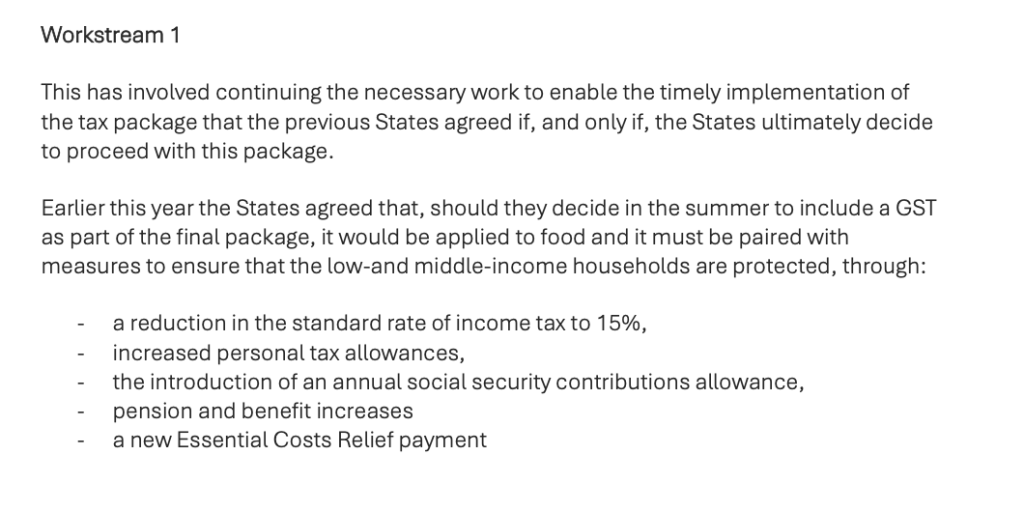
The last States agreed in principle to introduce the GST+ package – which includes reforming income tax allowances, introducing social security allowances, and other changes – but the current States will get the final say in July.
Deputy Lindsay de Sausmarez, President of the Policy & Resources Committee, said they are determined to make a decision once and for all.
“When I stood for this position, I promised to leave no stone unturned in our efforts to examine all the options before bringing recommendations to the States, and that’s what we’re doing,” she said.
“I appreciate that this is a lengthy and detailed update on that work, which has various workstreams running in parallel. Throughout this process we’ve been keen to show our workings, which is why we’ve provided various updates and engagements along the way – such as the Facebook livestream Q&A, which we’re going to repeat before the States debate in the summer.”
The various workstreams Deputy de Sausmaurez references include ‘Workstream 1’ which is essentially the GST+ package, and Workstream 2 which includes proposals for changes to company tax rates, as suggested by the Tax Review Sub-Committee.
Those changes would not bring in enough money to run the island’s public services without GST+ as well, so the Sub-Committee is suggesting the States back Workstream 1.
Workstream 3 has looked at making savings and cutting services, while Workstream 4 has looked at transport taxes including bringing in levies for electric vehicles.


Deputy de Sausmaurez said work will continue on those workstreams to ensure savings are made where possible, and the tax base is shared fairly across all sectors.
“One area that the Sub-Committee obviously could not consider was the potential for expenditure reduction, which needs to be informed by the committees who deliver public services,” she said.
“It’s clear that to plug the financial gap through expenditure reduction alone we would need to go well beyond the scope of what efficiencies can deliver: that scale of expenditure reduction could only reasonably be achieved via service reductions. P&R and the committees alike are keenly aware that any significant reduction in services we provide for the community would be unacceptable to most islanders, but it’s important that we explore where that line between reasonable and unacceptable might be so we can find the best balance between expenditure restraint and increasing taxes to inform our recommendations to the States.

“We’ve also worked with the Committee for the Environment & Infrastructure to move forward with the long overdue work on transport taxes. The States has already directed that we need to find the best way to address the growing unfairness and the erosion of revenues from fuel duty, as the community move towards more fuel efficient and electric vehicles, which currently don’t contribute much at all to the public purse. By working with E&I, we’re making sure we are looking at the issues in the round and taking both tax and transport issues into balanced consideration.”
Next steps
Now the Tax Review Sub-Committee has concluded its work, P&R has laid out the next steps for reforming Guernsey’s tax systems.
• 18th May 2026: The Sub-Committee, which includes independent international tax policy experts, will hold events for industry and members of the public to discuss the findings.
• Public drop-ins so P&R members can discuss work on tax reform with members of the public prior to finalising its policy letter (further details to be announced soon).
• 2nd June 2026: the 2025 States Accounts will be published. These will show an improved outturn for the year, which is welcome. However, the Accounts simply show a snapshot for the previous year and not the underlying position on which decisions about public finances must be made, and the funding gap remains.
• 8th June 2026: The Policy & Resources Committee will publish its final proposals in a policy letter in time for a States debate in July.
• P&R will host a Facebook livestream to answer questions from the community – to be held in between the Committee publishing its proposals and the States debate.
• July: States debate on tax reform proposals.
