

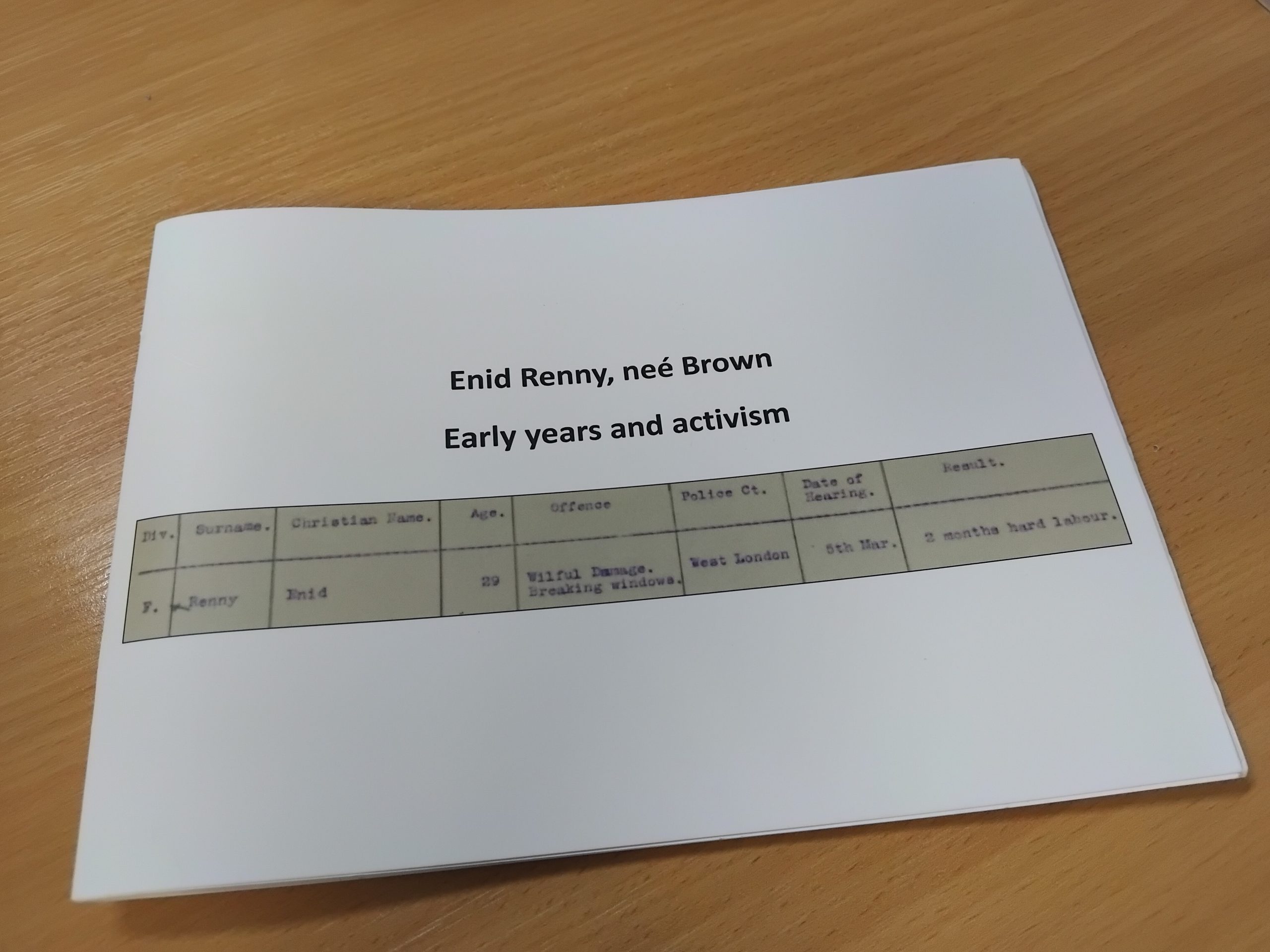
113 years’ ago, a woman was sentenced to two months in jail with hard labour for throwing a brick through a window of a post office.
She was protesting the continued ban on women voting – which started to be lifted within six years of her prison sentence being served.
That woman continued her activism after women had achieved the right to vote, continuing to campaign for workers’ rights and other issues that she believed in.
Her story is being shared with hundreds of children in Guernsey as part of International Women’s Day events this year, as her great-granddaughter – the Principal of Blanchelande College – tells her story.

Enid Marguerite Brown was born in Peckham on 14 July, 1882.
She is understood to have been educated at home and is believed to have studied nursing for a while before marrying Henry William Renny in 1903, when she was 20.
Henry was born in Russia and his family had numerous business interests including importing flax and jute, and they owned mills.
The couple moved to Scotland, with Enid having her first child in 1904. She started campaigning for women’s rights at around this time too.
In 1909, she made a speech calling attention to the condition of women in “sweated industries”.
Women made up 75% of Scotland’s textile workforce, meaning they were at risk of chronic respiratory problems, while frequent, sometimes fatal, accidents were also reported.
The Evening Telegraph called it “a clever little speech” which her family believe was a barbed reference to her position as a mill owner’s wife.

By this time, Emmeline Pankhurst had already created the Women’s Social and Political Union (WSPU) calling for radical action to win the battle for suffrage.
Dundee became a hot bed of Suffragette action with Winston Churchill successfully standing for parliament there in 1908. Enid is recorded as being involved in Suffragette action just one year after that when she was part of a Women’s Freedom League deputation that lobbied Churchill for women’s votes.
In 1912, after escalating campaigns involving window smashing in previous years, Enid and two other women travelled to London and targeted a post office just off Kensington High Street.
“It was Enid who did the damage, throwing a strong through a glass panel in the swing door to the post office”
Numerous other buildings were targeted in the area in the coordinated approach.
A watching coachman witnessed Enid throwing a stone through the post office window and ‘detained’ her and the other two women until the police arrive, even though there was no attempt to flee the scene.
One of Enid’s companions, Lily Lindsay told the arresting officer that “we’re not going to run away” as they seemed determined to be held to account for their actions.
This activism saw Enid sentenced to two months in Holloway Prison with hard labour.
She went on hunger strike along with other suffragettes and stitched her name on to a handerchief which is on display in Sussex.
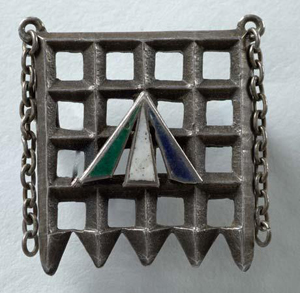
It’s likely Enid received the ‘Holloway Broach’ designed by Sylvia Pankhurst, representing the gates of Portcullis House, as a testament to her devotion to the campaign.

On her return to Dundee in 1912, Enid was “warmly welcomed”.
She continued her activism – with some thought given to the possibility that she may have been involved in further law breaking, but she was not ever arrested again.
When Emily Davidson died after being hit by King George V’s horse at the 1913 Derby, Enid, was reported to have said her actions showed “tremendously fine pluck”.
Suffragette activities were suspended the following year at the outbreak of the First World War but the involvement of women in the war effort is recorded as influencing wider perceptions of the role they played in society.
In 1918, women over 30 were granted the right to vote, while women could also now be elected to Parliament.
To encourage women to do so, organisations were established with Enid named Hon. Secretary of the Dundee Women Citizens Association. Its key issues were Housing Reform, Temperance, Legislation on Health and Public Morals, Equal Pay for Equal Work, and Education Reform.
Enid’s activism continued in the post war era, including in positions monitoring the performance of local elected officials as well as promoting peace and temperance.
Meanwhile, Henry Renny’s work had become embroiled in his wife’s activism in 1914 when a catastrophic fire at a five storey warehouse caused “immense” damage. The jute and flax lost was estimated at £1.8m in 2022’s values. Newspapers reported that water supplies to the sprinklers had been cut. He was declared bankrupt in 1925 and died aged 65 in 1929.
Enid Renny lived a long life, dying in 1974 aged 92.
By that time, women and men were both allowed to vote from the age of 18 across the UK and in Guernsey. That has since been reduced to 16 across the Bailiwick.
