


They will identify those who have built up an immunity to the disease and give a better idea of the Bailiwick’s situation.
It is still unclear how long immunity will last following recovery from covid-19.
“We’re looking specifically at where we should use [the tests],” said Director of Public Health, Dr Nicola Brink. “We’ve got some people that we’re sure have had covid but when we’ve tested them they’ve actually been negative – some people will lose their virus quite quickly – so the antibody tests will be quite helpful in that group of individuals.

Pictured: Dr Nicola Brink.
“Also, we’d like to use the antibody tests for contacts of cases of covid-19 and see how many actually got infected, so that will be interesting.
“We’re going to look at using it for staff and then, further down the line, we want to look at a population-based prevalence assay. We can’t do that too early, but we want to look at that in about September time.
“So, we’re going to look at the the three clinical situations in the first instance and then do some population-based screening.”
Dr Brink and her team have been working to find the best antibody tests, with some of those used around the world proving to be inaccurate.
“We have three different types,” she explained. “One is a lateral flow assay, for which we looked at the parameters in-house, so we did an evaluation ourselves. Interestingly, that is the same assay that has been chosen by some of the larger labs in the UK, so we were quite encouraged by that.
“Then there are another two well-based assays, so these are multi channel plates and we can process 96 samples at a time. The difference with the lateral flow assay is it’s a finger prick, while the multi-well assays are blood samples.”
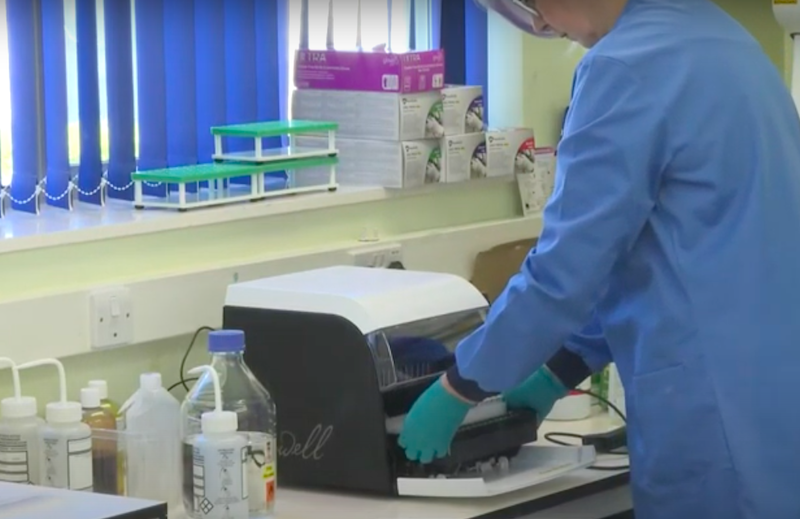
Pictured: Antibody tests are the next step, now that Guernsey has its own initial testing facilities.
However, we still can’t be sure that these tests will be accurate, she warned.
“These are new tests, so I don’t think we can be overconfident with any of their performances,” Dr Brink continued. “What we’re trying to do is look at using the tests and aligning it with not only virological results (people who’ve had swabs) but also looking at how we can use it in very defined clinical situations.
“At this stage, an over reliance on any antibody test would simply not be sensible. We’re going to have to use it with clinical judgement as well.”
Public Health is not yet sure when the antibody tests will be up and running, but they are thought to be the next “game changer” for Guernsey, now that the island has its own initial testing facilities.
“It’s early days for all of these assays, but we’ve done as much due diligence and assessments as we can,” added Dr Brink. “One of them, fortunately, uses the same platform that we use already in the pathology service, which is hugely beneficial.
“We’re optimistic and it will be interesting to see the results.”
