

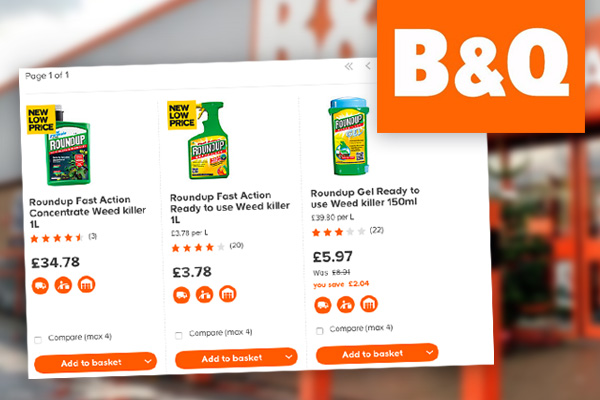
The products under the microscope are those that contain glyphosate, which has been a controversial chemical for some time.
But the Jury decision in the US could create waves internationally when it comes to how it is viewed from now on, having now officially linked the substance to cancer.

B&Q sell a number of herbicide products containing glyphosate, including the weedkiller Roundup. The DIY chain which has a shop at Admiral Park said it had been reviewing its range of weedkillers since last year.
“B&Q has been reviewing its garden care and maintenance range since 2017 and this review is ongoing.”
But it emphasised this review was not because of the case on the weekend, rather part of a wider check.
“We have a record of acting ahead of legislation where appropriate. We led the way in removing three pesticides in 2013 and neonicotinoids from our flowering plants in 2018.
“We offer alternatives to glyphosates and are currently undertaking a broader review of all our garden products.”
Guernsey uses glyphosate as one of its herbicide’s of choice to control Japanese Knotweed, which is an invasive species of plant found around L’Ancresse, as well as other parts of the island.
Glyphosate is one of just a few products that is actually approved for use in the island, as many that are approved in the UK, are not in Guernsey.
Meanwhile in Jersey last year, a spat began between dog owners and the States, as it used the herbicide in a popular dog walking area.
At the time, a dog specialist spoke out, saying she believed the substance could be affecting dogs when they came into contact with it. At that time, the Jersey Department of Environment said there was no evidence that the use of glyphosate is in anyway harmful to the public, to dogs or for that matter any vertebrates.”
Nationally, the UK’s farmers union has said any review would be worthless as nothing has changed in the creation of the weedkiller since a previous review, which deemed it safe to use. They said the most common weed killer in the UK should not be banned because of the decision of a Californian Jury.

The man involved in the case itself was DeWayne Johnson, 46 and a father of two. He was diagnosed with non-Hodgkins lymphoma, a cancer of the white blood cells, in 2014. His job at the time was to keep grass and weed under control at a school, and in doing so, used what was expected to be hundreds of gallons of Roundup.
The US court awarded Mr Johnson £226m. and said the owner of the producer of Roundup “acted with malice”. It said the weedkiller contributed “substantially” to the cancer.
The case was deemed closed by many when documents were revelled that proved the owning company knew their product “could cause cancer”.
