


A cross-committee group of Deputies want to find out whether or not a legal, government-regulated cannabis market would work in Guernsey.
The group, led by Deputy Marc Leadbeater, the President of Home Affairs, has lodged a Requête which asks the States to agree to a “proper examination” of the risks and benefits of a legal cannabis framework.
This would include looking at a time-limited pilot programme, similar to those being tested in Switzerland and parts of the European Union.
The local process would begin with setting up a cross-committee working group with representatives from Home Affairs, Health & Social Care, Policy & Resources, Economic Development, and Education, Sport & Culture.
The Home Affairs Committee would be the leading branch of this group.
So far several Deputies from all relevant committees besides Economic Development have signed to back the Requête which could force the States into action if a majority of deputies vote in favour of it.
The signatories include deputies Leadbeater, Tina Bury, Andy Cameron, Aidan Matthews, Charles Parkinson, Gavin St Pier, and Alderney Representative Alex Snowdon.
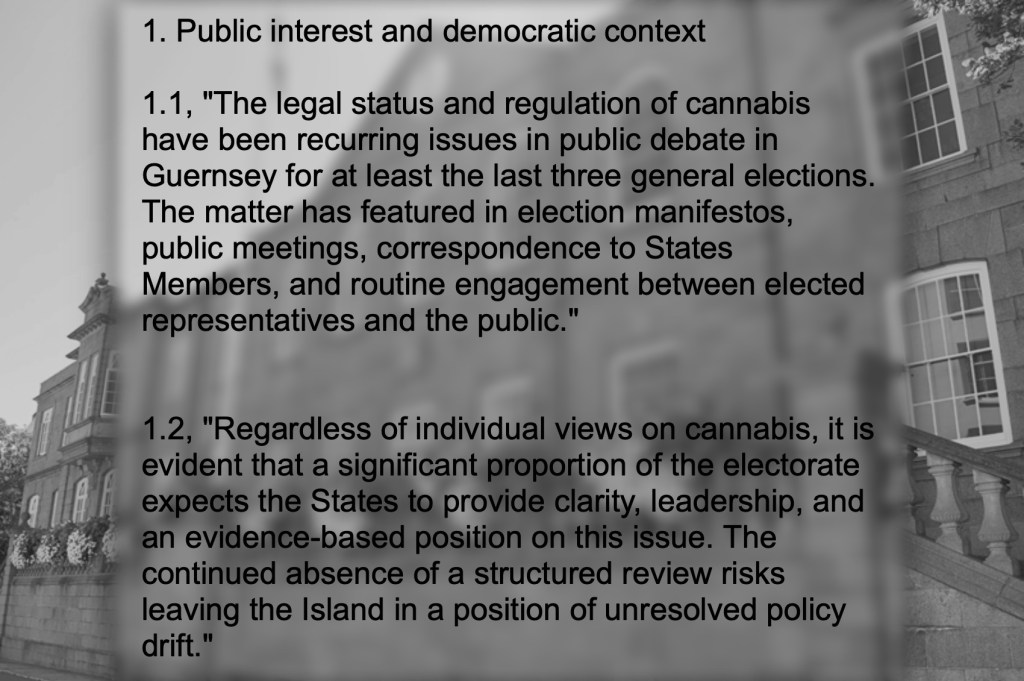
The Requête points to several issues which could be crucial to influencing whether Guernsey moves forward with a regulated market.
Firstly, it argues that Guernsey has created a “two-tier” system since introducing medicinal cannabis six years ago.
Since 2020 Guernsey has allowed private medicinal cannabis prescriptions. A year later the island’s first ‘cannabis clinic’ opened. 2021 also saw the first licence for the cultivation of medicinal cannabis (CBPM) issued in the Bailiwick.
By the end of 2023, 13,000 people were receiving prescribed cannabis.
Those backing the Requête argue this has created a system where those who can afford private fees can obtain the plant legally, while those unable to afford it but with similar needs are sometimes criminalised if they are forced to rely on the illegal market.
The second point the Requête raises is whether or not the current medicinal system may be inadvertently feeding the illegal market through the diversion of prescribed products.
Then there’s also question marks over the correct use of resources, with Home Affairs saying that policing and prosecuting cannabis offences takes up significant resources.
They argue this time could be better spent on more harmful issues like serious violence, sexual crimes, and harmful drugs like synthetic opioids. They also suggest that legal cannabis is safer than that found illegally.
The Requête queries how safe cannabis can be when it comes from illegal markets, with potency and quality being key problematic areas, and concerns over a lack of age verification or consumer protection for those engaging with illegal markets.
Those signing the Requête have argued that regulation would allow the States to “take control” of these factors.
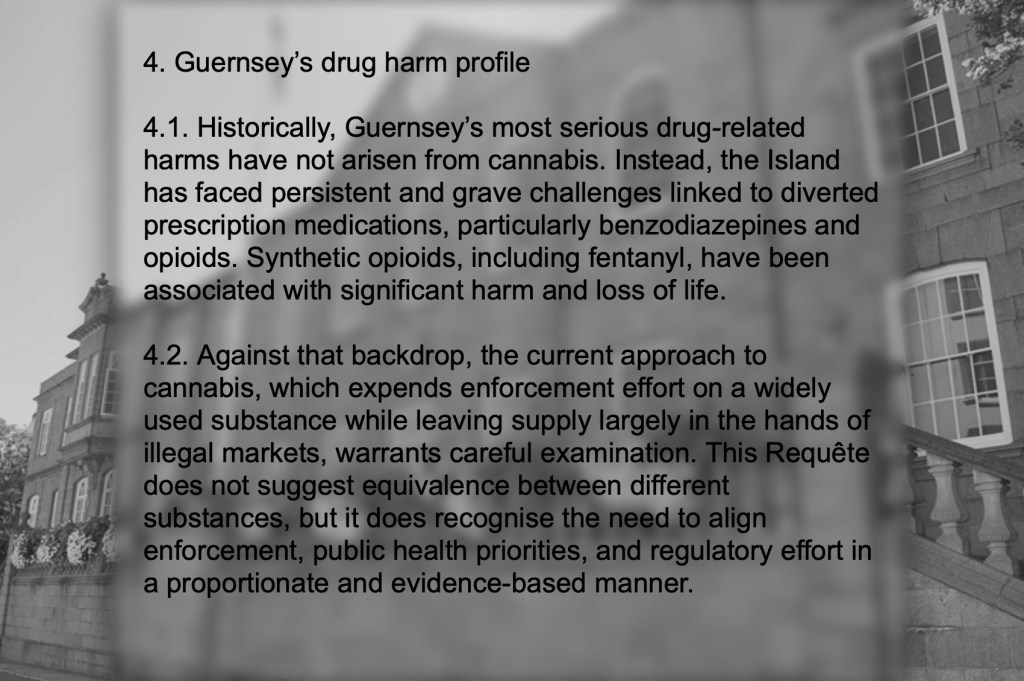
The Requête has been lodged for debate, likely to be this Spring, but even if it is approved it won’t result in the immediate creation of a new legal cannabis market. It would instead instruct the States to investigate whether or not it would be beneficial to the Bailiwick.
That would begin the process which would see the working group engage with the cannabis industry, medical professionals, law enforcement, and those with “lived experience”.
The working group would have to consult with external experts on harm reduction and taxation, and report back by December next year with clear policy options, a recommended model, and a cost assessment.
The full Requête is available online through the States parliamentary website, HERE.
