

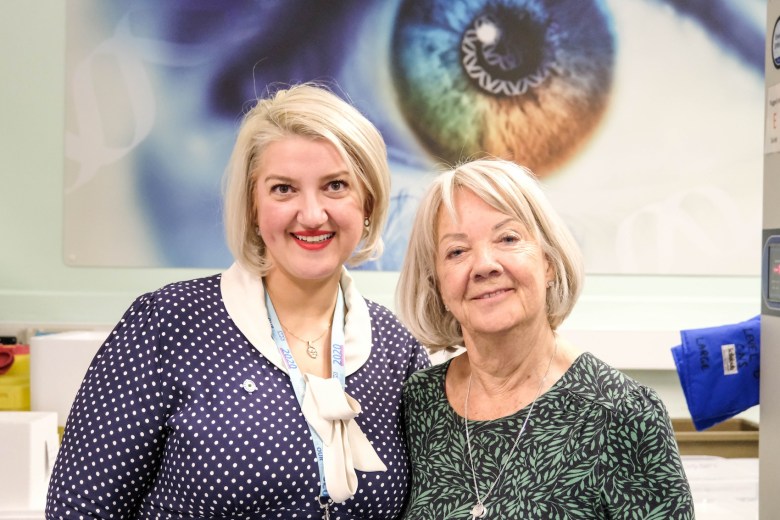
Money gifted from Dame Mary Perkins is funding a new four-year research project at the University of Southampton.
The study is using artificial intelligence and machine learning to investigate how age-related macular degeneration progresses into its most serious, sight-threatening stages.
Led by PhD student Maria Patsiamanidi, the project aims to analyse thousands of retinal images from the PINNACLE study, with a goal to develop a predictive model that identifies which patients are at the highest risk of their condition worsening.
Ms Patsiamanidi thanked the Specsavers co-Founder for her support with this work.
“I am incredibly grateful for the funding I’ve received, which allows me to fully dedicate myself to this work, access the best tools and resources, and collaborate with leading experts in the field.
“This support is not just enabling my research, it is helping me pursue a vision of turning cutting-edge AI into practical solutions that could improve vision and quality of life for millions worldwide.”
AMD affects approximately 700,000 people in the UK, and by age 90, one in five people will have the condition.
The research will be a primary focus of the new Institute for Medical Innovation which itself is a joint venture between the University of Southampton and University Hospital Southampton NHS Foundation Trust.
The £100 million facility will combine expertise in medicine, computer science, and engineering to tackle diseases including cancer, dementia, and sight loss.
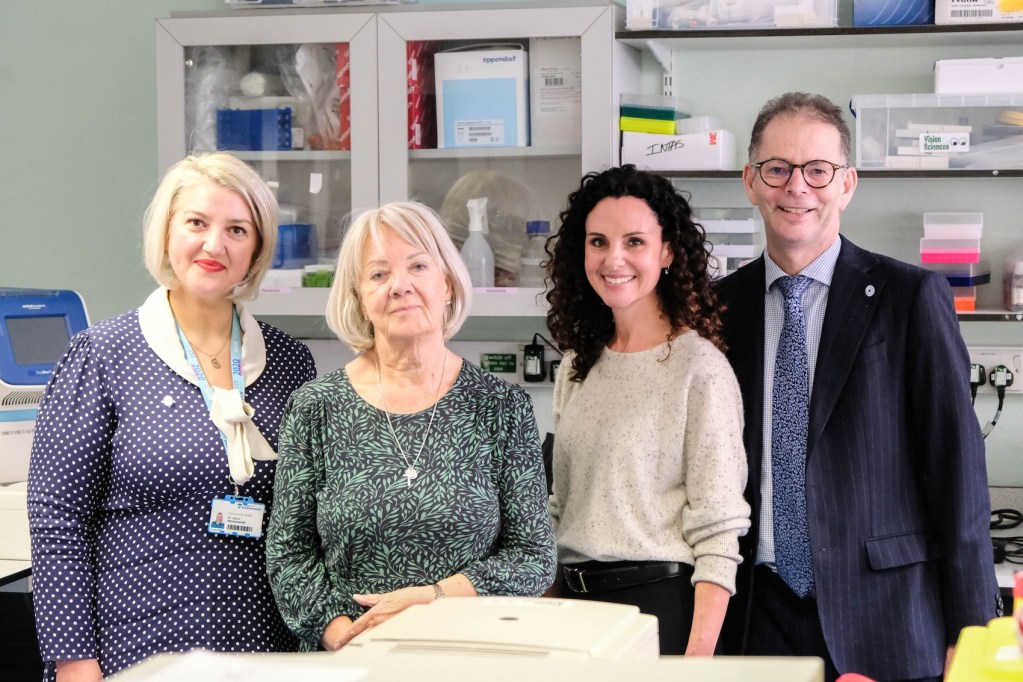
Dame Mary said of her gift: “Research is the key to ensuring more people can keep their sight for longer.
“I am very proud to be supporting Maria and the experienced team in Southampton, to find new and better ways of identifying AMD earlier.”
Bill Gardiner, Group Leader of the Guernsey Macular Society, said “Dame Mary’s generous gift is wonderful news”.
“It’s great that vital research into AMD is being supported and is a demonstration of the important relationship between the island and the team in Southampton.
“As someone who has AMD and a member of a larger group of people with it, it can be difficult to see the hope that lies in the future. But there is hope and it is in research. To know that Southampton will be home to a new research centre, with sight loss research at its heart, gives real hope to the thousands of people living with AMD across the Channel Islands and beyond.”
Guernsey has deep roots when it comes to the study of AMD, with island residents featuring in past research into the condition.
24 years ago a grant from the Guernsey Board of Health allowed Professor Andrew Lotery to begin a molecular genetics study. More than 500 participants, the majority from Guernsey, took part.
The data gathered has since helped identify genetic risk factors and contributed to the development of therapies for ‘dry’ AMD, which are now being used in the United States and considered for use in the UK.
Of the new research being conducted over two decades later, Professor Lotery said: “AMD is a debilitating disease affecting thousands of people every day. We need to find better ways of helping these people earlier.
“The PINNACLE study has already shown great promise in doing this, and Maria’s PhD will drive this important work even further. We are all extremely grateful for Dame Mary’s support.”
