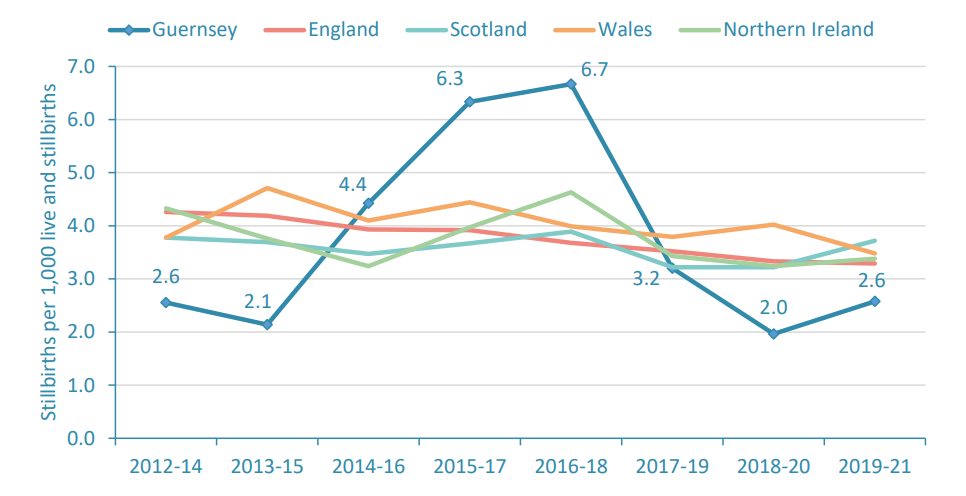
The data was revealed in Public Health’s recently published Mortality Report. It revealed the Stillbirth Rate (SBR) in Guernsey compared to other jurisdictions.
A stillbirth is defined as “a birth after the 24th week of gestation of a baby that has died in the womb” and the SBR is the number of stillbirths in a year out of 1,000 overall births.
It’s important to note that there are usually fewer than 1,000 births in Guernsey annually – for example, there were 622 births in Guernsey during 2022.
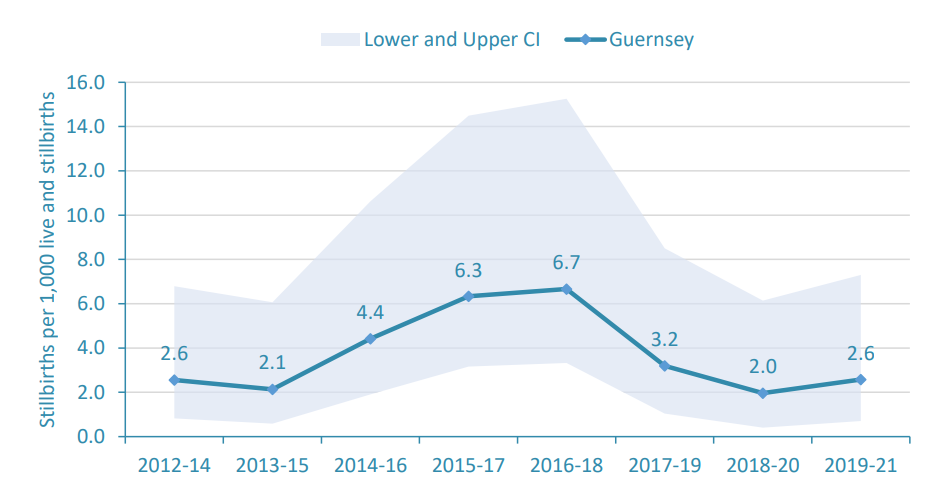
The rate increase in the middle of the above graph has been explained by Public Health: “The increase was due to a higher-than-typical number of stillbirths for 2016 and 2017 (6 and 4 respectively) which had an upward influence on the three-year averages that include these years.
“This demonstrates how a small number of stillbirths has a large impact on the rates and therefore why it is difficult to apply interpretation to these rates (given the small number of deaths included in calculating them).
“This is also shown by the width of the 95% confidence intervals shaded in the graph [above].”
Comparison
The figures have been compared with other jurisdictions, including England, Scotland and Wales, but notably not Jersey.
The following graph once again shows the spike for 2016 and 2017.
“This is likely due to the smaller population causing a small number of events to have a disproportionately large impact on the rates,” said Public Health.
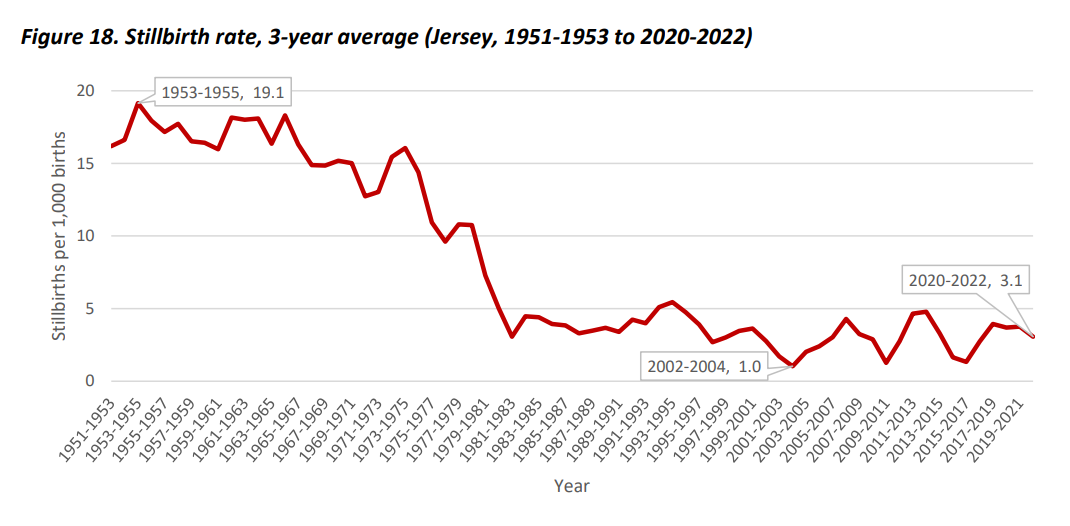
Statistics pulled from Jersey’s Superintendant registrar indicate that Jersey’s SBR hasn’t gone above 6 since the 1980s.
However, its current rate of 3.1 is roughly in line with Guernsey’s.