

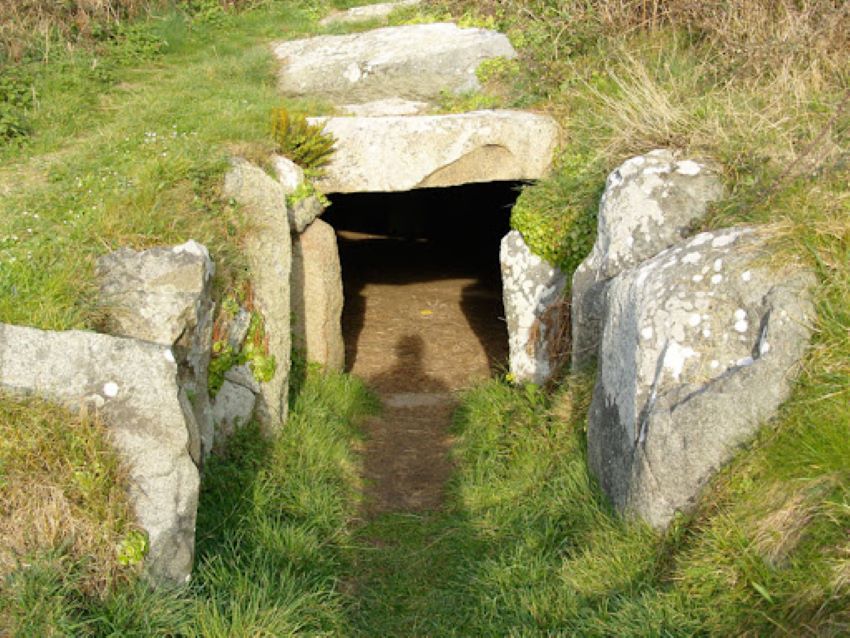
On Wednesday 22 December, the sun will rise at four minutes past eight. As it rises, the predicted angles of the sun should create the most ideal conditions for it to reach the back of La Varde dolmen, which sits on the highest point of the L’Ancresse commons in the Vale.
This happens only around the time of the winter solstice, which marks the shortest day of the year. Anticipating that this may interest a number of people who have not viewed the spectacle before, Guernsey Museums has offered advice on how to access the dolmen and how to make the most of an early morning start to be on the commons in time.
It should be possible to see the sun reach the rear of the dolmen on any clear day for 10 days either side of the solstice – from this coming Sunday, 12 December, until the end of the month. The chance of seeing the spectacle will become better between 17 and 30 December.
The States’ Archaeologist, Dr Phil de Jersey, has shared his tips for viewing the sunrise at La Varde.
Dr de Jersey said many people may not be aware that sunlight will reach the dark alcove at the back of La Varde dolmen at this time of year. He said the best place to see it to full effect is inside the dolmen, which is not far to the north east of the modern menhir – known as the Millennium Stone – erected in 2000.
Pictured: Guernsey Museums is encouraging people to get to the L’Ancresse commons one morning in the next few weeks to see the unusual effects of the sunrise on La Varde dolmen.
Dr de Jersey thinks many people would find it interesting and rewarding to visit La Varde to see the spectacle. He said the site is accessible to most adults and children who have reasonable mobility.
“The dolmen is at the top of a hill and access from the Pembroke direction is via a grassy, fairly even path,” he said.
“There are the usual common hazards to look out for, such as rabbit holes and slippery surfaces. There are no steps into the dolmen but adults are advised to watch their heads, as the entrance is very low. We would recommend taking a torch to have a good look around.”
Parking is probably best at Pembroke – or at Chouet if walking across from the west of the commons.
Dr de Jersey is hoping for clear skies for the winter solstice so that the annual spectacle can be seen at its best.
He expects photographers to want to capture the event and said “for capturing any effect, we’re reliably informed that it’s best to take a tripod and use no flash”.
“A clear sky to the south east is needed to get a good sunrise. There may not be many days with a good sunrise, so it’s best to keep a look out on the forecast. It’s best to arrive at 08:00 for the sunrise effect in the back alcove. This lasts about six minutes, from 08:07 to 08:13,” said Dr de Jersey.

Pictured: Guernsey Museums looks after dozens of historical sites across the island. The dolmen at La Varde is the green no. 12 on this map.
Guernsey has countless historical sites of interest, including at least five dolmens which have been studied quite extensively in recent years. Dolmens are burial sites, and some, like La Varde, are passage graves.
Dr de Jersey said there are “many unanswered questions about dolmens,” including why they were built in the first place.
“Most of the dolmens in Guernsey have entrances facing east, towards sunrise, so it’s definitely possible that this effect is intentional,” he said of the effect which will be seen at La Varde soon.
Dr de Jersey said there is plenty of information available for people who want to find out more about La Varde and other dolmens and sites.
“There is an interpretation board outside the dolmen and we also have a guide specifically for children and families on our website.”
Pictured: Guernsey Museums’ website, including more information about dolmens, can be viewed HERE.
Extensive research has been carried out into the dolmens across Guernsey by Dr de Jersey and others, including notably by Frederick Corbin Lukis, a celebrated archaeologist and antiquarian who lived between 1788 and 1871.
His research is cited on the Guernsey Museums’ website and the Megalithic Guernsey blogsite, which is linked to a book authored by Andrew Fothergill.
Megalithic Guernsey reveals that La Varde dolmen was “thoroughly explored by the Lukis family” during the summers of 1837 and 1838. At least two burial phases were discovered within it, “separated by a layer of limpet shells and pebbles”.
“They also found many bones, some of children, and some cremated remains in the lower of the two layers. Bones and skull fragments were found between the uprights and sherds from over 150 pottery jars were also unearthed”.

Pictured: Images from Andrew Fothergill’s Megalithic Guernsey site.
La Varde dolmen faces east south east and is aligned to Rocque Balan. This positioning is believed to be deliberate based on the effects of the sun rising and setting at different times of the year.
Pictured top: La Varde dolmen is situated near the Millennium Stone on the L’Ancresse commons. Credit: Megalithic Guernsey.
