


An alternate vision to the official Tax Reform proposals has been unveiled – with Deputy David Goy saying his plan would protect Guernsey’s lower and middle income households.
His ‘Productivity Incentivisation Tax’ is a “framework of fiscal due diligence”, he said.
It comprises three ‘pillars’ that together would ensure wealthy people who may not contribute much to the public purse through income tax, pay more.
He told Express that he’s confident his PIT plan will be on the table for debate, in opposition to Policy and Resources’s latest Tax Reform proposals, next month.
Productivity Incentivisation Tax
Deputy Goy says “at its core, PIT is a framework of fiscal due diligence” – and he doesn’t believe past States have done that due diligence to ensure that whoever is living in Guernsey is contributing fairly to the island’s running costs.
He said his proposed tax framework is built around “a simple question”:
“Before we ask for more money from middle earners, is there any other areas of untapped contribution that we should look at first?”
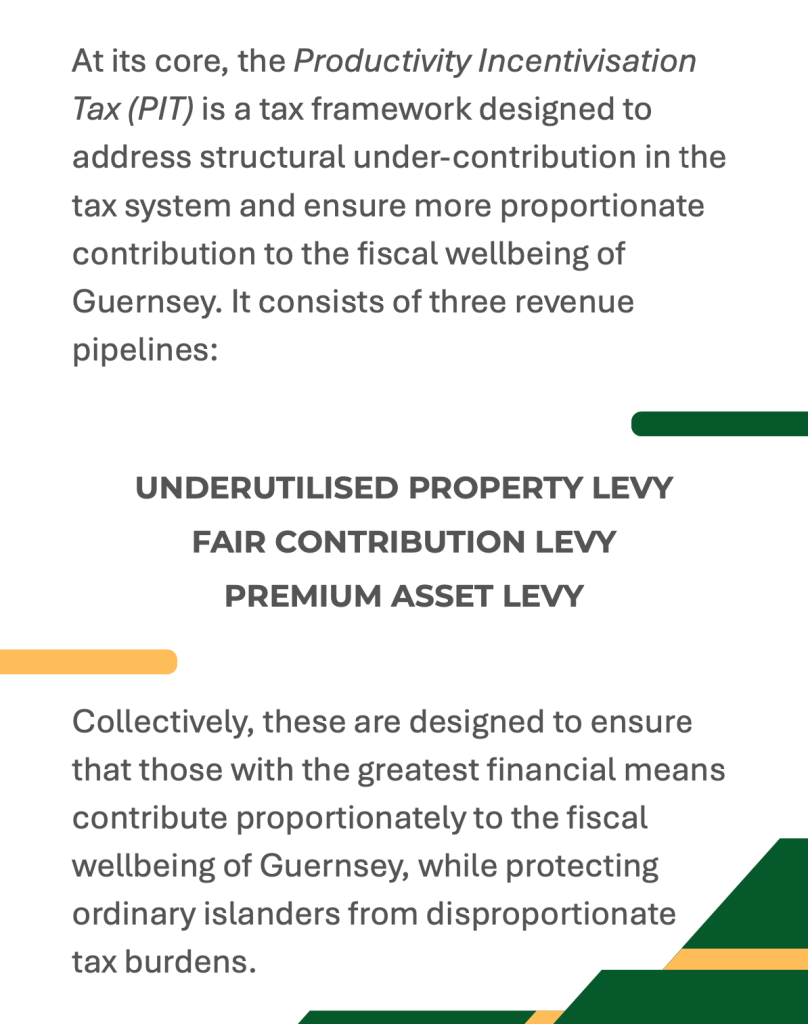
The three pillars that make up PIT would capture income from other sources, not currently utilised, without adding any additional burden on to lower or middle income households.
Deputy Goy said it also incorporates a number of behavioural mechanisms designed to encourage productive economic activity, housing utilisation, and local investment.
PILLAR 1 – The under-utilised property levy
Under Deputy Goy’s plans, owners of properties which are ‘under-utilised’ would be forced to contribute more money to the public purse through a punitive Tax on Real Property (TRP) rate.
He said this would discourage the use of Guernsey property as passive wealth storage, and incentivise owners to sell them or rent them out – contributing to the property market.
Owners who continue holding Guernsey property as passive wealth storage would be required to make a substantial financial contribution through a high levy on such properties.
Exemptions, including for people who have to move into residential or nursing care, would be written into law.
Deputy Goy said States data shows that around 183 residential properties were vacant last year, without accounting for holiday homes and commercial properties that are left vacant or underused.
PILLAR 2 – The Fair Contribution Levy
Where an individual is asset rich, but not technically earning and contributing via income tax, Deputy Goy wants to introduce a Fair Contribution Levy to ensure they “make a fair and proportionate contribution to the public services, infrastructure, and stability from which they benefit”.
He said this levy would not rely on taxable income alone, and existing systems could be used to capture a contribution from high net worth individuals, through TRP or similar.
Individuals would be encouraged to be transparent about their own financial standing, offering an opportunity for untaxed inflows to be voluntarily declared and taxed at the standard 20% rate
Exemptions would be written into law again.
PILLAR 3 – The Premium Asset Levy
High value cars, boats, private planes, and properties would be taxed at a high rate under Deputy Goy’s PIT plan.
Using cars as an example, different levies would be set for different value vehicles, starting at cars worth £75,000 and above.
Boats 15m and above in length would be charged too, with the top tier of ‘superyachts’ facing the highest levies.
A similar ‘tier’ system for planes, would see owners of private light aircrafts and turboprops charged the PAL, with higher charges for owners of private jets.
High value document duty would come in for properties worth £2.5m and above, on an increasing sliding scale.

The document can be read in full HERE.
Revenue
Deputy Goy’s plan does not currently state how much revenue will be raised through the three pillars above.
He says the States doesn’t currently have all the data available to know how many ultra high net worth individuals are living in the island, and are not contributing proportionately, but his plan would ensure they are paying more.
P&R’s plan
Deputy Goy says he will vote against the new Tax Reform proposals published by P&R this week.
The plan includes changes to income tax and social security contributions, a 3% GST, and a blanket 1% saving across all States departments.
He says it will unfairly impact lower and middle income earners and continue to protect the wealthiest people.
Feedback
Deputy Goy has been working on the PIT since before he was elected in June last year.
The positive support he found for his ideas prior to the election has continued.
“I think with the public it’s absolutely positive. This is what the majority wants. They don’t want GST. They don’t want anything that takes more money from them, whether it’s income tax rise or additional charges on everyday goods, or public service cuts, or deterioration in public service.”

Political feedback has been more mixed, but Deputy Goy said he has a seconder and the PIT will be lodged for debate as an amendment to P&R Tax Reform proposals.
“I will be working with my seconder for and any Deputy who is willing to, in fact, anybody, because PIT is for the people. Deputies are for the people, and I want everyone to be able to come to me and say, ‘hey, I love PIT, but I found a loophole’, or “I found a technical flaw’ to if someone is caught up accidentally through an unintended consequence, that’s okay, come and feedback to me, because ultimately this is for the people, and what I want to do is make sure that PIT does not catch anybody by accident.”
High Net Worth Individuals
In particular, Deputy Goy is very keen to hear from any HNWI who would be impacted by PIT if the States back it.
He said his document is a living plan which he is updating, and feedback will be listened to.
“I encourage any high net worth individuals to come and speak to me, because I want to hear from their side as well.
“People think all high net worth individuals are all the same. They’re not. Some are very productive, some run businesses, some hire many employees, they pay their contributions, they follow the rules of economy. PIT doesn’t penalise any of these people.
“What PIT looks at is much more HNWI, high-net-worth individuals who are basically economically unproductive. They might own a few properties on the island that are rarely lived in, they don’t really hire any meaningful number of people on the island, they live in the top 10% TRP, but on paper they’re so poor that they pay no income tax or social security. This is the structural problem that PIT looks at, and it is basically asking ‘what’s happening there? Can you please explain and help us to understand the situation better?’
“Perhaps there is reasons for it. I hopefully have covered all of that in the exemptions, but if not, hey, I want to know.”
The Productivity Incentivisation Tax can be read in full HERE.
