

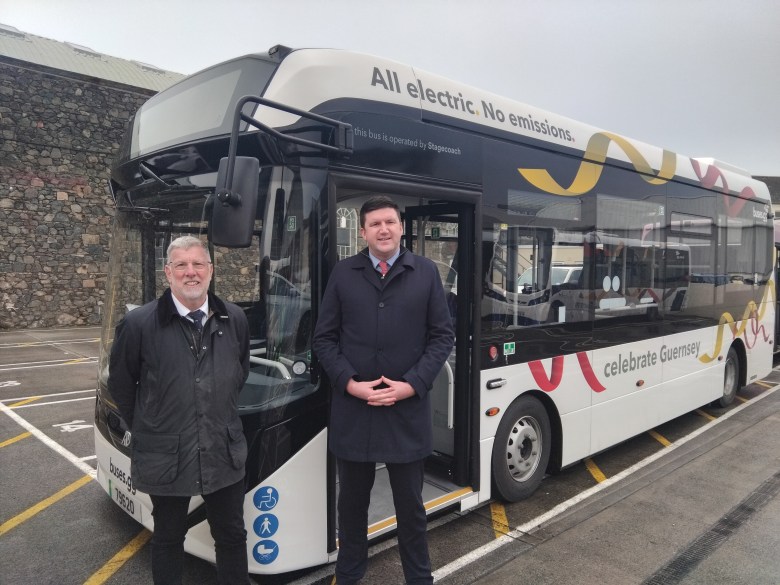
Two electric buses arrived at St Peter Port Harbour early on Wednesday morning and from today you’ll see them on the roads for driver training.
The buses will then enter into regular use, covering hundreds of miles per day.
After an initial trial of one electric bus last year, the two buses have been bought by the States for its contractor Stagecoach to use.
The rest of the fleet will gradually be replaced too, said Deputy Adrian Gabriel, the President of the Environment and Infrastructure Committee.
This is in line with Guernsey’s aim of seeking to reduce its emissions by 57% on 1990 levels by 2030, with transport being the main contributor to direct emissions.
“It’s been a long time coming, and getting a vehicle which is suitable for Guernsey has been a challenge, as we’re finding with our diesel vehicles as well,” he explained.
“So we’ve gone down the route of electric EV busses, which we’re really pleased to have actually here in the flesh in Guernsey, some vehicles which are capable of coping with our narrow roads and the demands of an electric vehicle as well, and these vehicles are superb. They’re light, they’re airy, they’re quiet, which is a real bonus for the passengers who will notice them, and even the other traveling public will notice them. If you’re on a bicycle or pedestrian or even a motorbike, following a diesel bus is not a pleasant experience. Following one of these will be an amazing experience. They have zero tailpipe emissions, which contributes to lowering our greenhouse gas emissions as a whole on the island.”
Peter Knight, Managing Director at Stagecoach South West, drove one of the buses from the Harbour to the bus depot along Les Banques on Wednesday morning.
“We’ve been out and about around town, just for a little bit to give our stakeholders a flavour as to what the vehicle is like. It’s very, very different. They’ve got power when it’s needed and when it’s required, and I was certainly really impressed with how it drove this morning.”

“We’ll be doing a lot of evaluating and monitoring to see how they bed into their operational life here in Guernsey over the coming months and years ahead,” he added.
“They are tried and tested technology, we have lots of electric vehicles in the stagecoach bus fleet, so I’m really delighted, as the Managing Director of Stagecoach South West and Guernsey that islanders can benefit from the benefits that they bring.”
Mr Knight said any passengers who travelled on the electric bus that was trialled here last year will find them very familiar.
“They are exactly the same make, model, shape, size, and all the rest of it. It was through that sort of evaluation and proving that gave the States of Guernsey the confidence to invest and purchase these two vehicles.”
Financially, Mr Knight said the value in introducing electric buses will be across the whole lifespan of the vehicle. The higher cost in buying the buses is balanced by the money saved in fuel, he said, as well as significant savings in ongoing maintenance costs because the electric buses have half the number of moving parts compared to diesel buses.
The vehicles have a range of about 300 miles, while the most intensive routes in Guernsey cover around about 120 miles daily.

The electric buses were due to be purchased alongside four diesel buses, however, following the diesel bus provider withdrawing from the market, the Committee for the Environment & Infrastructure said it had to take a different approach. Instead, the States has purchased the three smaller Mercedes Sprinter vehicles which the island previously had on lease.
E&I will also be exploring additional alternatives said Deputy Gabriel, and in time, we’ll see more electric buses on island roads too.
“There’s the significant cost outlay, of course, but in the long term, it’s about how it contributes to our Integrated Transport Strategy, providing choice for the consumer, for the traveling public, and public transport has a role to play in that.”
Bus fares
Ahead of launching the island’s first two electric buses, E&I has also launched a consultation on putting bus fares up.
The annual change is “designed to ensure that bus travel remains affordable, while modestly adjusting fares to attempt to strike a balance between user contribution and government subsidy, gradually reducing the bus service’s reliance on public funding,” said the committee.
If introduced, these proposals would increase the standard and pay as you go fares by 10p, to £1.70, and £1.25 respectively.
Other fare changes can be viewed HERE.
Anyone who would like to comment on the proposals can do so before 17:00 on Wednesday 28 January 2026 by emailing passengertransport@gov.gg or writing to The Senior Passenger Transport Officer, Driver & Vehicle Licensing, Edward T Wheadon House, Le Truchot, St Peter Port, GY1 3WH.
