


With two weeks to go before the voter registration period closes, there is concern that the number of names on the electoral roll will be down on the first Island Wide Vote in 2020.
Data recently published also suggests that ‘young voters’ will be under-represented when Guernsey goes to the polls in June.
The reality is that the island has always enjoyed relatively high voter turnout but some sitting deputies are among those concerned that Island Wide Voting has turned out to be somewhat of a poisoned chalice.
It’s also been suggested that the wording on the leaflet sent to every home in the island, encouraging those over 16 to sign up to vote, may have been misleading.
For those who have signed up to vote, concerns have also been raised about a potential 500-page manifesto booklet being delivered to help you make your election choices.
Signing up
Voter registration closes on Wednesday 30 April.
Only those people aged 16 and over who are eligible to vote and have registered to do so will be able to have their say in the second Island Wide Vote in June.
By the beginning of April 23,501 people were registered on the Electoral Roll, with more than 22,000 polling cards sent out to their registered addresses by the end of March.
Anyone who registered after 27 March will receive their polling card during the week of 5 May when the next tranche gets sent out.

The Committee for Home Affairs has political responsibility for the Electoral Roll.
Home President, Deputy Rob Prow was asked about the registration numbers during the States meeting last week.
He defended the wording on leaflets sent to every home address in Guernsey last year, saying it was clear that everyone had to register on a new electoral roll before the coming June election, even if they have previously voted in the island.
Deputy Prow said the initial response to those leaflets was positive with 14,312 people registering to vote in December 2024, compared to 11,743 people registering to vote in December 2019.
However, voter registrations have declined since that strong start – and by March they were sitting around 3,500 behind the same period in 2020 before the island’s first fully Island Wide Vote.
Deputy Chris Le Tissier had asked Deputy Prow if ambiguity in the electoral roll leaflets – which asked ‘have you registered to vote’ – did not make it clear that a new electoral roll was opening for the 2025 election, but the Home Affairs President disagreed.
“The committee considers that the following text which appeared on the leaflet was clear, and it says: ‘If you would like to vote in the 2025 Guernsey General Election, you must register to do so now, even if you have registered in a previous electoral roll’,” he said.
Deputy Prow also confirmed that ‘reminder cards’ are being sent out to every household where no one is registered to vote this week, giving those people two weeks to sign on to the electoral roll if they wish to vote in June.
Young voters
Deputy John Gollop specifically asked the Home President last week whether those final reminders about registering to vote should include social media marketing campaigns aimed at young voters.
The Father of the House said “(young voters) appear to be more tardy in coming on the roll, and that might be because they don’t understand that each election they have to re-admit themselves because they’ve done it less often”.
Deputy Prow said that his committee has “discharged its responsibility around the electoral roll” and that he believes it has been “properly advertised”, but he also admitted that his Home Affairs committee has considered whether responsibility for the electoral roll should switch to a different department.
He said that – and any consideration over future marketing campaigns – are for the next States to look at though.
One option they could look at in the future could involve speaking to young social media stars directly – such as Harry Lowe, better known as Wroetoshaw in the Sidemen, or even some of the island’s Only Fans creators – suggests political commentator Marc Winn.
Mr Winn used the Guernsey People Have Your Say forum to start a discussion on young voters last week, accusing the States of missing the mark in its social media campaigning so far.
He said “it is pretty weak” and “shows a lack of experience in youth marketing as well as a lack of engagement”. He suggested that the States use some of the “very successful young global social media marketers” we have in Guernsey to try and engage others ahead of the election.
The data that Mr Winn and others have cited is shared above.
It shows that voter registrations among voters aged between 25 and 35 are lower than any other age group in the island.
Recently released data shows that voters aged around 70 are the most likely to have signed up to have their say, with declining numbers in all other age groups.
You can vote in Guernsey from the age of 16 up, with more people registered to vote aged between 15 and 25 than in the next decade of life.
Deputy Andrea Dudley-Owen suggested that is down to targeted campaigns in Guernsey schools and other educational and youth facilities.
Compulsory voting
Some countries – including Australia, Belgium, Brazil, and the Democratic Republic of Congo, – have what is known as ‘compulsory voting’, so their residents don’t have to register to vote every time there is an election.
Wikipedia states that changing to compulsory voting in Australia in 1924 led to increased turn out at elections with it rising from between 47% and 78% turnout to between 91% and 96%.
The 2023 Australian Indigenous Voice referendum had an 89.95% turnout, while the 2022 Senate and House of Representatives elections had just over and just under 90% turnout respectively. Australian residents can be fined $20 if they don’t cast a ballot.
The most recent Belgian Chamber of Representatives vote, in 2024, had an 87% turnout.
The 13% who chose not to vote would have faced the risk of a fine for not doing so. If a voter misses three elections they can lose some of their civil rights in a further punishment.
Brazil’s 2022 General Election had a 79% turnout – with those not casting a ballot facing fines for each round they missed.
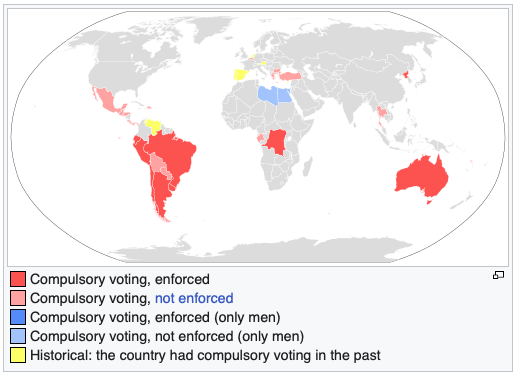
As stated above, Guernsey already enjoys a high voter turnout – with 80% of those registered having their say at the ballot boxes in 2020 when the island held its first fully Island Wide Election.
Prior to that, the last district election in 2016 had a 71% turnout, with a similar stat for the 2012 election.
The process of running a new electoral roll for each election has a financial cost for the States as well as the logistical impact of allocating staff to dealing with it and for those reasons, some people have suggested the island switch to an ongoing electoral roll with mandatory voting.
Deputy Prow said he thinks mandatory voting – and with that an ongoing electoral roll – should be considered here. But he also thinks that’s for the next States, not the current one, to consider.
“This is not what was agreed for this election, but I think it is something that we should consider, or the next States should consider,” he said.
“Registration is not compulsory, but suggestions that it should be have been debated, and that would be a matter for this assembly.”
Not all jurisdictions with compulsory voting succeed in reaching high voter turnouts though, which could be seen as a warning that Guernsey shouldn’t waste its time in making that change.
The Democratic Republic of Congo had a 48% turnout in 2023 for the country’s National Assembly election.
The BBC described the election as “flawed, chaotic, historic, complex, rigged“.
Manifestos
With the island’s second fully Island Wide Election now just two months away, the thought of reading through manifestos will be crossing some voters minds.

Before the 2020 election, a manifesto booklet was delivered to each household with a registered voter.
For that poll, candidates were given two pages each. This time round they can have up to four pages, with some people estimating that the high number of candidates mean the manifesto booklet will look like a ‘phone book’ when we receive it at the end of May.
The States Assembly and Constitution Committee are responsible for that aspect of the election, and President Deputy Carl Meerveld told the States last week
“The Committee carefully considered both the budget and logistical implications of offering candidates either two or four pages in the manifesto booklet.
“The Scrutiny Management Committee review of Island Wide Voting established that across all age groups the majority of respondents wanted more information in the manifesto booklet, with over two thirds supporting this view.
“The committee is confident it does not favour incumbents. Remember that prior to 2020, all candidates, new, returning, and incumbent, freely chose the number of pages, generally ranging from two to eight to be presented to the electorate. The committee has sought at every point to give candidates as much freedom as possible in their campaign.”
The election
The next Guernsey ‘General Election’ will take place on Wednesday 18 June 2025.
Anyone who wishes to vote must be registered on the Electoral Roll by Wednesday, 30 April 2025.
Registered voters will be able to cast their ballot on polling day or a a ‘super polling station’ open in the couple of days before hand, or you can opt for a postal vote.
