

Nearly 100 people turned up to Sark’s Island Hall on Monday to hear about plans to create a ‘vision’ for the island’s future.
But what is Future Sark, how will it work, and is it a waste of tax payer’s money at a time when politicians are considering tax reforms and are planning to buy and upgrade the island’s electricity network? Express takes a deep dive to find out.
Democracy, an American journalist once wrote, is “the theory that the common people know what they want, and deserve to get it good and hard”.
Sark, of course, is a newcomer to democracy.
The island gave up its title as the last feudal state in Europe nearly 20 years ago, holding its first fully-democratic elections in 2008 – the first since the island was colonised more than 440 years earlier.
Some would argue democracy has never been healthier on the island, with Chief Pleas now at full strength and Sark holding four contested elections in a row since 2022 – a rarity in the years before, where vacant seats regularly outnumbered the candidates.

But do the “common people” of Sark know what they want for the island?
That’s what a new project, Future Sark, is aiming to find out.
Deja vu?
For an island that spent nearly 450 years under feudalism, people seem very keen to write reports and survey its inhabitants to find out what they want.
In the last few years alone, we’ve had the Prince’s Foundation‘s ‘Visioning Exercise’, a review into possible tax reforms – not to mention the ongoing discussions about what to do with the island’s electricity grid.
Then before that, there were a string of reports by Roger Venne in 2016, Colin Kniveton in 2013, Belinda Crowe in 2012 – going all the way back to 1967’s Jellicoe Report.
So what is Future Sark hoping to teach the island’s politicians they don’t already know from all these reports – as well as speaking to people in the street and the pub?
Vision vs plan
Unlike the past projects, Future Sark isn’t trying to find solutions to Sark’s problems or create a roadmap or plan for the island to follow.
That’s according to Steve Skelton from political consultancy Question Factory, which is carrying out the work.
A former Jersey resident, Mr Skelton helped run a similar programme Jersey ran in 2017, called Future Jersey, which gave it a set of guiding principles to work towards.
Mr Skelton explained: “A plan is the government’s job – a set of actions they’re elected to deliver and held accountable for.
“Future Sark sits over the top of that as your vision and community aspirations.”
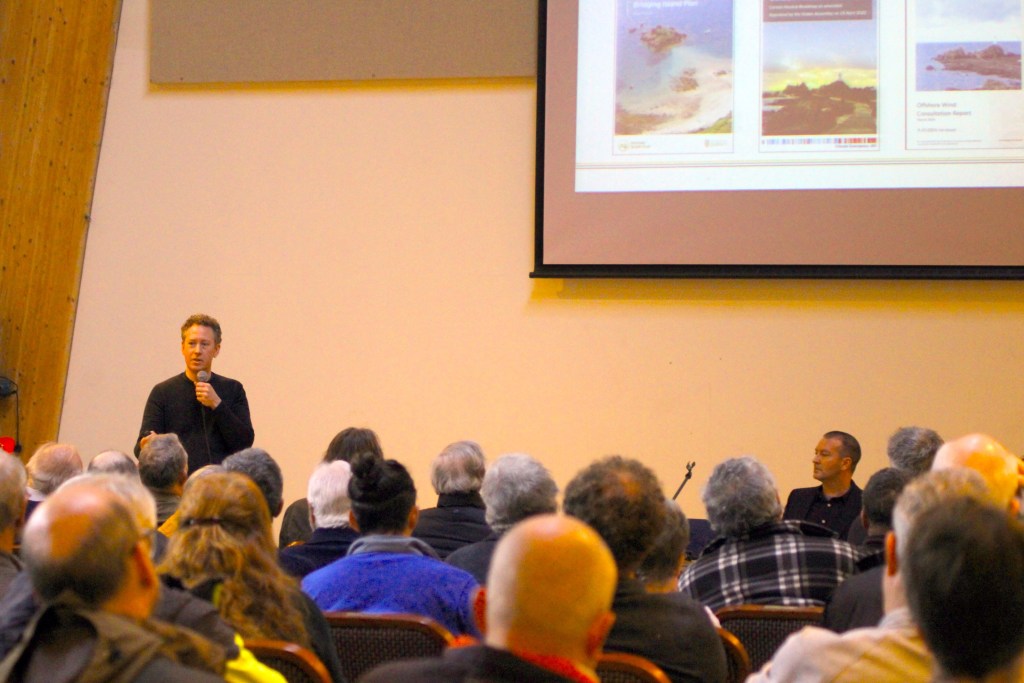
Mr Skelton said Jersey’s government still regularly references Future Jersey’s recommendations to this day, especially around major budgetary decisions.
Sark-sized
With over 100,000 people living there, Jersey’s population is more than 180 times bigger than Sark’s, so it’s inevitable there will be some tweaks to make the process work for the smaller island.
Mr Skelton stressed that it was vital to find a “Sark-sized” version of the process that would work for the island and would come within its smaller budget.
‘Listening exercise’
The six-month project will set out to understand what locals, businesses, and other organisations think needs improving about Sark, and it will create a “framework” for future politicians and others to use.
Conseiller John Guille, Policy and Finance (P&F) Chair, told Express Future Sark was about “listening to islanders”.
He said: “This isn’t outsiders coming in to tell us how to run our island; it’s about getting professionals who’ve done this before to help facilitate a conversation for Sarkese.
“What do they want for the future of their island?
“What bits could we do a little bit better on, and what bits should we completely rethink?”
Monitoring
Question Factory will be running a series of surveys, workshops and other exercises with the community, local firms, and other groups over the next six months.
It aims to create a report later this year, in time for Sark’s next general election.

As well as desired outcomes, the report will also put in place a “monitoring framework”.
“What do we want and how will we know if we’ve got it?,” Mr Skelton said.
Because of Sark’s small population – 562 at the 2023 census – it was important any metrics were the right “size”, as the island could not sustain a “data department”, like a larger jurisdiction might.
Mr Skelton said he and his team would work with Chief Pleas to find “objective indicators” to help the island know if it was “heading in the right direction”.
The aim was to come up with a way to say: “If ‘X’ is true, then we are making progress, if ‘Y’ is true, we’re not,” he added.
At its heart, Future Sark would be “the story that people in Sark are telling themselves about the island they want their children to inherit”.
“But, let’s be specific about what that actually means,” he added.
Help from Jersey
Conseiller Guille thanked politicians and civil servants from Jersey for their support with Sark’s down-sized version of its 2017 process.
He said Jersey had “generously” offered Sark administrative support from civil servants who had been through a similar process.
The project’s total cost has been capped at £30,000, in part because of the support from Jersey.
‘Fairer’
It might sound like a worthwhile project, but on an island where everyone knows pretty much everyone else, is there really any need for a survey to find out what people want?
Conseiller Guille said that while many islanders were very vocal about their views “in the street and in the pub”, the Future Sark approach was a “really fair way to get everybody’s opinion”.
“Some people are more confident speaking than others – some voices dominate,” he added.
‘Bright ideas’
So will Future Sark provide a framework for the island going forwards, or will it end up as another expensive piece of paper gathering dust in a drawer?
Perhaps Guernsey’s Lieutenant Governor, Sir Richard Cripwell, summed it up best.
He told the audience at the Island Hall that many people had come up with “bright ideas” for Sark in the past, but they only mattered if they were actually used and acted on.
Only time will tell what Future Sark finds people want, and whether the next batch of politicians choose to act on it.
