

If your local supermarket announced it was ‘freezing’ prices, what would you think it meant?
Most people – we imagine – would expect prices to stay the same, not go up.
What if the same supermarket advertised hundreds of pounds worth of ‘savings’? Would you expect prices to go up next time you went in? Nor would we.
But that’s arguably how some deputies and political commentators are using those words.
Spending more money is being hailed as ‘savings’, while increasing the States’ overall budget over the next three years – potentially by 20% or more – is being branded a ‘freeze’, with warnings it could put pensions and public services at risk.
Critics are accusing them of what George Orwell called ‘newspeak’ and ‘doublethink’ – in other words playing games with words to confuse people.
So how could millions of pounds of ‘savings’ and years of spending ‘freezes’ end up with the States spending tens of millions of pounds more than it is today?
Express decided to dive deeper…
A saving by any other name?
When Policy and Resources’ (P&R) launched its tax reform policy letter the committee claimed the States would make £20m of “savings”.
But this doesn’t mean the States will spend less money than it is currently. It means it’ll spend more money.
The so-called ‘savings’ – which P&R hasn’t outlined yet – are compared to what the States projects it could spend in future. They’re also over three years to start with – so it’s actually more like £7m a year of ‘savings’.
So, if the States is able to stick to this – and it doesn’t have a good track record of coming in on budget – taxpayers should expect more money to be spent – just not as much as the States would like to spend.
It’s the equivalent of telling your boss the Christmas party will cost £8,000 more than last year’s – but you’re saving them money because the first quote was £10,000 more.

There are, of course, reasons governments use the term this way. A department that reduces a projected £100m increase to £80m can reasonably describe the £20m difference as a saving in financial planning terms.
The question is whether that technical definition matches the meaning most people attach to the word in everyday conversation.
Likewise, despite front page headlines about a three-year spending ‘freeze’, the States’ budget would increase – potentially by up to 20% or even more.
Deputy Andy Sloan’s amendment means the States’ overall budget won’t be able to increase by more than inflation for the next three years – if the tax proposals are voted through later this year.
Supporters of inflation-linked limits would argue that a budget which rises only to match higher prices is not an increase in real terms. Without such an adjustment, public services would effectively receive less money each year as costs rise.
But to many households, a bill that increases year after year would still feel like an increase – not a freeze.
Over the past three years, inflation has hovered at about 3.5% to 4.5% a year – meaning prices have risen by around 12% overall once the annual increases are compounded.
The senior civil servants responsible for modelling the effect of the tax changes have already predicted that GST will increase inflation by 1.9% – which critics say is optimistic.
So, if inflation was otherwise stable, the States’ budget could be allowed to rise 18-20% by 2030.
And if P&R is wrong – and GST pushes inflation higher than expected – then the budget could be allowed to rise by even more than 20%.
That’s arguably not what most people probably imagine when they hear about spending ‘freezes’ and ‘savings’.
If a bag of potatoes costs £1 in 2026 and by 2030 it was £1.20, very few people would describe that as a ‘freeze’.
Solid wind
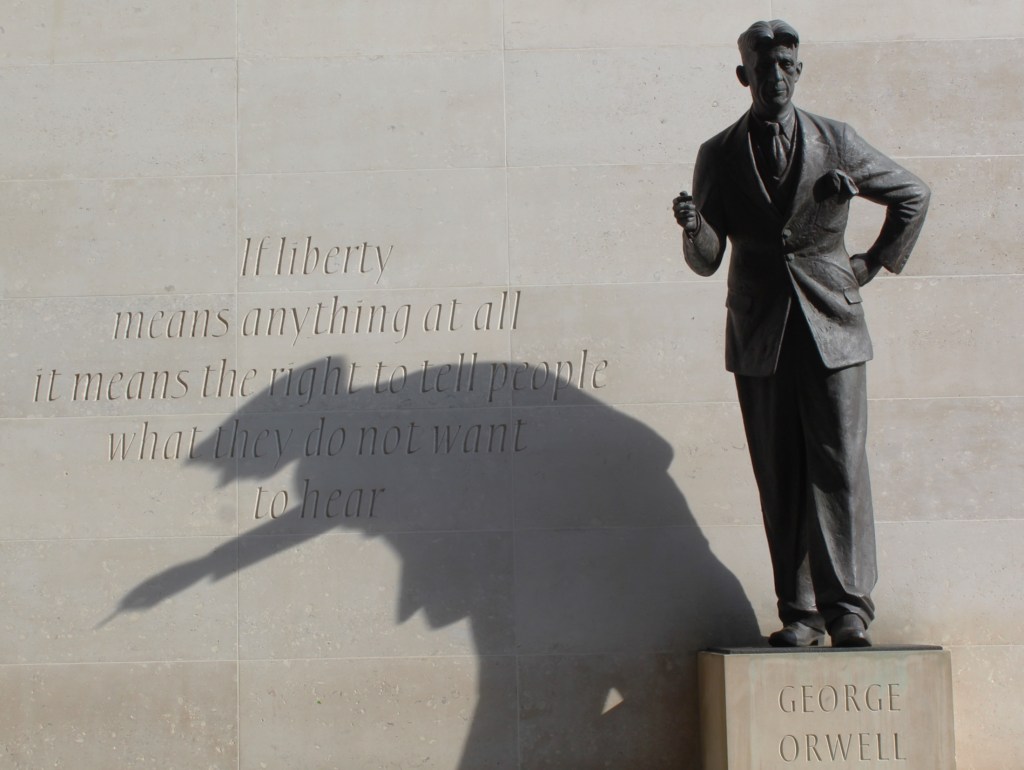
George Orwell wrote that political language was “designed to make lies sound truthful and murder respectable, and to give an appearance of solidity to pure wind”.
Orwell, a famous proponent of free speech, believed sloppy and misleading language was more than a bad habit – it was a political tool.
When words stop meaning what people think they mean, he argued, citizens become less able to challenge those in power and less able to see reality clearly.
It’s a beautiful thing, the destruction of words.
George Orwell
There is, of course, another side to the argument.
Governments and economists are not necessarily trying to redefine words; they are often using technical terms with specific meanings.
In the same way a ‘spoiler’ means different things to a film buff and a car designer, so words can have specific technical meanings to politicians and economists.
A ‘saving’ in a budget document may mean avoiding a projected increase, rather than reducing today’s spending.
The question is whether the public speaks the same language.
Outside Sir Charles Frossard House, most people do not think of spending more money as ‘saving’ money.
Nor do they instinctively describe a budget that rises by inflation every year as ‘frozen’.
Technical definitions may satisfy accountants, but politics depends on ordinary people understanding what they are being asked to support.
Language and law
Some words are open to interpretation.
Was the weather “good” last week? It depends if you like warm weather or not.
Is Legally Blonde a “classic movie” or “overrated”? It’s up to you (though we’d argue for the former).
Other words, however, aren’t – especially words used to help write rules and laws.

When someone is accused of “murder”, “driving without due care and attention” or “fraud”, the facts of the case might be open to interpretation – but the words themselves are tightly defined.
Senior civil servants – along with P&R – have argued they can’t share the modelling behind the tax proposals – even with deputies – because it contains ‘sensitive’ personal data.
Some deputies argue they’re wrong and the data isn’t sensitive.
Officials, however, argue the issue is not simply whether information can be shared with elected representatives, but whether releasing it could breach legal obligations or expose personal information.
The dispute goes beyond semantics – it has real-world implications, affecting which deputies can fully scrutinise P&R’s proposals.
Pensions and health cuts?
And it’s not just transparency that can succeed or fail on the strength of a few keystrokes.
No politician actually proposed a literal ‘freeze’ – that was media shorthand for capping spending at inflation – yet neither side corrected the label.
Deputy George Oswald, President of Health and Social Care (HSC), has suggested there would need to be “significant cuts” because the cost of some treatments and medical equipment is rising faster than inflation.
Likewise, Employment and Social Security (ESS) President Deputy Tina Bury has warned that Deputy Sloan’s proposed spending cap could reduce the real value of old age pensions by requiring the social security system to absorb rising costs within a fixed spending envelope.
Deputy Ross Le Brun called the idea of keeping spending within inflation “ridiculous and unworkable”.

Those warnings have led to headlines suggesting the spending “freeze” could force cuts to pensions and healthcare.
But supporters of the amendment reject that interpretation – accusing their opponents of “scaremongering”.
They argue the amendment is intended to stop the States growing faster than Guernsey’s economy, not prevent payments from self-funded schemes such as the Guernsey Insurance Fund, and accuse opponents of overstating its consequences.
Writing on Facebook, Deputy Haley Camp said: “We need to stop hiding behind emotive language such as this.
“All I hear is that savings are slash-and-burn, salami-slicing, risk public order, risk lives…
“But ‘Deputy brings tough but fair amendment to the States’ isn’t a catchy headline.”
Genuine fear or scaremongering?
Threats of cuts will undoubtedly scare many older people, with the Chair of Age Concern Guernsey warning that any “spending freeze” would “bite for a lot longer” than three years.
However, to others it’s been seen as “emotional and financial blackmail” by politicians.
One pensioner, responding to Deputy Bury’s warning, said older people deserved “better than a politician waving the threat of poverty to win an argument”.
They added: “You’re threatening pensioners with cuts to scare us into opposing a budget policy you don’t like. That’s not leadership – it’s scaremongering.”
”You represent us. You don’t get to weaponise us.”
Whether those competing interpretations are ultimately correct may depend on how the amendment is interpreted and implemented.
Deputy Sloan previously told Express his amendment was simply designed to force P&R to keep spending “under control” and exercise a minimum level of fiscal discipline.
Whether that’s a “ridiculous and unworkable” aspiration or not will be discussed at length over the coming 10 weeks.
What is beyond dispute is that the language being used has shaped public understanding of the debate long before any practical consequences have been tested.
More than semantics
Many political debates involve arguments about numbers.
Increasingly, they also involve arguments about the words used to describe those numbers.
Is spending that still rises every year really a ‘freeze’? Is avoiding future expenditure really a ‘saving’? Is every dataset that officials decline to publish necessarily ‘sensitive’?
Reasonable people can disagree over tax, spending and public services.
Democracies depend on voters understanding what is actually being proposed.
Orwell warned that language could obscure reality rather than illuminate it.
Whether that is happening in Guernsey today is ultimately for readers to decide.
But before deciding who is right about tax reform, spending or transparency, it is worth asking one simple question: Are politicians and the public speaking the same language?
