

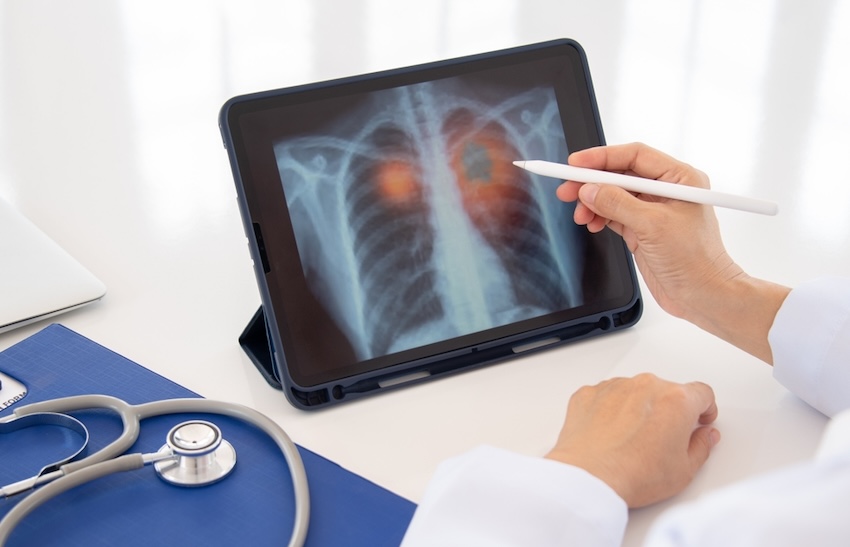
But lung cancer tends to be picked up much later.
The earlier a cancer is diagnosed, the better the chances are that it can be successfully treated.
Monitoring which stage cancer is at helps to direct resources to where it is most needed and in England, the government has set out a plan for 75% of all relevant cancers to be diagnosed at an early stage by 2028.

Here, authorities are currently playing catch up on producing cancer data for the Channel Islands and yesterday Guernsey and Jersey released the second update report this year which takes the figures to 2020.
“For the first time, this report contains data about cancer staging for four cancer sites — breast, colorectal, lung and malignant melanoma cancers,” said Jenny Cataroche, Head of Public Health Intelligence.
“This means we are able to compare the proportion of these types of cancers that are being detected earlier to those detected later.
“This is really important from a Public Health perspective because where cancers can’t be prevented our hope is for them to be detected at an early stage — the staging data shows us where to focus our efforts to achieve that.”
The report is provided jointly for the Public Health services of Guernsey and Jersey by the National Disease Registration Service, a branch of NHS England.
In Guernsey, an average of 717 malignant cancers were registered each year between 2018 and 2020.
The top five most common incident cancers by rate are non- melanoma skin cancer, prostate cancer, breast cancer, colorectal cancer and lung cancer.
For most cancer types, Guernsey’s rates of cancer incidence do not differ in statistical significance from those of England or the South West region.
But there are exceptions.
Local incidence rates are significantly lower than the South West for kidney and ureter cancer and uterus cancer.
They are significantly higher than England and the South West for non-melanoma skin cancer, malignant melanoma.
Head and neck cancer mortality are also higher than England and the South West Region as is “other cancer” mortality.
Diane Mathews, Strategic Screening Lead for Public Health Services, said: “Guernsey’s high skin cancer rates are directly associated with high UV exposure from the sun. That’s why it is so important for islanders to enjoy the sun safely.
“The message is two-fold: prevention i.e. covering up, wearing a hat, staying out of the sun between 11am and 3pm and wearing a suncream; and early detection i.e. knowing what is normal for your skin and seeing a doctor if anything changes.”
She said the data provided a rationale to initiate a much larger education and awareness piece in 2025.
“We would like to empower members of our community to spread the prevention message and spot changes in their own and other people’s skin. This can be done by working with colleagues in Education and services such as hairdressers, podiatrists, massage therapists and other practitioners who often have the opportunity to spot changes in skin.”
For more information on sun safety, cancer data and cancer prevention, see:
