


Laid out in a policy letter, the Future Guernsey Dairy plan will either see the the current site at the Bailiff’s Crossroads go through a major refurbishment, or see an entirely new Dairy facility built.
The States Trading Supervisory Board has put the policy letter together to address the ever-worsening condition of the current dairy. It was 30 years ago that the dairy received its last refurbishment, and while that was a major piece of work, the facility has aged so much now that it has recently been given a two out of five hygiene rating, simply because the building is nearly falling down.
Where any new facility would actually be is not yet known, but STSB’s Deputy Managing Director said they would, and have been, considering the matter carefully. Farmers want it close to their fields – in the south – but the IDP restricts the building, which is essentially a factory, to certain ‘industrial’ areas.

Pictured: While the policy letter is setting out two options, the Dairy’s preferred option would be a totally new facility.
Going forwards, if the States agree the policy letter, business cases for both options will be worked up, starting from a baseline of six months work which has already taken place. When those business cases are done, a decision will be made on which option is the best.
STSB estimated the construction cost for either option is likely to be the same – around £25 million, and could all be completed in 2024. The potential efficiency savings, compared to the current dairy, could be more than £0.5 million a year.
“There is no more iconic image of the island than a Guernsey Cow in a Guernsey field. If we want to retain that, then we need to ensure the dairy industry remains viable and sustainable, and Guernsey Dairy is key to that,” Deputy Peter Ferbrache, STSB President, said.
“The current premises are no longer fit for purpose, so major investment is needed to provide a modern facility that is more efficient and meets the highest food production standards.”

Pictured: Deputy Peter Ferbrache.
The dairy currently operates seven days a week, to produce Guernsey milk, butter, cream, cheese and ice cream. Due to the huge complexity around maintaining current operations while carrying out a major refurbishment – even for a reduced product range – a redevelopment on the existing site is currently not the preferred option.
However if States Members agree to the current proposals, further work would be carried out to assess all the viable options before a final plan is presented to the States.
The Dairy’s General Manager, Andrew Tabel, said no matter the choice, there was a need for urgency.
“We’ve been being very careful with replacing existing equipment at the moment because we are trying to make sure it is all future proofed and we are not wasting money buying things that might be replaced in a full rebuild, but that can only go on so long,” he said.
“There is a need to deliver this by 2024.”
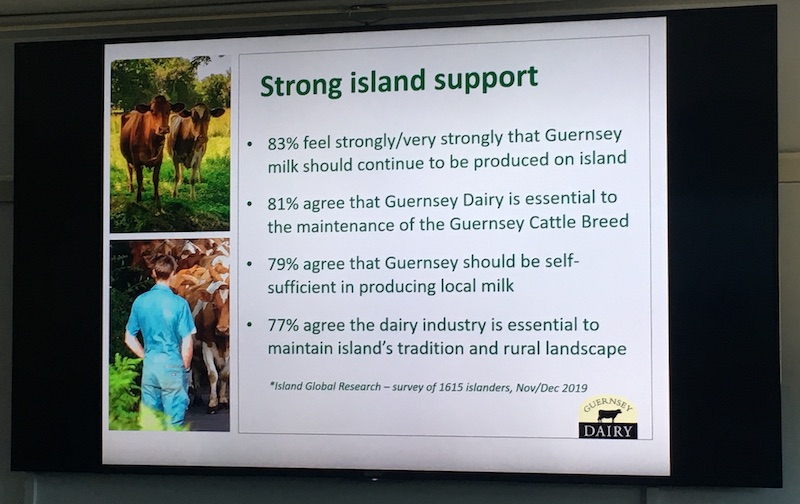
Pictured: Guernsey Dairy commissioned a survey of islanders to get their views on the Dairy brand.
The project is also considering other features to promote the Guernsey cow, the island’s centuries-old farming traditions, and local produce.
For example, creating a heritage centre alongside a new dairy would provide a tourist attraction and focus for education, to showcase the iconic cattle breed and local farming.
Another addition could be to encourage micro-dairies, run by third parties, which would be supplied with milk to produce speciality local dairy products. Similar businesses already exist, producing local cheeses, ice-cream and yoghurt.

Pictured: Although sales have declined in recent years, with an increase in plant-based alternatives, nine out of 10 local households still regularly buy Guernsey Dairy milk.
Guernsey Dairy has a continuous maintenance and improvement programme to ensure it continues to meet regulatory and quality standards and to deal with the condition of the building and equipment. This would continue during the potential build of a new dairy, to keep production going.
Dairy processing technology has also moved on significantly in the last 30 years, however Mr Tabel said the lack of space at the site and its small footprint is an obstacle to introducing modern and efficient equipment. He said the best way to get this new equipment in place and in to the process would be with a new facility.
Finally, he said if the issues were not addressed, there is a risk production capacity will reduce and no longer meet demand, resulting in milk having to be imported. That would further undermine the dairy’s financial sustainability and that of island’s 14 dairy farms, most of which would cease operating.
Concerns were raised that without support to the dairy industry, there would probably still be Guernsey cows in Guernsey, but the Guernsey Cattle Breed would likely go into permanent decline.
Further details can be found at gov.gg/futuredairy.
Pictured top: The current Guernsey Dairy.
