


If GST is introduced, a number of exemptions will be enshrined in law – including GP appointments, emergency hospital visits, ambulance usage, and pharmaceutical supplies.
Dentists and opticians would also be exempt from charging their patients a goods and services tax if it is introduced, along with childcare provision for pre-school age children, burials and cremations and other unavoidable costs that many people face.
Public services that the States provide for free, domestic banking and insurance services, and charities’ services are all also suggested to be exempt from GST.
Those items are all included in the below list that the States will be asked to approve, when deputies vote on including retail food sales in the proposed new 5% charge.
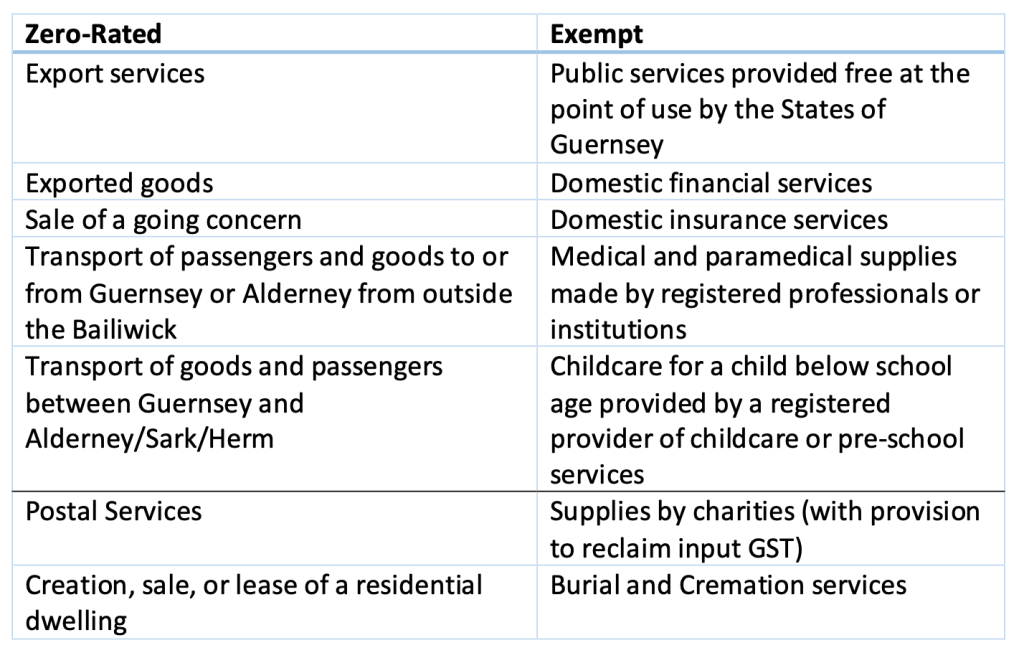
Transport of goods and passengers to and from and between the islands of the Bailiwick, exported services and goods, the sale of a going concern, postal services, and the ‘creation, sale, or lease of a residential dwelling’ are ‘zero rated’ under the current proposals.
It’s still not a done deal that GST will be introduced though – with a decision on that due this summer – but work has continued on preparing for it to be implemented in the meantime so it can be brought in smoothly if the States decide to do so.
This week it was formally suggested by Policy and Resources that the charge is set at 5% if it is brought in – based on a broad based system, which will be kept as simple as possible.
That means all food – whether bought prepared and served in a restaurant or from a supermarket – would be included. If retail food sales are excluded the charge would have to come in at 6% warned Policy and Resources this week.
“One of the decisions we need from the States is whether GST, if it were to be implemented, should be a lower rate and apply to most goods and services including food, or whether it should be a higher rate but exclude food sold in retail outlets,” explained Deputy Gavin St Pier.

“Our recommendation to the States is that a consistent lower rate including food is the best and most efficient approach. It is the clear preference of the business community,” added the Vice President of P&R.
Deputy St Pier said deciding to recommend including retail food sales in the GST net was based on the wider picture of keeping the proposed charge as low as possible.
“By having it as a broad based, in other words, having it as simple as possible, and therefore covering pretty much all goods and services, that helps keep the rate as low as possible.
“As soon as you start introducing exemptions and exceptions, then you have to have a higher rate in order to bring in the same amount of revenue. We’ve seen that, but just by looking at food.
“If we’re aiming to raise around about £50 million net of all the mitigations, then in order to deliver the same amount, you’d have to have a 6% rate rather than a 5% rate. So I think that’s the first thing, is actually recognising that the way you keep the rate low is by having it really, really simple, as broad as possible.”

Women’s sanitary products are among those essential items which will incur GST under P&Rs proposals, with Deputy St Pier acknowledging the committee has looked at discussions about these items elsewhere.
He said where items are exempt, but their charges vary, it can then be easy for shops to charge what they like anyway so the customer won’t always see any saving.
He said we might even see that some prices do not change much in shops if GST is introduced as the inflated cost we pay in some shops, which are the same or higher than prices including VAT in the UK, will mean GST is simply absorbed by the retailer or service provider.
“(Sanitary products was) one of those things where actually in the UK, politically, controversially, the pressure was brought to bear, understandably, in terms of concern about it. And so there was a reduction or an exemption, but not all of that was passed on, because actually, often what retailers do is they just increase their profit margin.
“In other words, they don’t reduce the cost by the full amount of the reduction in Goods and Services Tax but they just increase the profit margin.
“Of course, that’s what we currently have with a number of UK retailers here who are currently selling at UK prices. In other words, UK prices that are VAT inclusive,” he added.
“What we saw in Jersey is that when GST was introduced, well, those retailers did not increase their prices by GST. They simply absorbed the GST and took a lower profit margin. And the reality is that those groups are driven by group decision making, and so we would expect that to be a similar effect here, and that’s why, actually, the modelling can, I think, pretty reliably predict that a 5% GST does not lead to a 5% increase in prices across the board.
“In fact, the assumption that set out in the policy letter is that a 5% GST, would lead to a 3.2% increase prices in RPI and inflation because of that effect.”

While not exempt from GST under the current proposals, women’s sanitary products have been included in the ‘basket of essential goods’ that P&R has used to calculate an Essentials Cost Relief Payment.
That system could see lower income households receive an annual fixed payment to help cover their essential living costs.
It is proposed that is set at £520 a year for a single adult or £860 a year for a couple.
Private school fees for the three colleges have also not been included in the list for exempt or zero rated goods and services.
Deputy St Pier said this was also discussed by P&R but it was decided that keeping the proposed new charge as broad based as possible was best.
That means that school fees at Blanchelande, Elizabeth, and Ladies colleges will incur GST if it is introduced.
