


Living standards in Guernsey have barely changed in 15 years.
Factors behind the island’s stagnant economy, and how it compares with Jersey, were dissected by the Institute of Director Guernsey’s lead on economics Richard Hemans at the organisation’s breakfast seminar today.
The portion of the working age population in employment has fallen from 78% to 75% since 2019 in Guernsey, the equivalent of about 1,300 people.
Jersey’s equivalent labour participation rate in 2023 was over 82%.
“If Guernsey had the same ratio, this would equate to over 3,000 additional people in employment,” said Mr Hemans.
“Guernsey’s low participation rate is limiting economic output, increasing our dependence on immigration and putting pressure on public finances.
“The participation rate could be improved by encouraging workforce diversity, promoting lifelong learning, improving health care, supporting working families and raising the retirement age.”

Guernsey’s productivity was also markedly worse than Jersey’s.
In 2023, Guernsey’s productivity fell by 3%, it has only increased by 2% in 15 years, whereas Jersey’s has increased by 8% in 2023 and by more than 12% in 15 years thanks to its finance sector and in particular banking.
“This means that Guernsey living standards have barely changed in 15 years,” said Mr Hemans.
“Productivity is the main determinant of living standards and long term economic growth. Low productivity undermines our competitiveness. Low productivity can be addressed by skills investment, investment in infrastructure such as transport, digital, housing and health, improving regulation and encouraging innovation and enterprise in areas such as FinTech, renewable energy and sustainable finance.”
Demographics is probably the number one challenge facing Guernsey, he said.
The dependency ratio, or the proportion of the non working age to the working age population, has deteriorated over the last decade, but has stabilised in the last five.
It is 56.7% which compares with Jersey’s 52.9%, although the gap has narrowed slightly recently.
“A high dependency ratio puts pressure on public finances, increases the tax burden on the working age population and lowers our economic growth. We could be addressing this by more immigration, raising the retirement age, trying to increase fertility rates where possible, promoting labor force participation, driving productivity and strengthening private savings.”
The island’s population now stands at 65,000, with growth averaging 550 people a year in the last five.
“The natural population has started to decrease and net migration has started to increase” said Mr Hemans.
“It is this net migration that has stabilised the dependency ratio, increased the population and provided the labor that the economy needs, but a growing population puts pressure on infrastructure, increases the cost of housing and will undermine social cohesion, if not managed properly, policy could focus on infrastructure investment, increasing the housing supply, investment in education and ensuring immigration focuses on working age people who will go into employment.”
GDP comparisons between the islands show divergence.
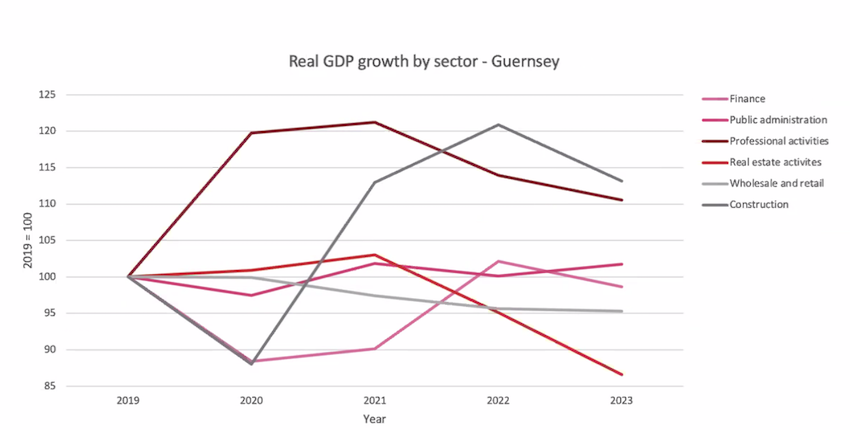
“Jersey’s economy is now 15% bigger than it was in 2019, and 18% bigger than 2009, just after the financial crisis, thanks to the growth of its finance sector, while Guernsey is 1% larger than in 2019, and 5% against 2009. Guernsey’s economy is stagnating right now and needs some growth.”
Guernsey’s real GDP fell in 2023 because finance shrank by 3%, professional activities by 3% real estate activities, which is mainly households, by 9% and construction by 6%. The only growth from a significant sector was in public administration, which grew by 2%.
Jersey’s GDP grew in 2023 because finance increased by a “staggering” 19%, professional activities by 4% and construction by 5%.
Jersey’s banking sector grew by 32% in 2023 as it benefited from rising interest rates, he said, while Guernsey’s banking sector contracted by 11% .
“Jersey’s banking sector has nearly doubled in two years and now represents roughly a quarter of Jersey’s GDP on its own, which is significant, but also a large concentration risk.”
He said that Guernsey’s banking GDP decrease in 2023 is inconsistent with a rising interest rate environment.
“Feedback is there were some specific issues at several large banks and RBC started the transfer of their banking operations to Jersey in 2023.”
Elsewhere, Guernsey enjoyed continued growth in funds, but suffered a decline in fiduciary while Jersey reported strong growth in both fiduciary and funds.
Mr Hemans expects the economy to be flat or showing a slight decline when the 2024 figures are confirmed.
