


Guernsey’s Home Affairs Committee has decided to leave four 2,000lb World War Two bombs buried eight metres deep in the Route Isabelle and Le Foulon area.
Historical records indicate the ordnance was dropped by a British Short Stirling Bomber to empty the aircraft following an aborted raid.
The decision comes after specific safety and risk analysis, with specialists from the Ministry of Defence (MoD) and NATO determining that the risk to the public was extremely low.
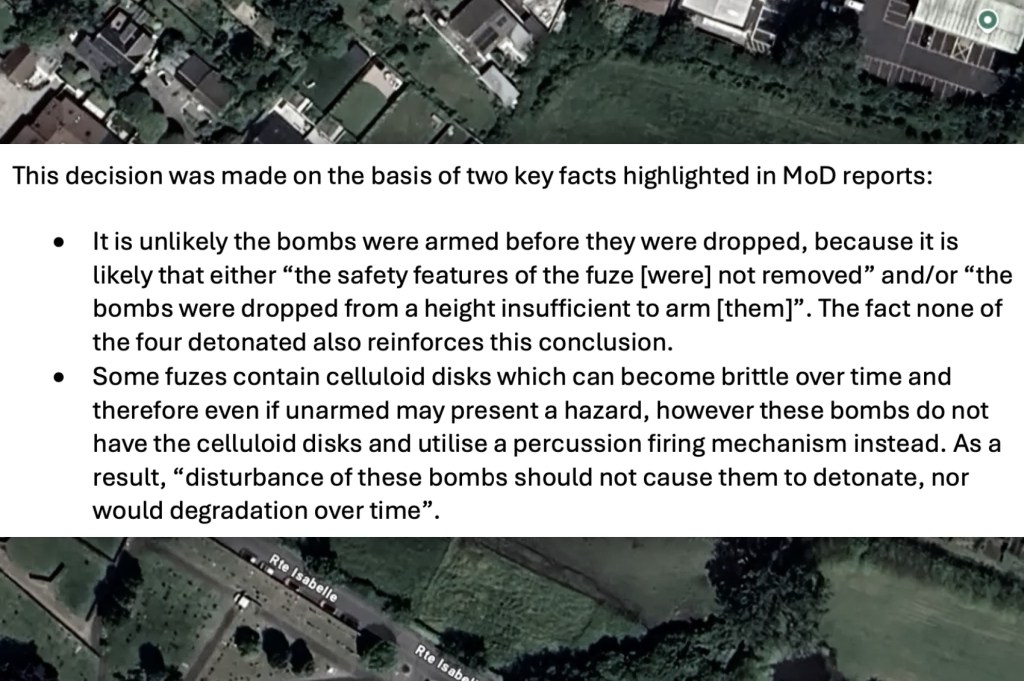
That analysis said the bombs were unlikely to have been armed because they were not dropped on a target and may have lacked the sufficient height needed to arm the fuses.
It also determined that the firing mechanism used in these devices was not subject to degradation that could cause a spontaneous detonation over time.
The chance of any “sympathetic detonation” between bombs was remote, at under 5%, and major structural damage to the area was considered to be highly unlikely.
Following the analysis and research conducted by specialist teams, the States of Guernsey concluded that leaving the bombs undisturbed presents the least risk to the community.
Alternative options, such as excavation and relocation, were rejected.
The removal of any bombs would have required a 1.5km evacuation cordon for several days, and officials said that any risk to the public would heighten if the bombs were disturbed or moved.
The NATO report concluded that it was unlikely the four bombs were armed before being dropped, because they were not being dropped on a target, “from the evidence available, EODTIC believe that four bombs – High Explosive Aircraft 2000lb Armoured Piercing fitted with fuze percussion aircraft bomb tail no. 37 – were dropped.
“None of these bombs functioned, although one is believed to have suffered dynamic breakup through impact.
“Evidence supports that the bomb fuzes are unlikely to be armed. The bombs and their fuzing system are highly unlikely to spontaneously detonate.”
The British Army said it would not support excavating the weapons for in-situ detonation, but the MoD did say that it was looking to help the States make the right decisions when it comes to buried ordnance.
A spokesperson for the Ministry of Defence said: “The MoD has provided support and advice to the States of Guernsey throughout this operation.
“Our aim has been to enable the SoG to make informed decisions and ensure public safety.
“The MoD has, and will continue to supply, timely expertise and scientific information on request.”
Guernsey’s Emergency Planning Officer said that while the bombs will remain in place, the situation will be monitored and reassessed if any changes occur.
Kevin Murphy said: “Our planning has been guided at every stage by specialist advice from the Ministry of Defence, the British Army and a NATO specialist asset.
“The assessments show that the ordnance poses no threat to life and only a very small chance of any structural damage if they do detonate, and the chances of that happening are extremely small.
“By keeping the bombs safely buried, we avoid the significant disruption and unnecessary increased risk that excavation would create. I’d also like to reassure the community that this decision is not the complete end of the matter.”
Mr Murphy continued: “We will continue to monitor the situation and if any changes occur, reassess the best way to achieve public safety.”

Home Affairs said that their intention was to continue following the experts’ advice.
The political lead for Guernsey on the matter, Deputy Marc Leadbeater, the President of the Committee for Home Affairs, said: “We want to reassure the community that this decision has been taken following careful consideration and has been guided by extensive expert evidence and a clear understanding of the very low level of risk involved.
“The expert analysis shows these devices are highly unlikely to be armed and leaving them undisturbed at depth is the option that presents the least risk to the community.”
Deputy Leadbeater concluded, “Our priority throughout has been public safety and this decision reflects the best technical advice available which shows disturbing them would create far greater risk.”
More to follow…
