

The new testing option has been designed to find and hopefully extinguish any ‘missed’ infections, in line with guidance from the European Centre for Disease Prevention and Control.
Public Health Director Dr Nicola Brink said the pilot is due to run throughout December and probably into January, with the aim of increasing the numbers taking Day 13 tests so that her team can analyse the figures and better understand the late presentation of the virus.
“We have been looking at the role of Day 13 testing, which is for people who have been in self-isolation for two weeks and we test them on day 13 to ensure that they don’t have a late infection,” she said.
“We’ll get about 94% of people on Day 7, but 6% will become positive between Day 8 and Day 13. We are trying to protect those individuals on Guernsey.”

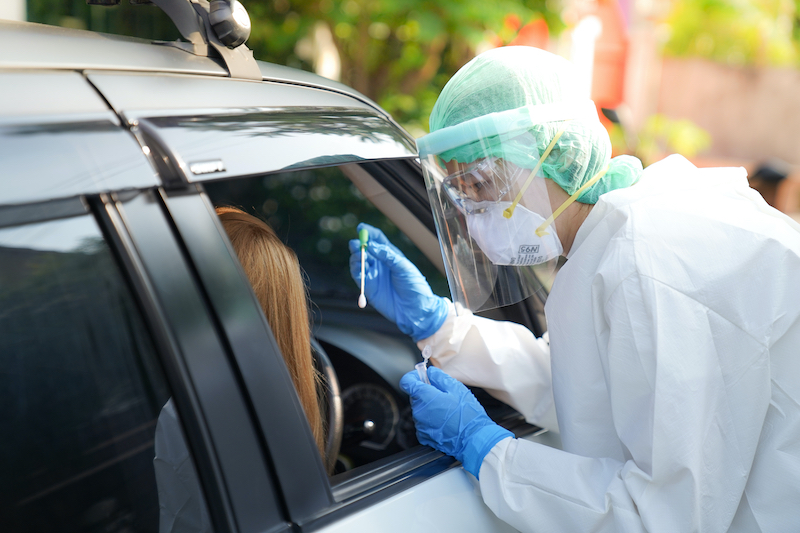
Pictured: How Day 13 testing will work in practice.
Dr Brink said one of the other benefits of Day 13 testing is that a negative test will assure people that they are able to mix with their families and friends again, safe in the knowledge that they do not have the virus.
All travellers will be called by the Scheduling Team to arrange a test either at the Princess Elizabeth Hospital in Guernsey, or the Mignot Memorial Hospital in Alderney.
Those who receive a negative Day 13 test result can leave self-isolation immediately, while those tested as part of a family or group will have to wait for each member to receive a negative test result.
