


The States paid out nearly £5,000,000 in relocation costs to attract 500 ‘essential’ workers to Guernsey last year.
The £4,757,453 bill for 2024 was revealed in answers to questions posed by election candidate, Deputy Chris Le Tissier.
He was given the bill for States staff relocation costs for each year from 2018 to 2024 – with the amount spent annually increasing by more than £3m in that time.
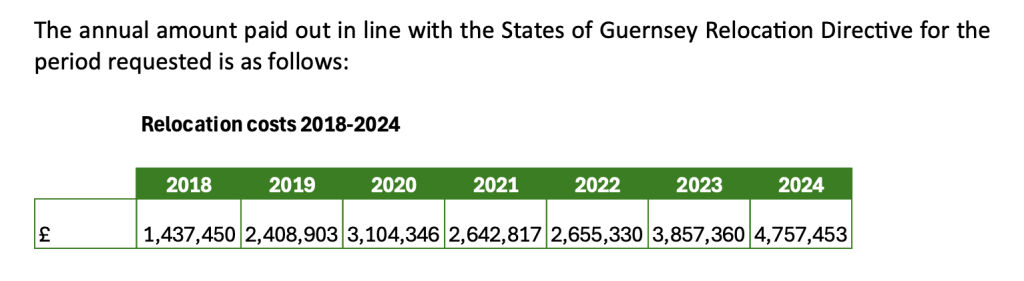
Covid can’t be blamed for the increase, as it often is, because the spend on relocation costs had already started to increase before the pandemic era of 2020-21.
By 2019, the annual spend on helping new staff relocate to Guernsey had gone up by a million pounds compared to 2018. It then went up by over half a million during 2020, before dropping back in 2021 and 2022.
The amount spent on relocation costs then reached new peaks in 2023 and 2024.
The amount spent on relocation costs related to just under 300 people in 2018 and just under 500 people in 2024.
That means each person moving to the island to take on work as an essential States employee last year cost taxpayers an average of around £10,000.
The average cost to the taxpayer of an essential worker moving to the island in 2018 – based on 300 people moving over at a cost of just under £1.5m – was less than £5,000 per person.

Relocation costs can include covering the expense of physically moving a person and their belongings to the island as well as a subsidy for housing.
In replying to Deputy Le Tissier’s Rule 14 question, a States spokesperson said the figures above “include all elements of relocation payment as per the Relocation Directive i.e. Relocation Allowance; Additional Relocation Allowance or Mortgage Support Allowance”.
The spokesperson said “these payments are only paid to employees who meet and comply with the criteria set out in the Directive”.
It was added that “some of these payments are also liable to tax and social security deductions”.
Explaining why the States spends money on staff relocations, the spokesperson said the government “relies on recruiting staff from outside the Bailiwick in order to deliver essential services”.
“These are primarily in specialised areas such as health and education, which benefit every island resident. The costs have risen for two main reasons. The numbers of staff receiving the benefits rose from just under 300 in 2018 to just under 500 in 2024. In addition the costs of rental increased during, and since, the Covid pandemic and so more people receive the maximum capped Additional Relocation Allowance.”
Relocation expenses can only be claimed by a person moving to Guernsey to take on an employment offer that meets set criteria – the ‘Relocation Directive’ does not cover family members relocation costs.
If any employee decides to leave the island before a fixed term contract is up, or within the first three years of a permanent contract, then they may have to repay any relocation expenses.

‘The States of Guernsey Relocation Directive’ is being reviewed – looking at activity data, workforce sector analysis and financial modelling to see if it can be better utilised.
The results of that review are due out later this year.
“Should any changes be made to the Directive, consideration regarding workforce stability and recruitment to key areas of the public service such as health, social care, education and law enforcement will remain of paramount consideration,” said the States spokesperson.
