


Scrutiny has called on the States to reject Policy & Resources’ new fiscal policy after labelling it “not sufficiently clear, coherent or robust to operate as an effective constraint on fiscal decision-making.”
Deputy Andy Sloan, President of Scrutiny, penned a highly critical letter of comment ahead of the States debating the updated policy next week.
Deputy Sloan reiterated in his letter that the issues identified reflect “fundamental issues of “structure, definition and governance that go to the heart of how the Framework would operate in practice”.
“Given the central role of the Fiscal Policy Framework in guiding the long-term management of the States’ public finances, the Committee does not believe it would be appropriate for the States Assembly to approve the Policy Letter in its current form,” he wrote.
Deputy Sloan called on deputies to send P&R back to the drawing board and to strengthen the oversight of public finances and their governance by giving Scrutiny more power to task an independent panel with analysing the policies and publishing reports more widely.
Deputy Sloan said this would “significantly enhance accountability and public confidence without increasing cost.”
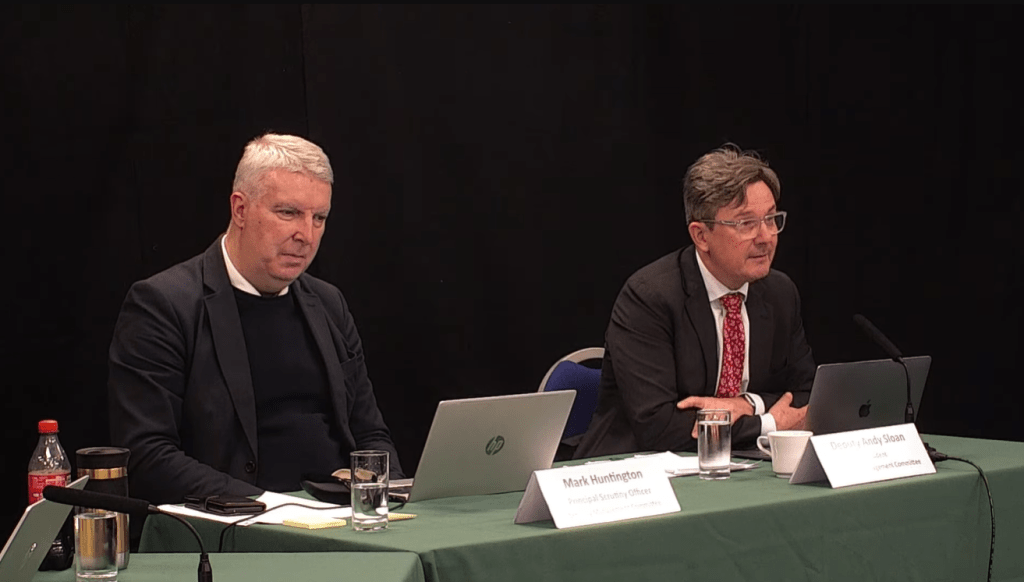
A lack of “effective guardrails” was noted in both the public hearing and letter of comment.
Deputy Sloan said there were a lack of “enforceable constraints” in the policy against government borrowing and budget deficits with no assessment of how long the States may be in the red or of when a deficit becomes unsustainable.
Part of this was linked to a move away from “balance” to “stability” as the central principle that lacks clarity, but also a perceived move away from firm rules to principles.
“While the Committee accepts that rigid rules have limitations, it is concerned that the near-complete removal of measurable benchmarks materially weakens the ability of the States Assembly, the public and independent bodies to assess compliance,” Deputy Sloan said.
“The Committee is concerned that, without clear distinction, this ambiguity could be used to justify the repeated use of short-term, potentially high-cost borrowing instruments to address what are, in substance, cumulative structural cash deficits.”
He also said it isn’t clear how reserves would be replenished, or why P&R had set the target of reserving 50% of GDP in the long-term.
The States Fiscal Policy Framework, and the Government Work Plan, are due to be debated during the meeting scheduled to start on Wednesday 28 January.
