


Naomi and Ben Tustin are the co-founders of Guernsey Seaweed – with the pair doing most of the hands on work themselves, supported by a small band of employees.
Starting with selling fertiliser around five years ago their business model was derailed by the covid pandemic.
Since then their product lines have developed, with cosmetics and food now making up the bulk of the ‘shop’ section at guernseyseaweed.com.
The decision to branch out into skincare products stemmed from the joint partnership with Wheadon’s Gin during the pandemic which saw Ben and Luke Wheadon work together to make seaweed hand sanitiser.
“Luke spoke to me about it because he had alcohol but didn’t have anything to mix it with. He said ‘can you make a gel out of seaweed?’ and so we did, in five days.
“Me and Luke then spent weeks and weeks cutting the seaweed then cooking it up in the Bella Luce kitchen and then mixing it together. We were doing something like 10 hour days and we were cooking something like 350 litres of seaweed gel every day.
“It was very intense.”

Pictured: The range of cosmetics made using Guernsey seaweed has grown.
The seaweed hand sanitiser proved extremely popular, with the men selling it at cost, and organisations like St John sharing it with health care workers and others across the island.
“…then cosmetics came off the back of that,” said Ben.
“The hand sanitiser turned out to be really moisturising, which didn’t make any sense at all because it had 70% pure ethanol in it which strips your hands of everything. But the 30% seaweed bit turned out to be phenomenal and loads of people were saying ‘I love it’, ‘it’s really nice for the hands’ and then a fella with eczema stopped me in the street and said ‘I had really bad eczema using other hand sanitiser and I’ve used yours and my eczema cleared up’, so I couldn’t really ignore that and that’s when I started making serums and moisturisers from the same gel base, and not alcohol.”
While Ben has been busy developing products such as shampoo, conditioner, body wash, serums, liquid soap and hand and body creams, Naomi was already busy testing out different recipes to suit every hungry palate starting with the seaweed salt, mixed seaweed flakes and herby seaweed seasoning at the end of 2019.
“People have eaten it for hundreds of thousands of years, so there must be something that we can do…so I just bought a cheap dehydrator and went to the beach and picked half a dozen different types of seaweed and dried them all and powdered them all and put them all into little bags and mixed them together and added other things and gave it out to friends and family and said ‘try this and tell me what you think’. I spent about six months just tweaking things and changing things and then we launched with three products.
“We went to the vintage agricultural show with our first stall and we had something like 200 tins and we sold them all. It just went on from there and we created the chili seaweed salt which people liked, but some said it is not hot enough so we do a mild one and a hot one, and then later on the barbecue rub came and we’ve just started doing whole seaweeds as well.”

Pictured: Stocks of the new Guernsey seaweed book are available in local bookshops and online now.
Every product line involves a lot of record keeping leading Naomi to think they could write a book about the various uses of Guernsey seaweed.
While training new recruits to help him with the foraging tours they also run, Ben wrote some ‘crib sheets’ to help them remember the various facts he had taught them and that along with hordes of information on the history of seaweed from the Guernsey Archives formed the basis of their new book.
Out now, ‘Vraic, A Guide to Guernsey Seaweed’ includes information on both ‘drift seaweed’ and ‘fresh seaweed’ and how both are used by the company.
“The one that’s washed up is known as drift seaweed, so it drifts about in the ocean,” explained Naomi. “That’s perfect for your garden. You can gather it up, put it in a bucket or a wheelbarrow or something, take it home, put it on your garden, just put it straight on your garden. Don’t do anything else with it. Just make sure you’re not collecting up any sand, just take the seaweed and put it on the garden.
“Then for the cosmetics and for the food, we cut fresh seaweed. The ones that we want are down lower tide. We harvest probably about 56 or 57 different types. I think they all have different flavours and different properties that we want to use. So we go down, cut those and then take them home. We do wash those and we always leave at least a third so that it will grow back.”
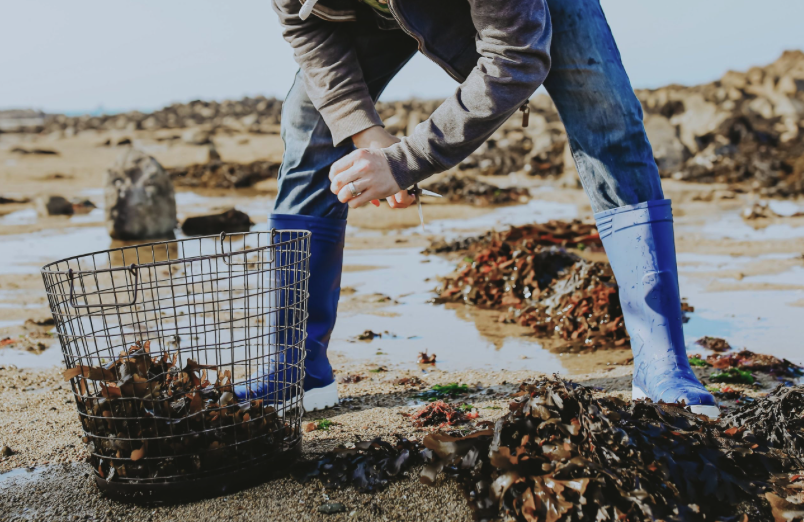
Pictured: Ben Tustin foraging for seaweed (credit Guernsey Seaweed).
Both Ben and Naomi have tasted all the seaweeds that they harvest, use and sell. While none growing locally are likely to be fatally toxic, there are some to be wary of he warned.
“There’re a couple,” he said. “One’s got arsenic in, there’s another one that’s actually quite rare and it’s got sulphuric acid in it. You don’t particularly want to eat them, but to be honest, if you took half a mouthful you’d know immediately.
“So there’re none that will kill you, but only two which will give you a bit of an upset stomach if you eat too much. You’d know about it because basically the rule is, ‘don’t eat a seaweed that tastes bad because it’s not gonna be the best for you’.”
The nicer flavours of the seaweed salt and the mixed seaweed flakes can be used in most meals which is reflected in their sales, while the face cream and serum are among the most popular cosmetic items sold.
The burgeoning seaweed sector has seen six local hotels use the products in their bathrooms, reducing the amount of small plastic bottles being imported in to the island, and off-island sales are growing too said Ben.
The recent Channel 5 programme on the Channel Islands which featured Guernsey Seaweed among other local businesses brought a number of new customers to their website.
“It’s finding that balance to push it forward and to help it grow, while still being small enough to be hands on and involved,” he said. “I don’t think either of us would just want to sit and watch it all happening. We enjoy going to the beach and picking up seaweed and cutting seaweed and making the products and then being on market stores or selling or talking to people about.”
“I used to look at when high tide was to go swimming, but now I just want to know when the low tide is so that we can go and collect seaweed,” added Naomi.

Pictured: Guernsey seaweed was shared with a much wider audience via Channel 5’s TV series.
Regardless of how big the Guernsey Seaweed company grows, the island is still a long way off harvesting vraic at the levels being taken off the beaches two hundred years ago.
“In the last year we probably collected half a tonne in total,” said Naomi.
“In 1824 they took at least 250,000 tonnes off the beach every year…”
With meticulous records, Ben and Naomi keep track of where they’ve harvested and where the seaweed growth is strongest at different times of the year.
“The bays change massively. Port Soif last year was covered in Sargasso, which is an invasive species,” said Ben.
“It’s a major problem worldwide actually and the reason is predominantly that a chemical fertiliser has been dumped into the ocean and the Sargasso basically wants to clean the sea so it soaks it all up. Last year Port Soif was covered in it and when it coats the top of the surface, sunlight and oxygen can’t get down so nothing else grows.”
So far this year there has been no sign of the invasive Sargasso but the Tustins’ will continue keeping records as they go about their harvesting so they can monitor how our seas and shores develop.
