

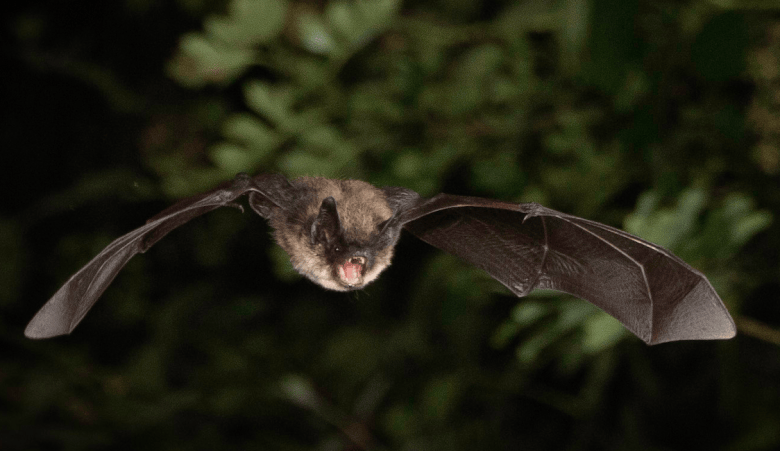
The Bailiwick Bat Survey has finished after four years, and in the process “completely changing the understanding of bats across the Bailiwick of Guernsey”.
In 2020, little was known about the bats within the Bailiwick of Guernsey. To address this, volunteers were given the opportunity to borrow sound recording equipment which were deployed for up to seven nights.
The sound recordings were then uploaded to the British Trust for Ornithology’s (BTO) Acoustic Pipeline for analysis, providing initial results within hours.
Since the start of the Bailiwick Bat Survey in 2021, the citizen science-based approach has helped 420 volunteers to conduct more than 9,000 nights of recording 2,364 different locations , with 16 million triggered sound recordings have been collected.
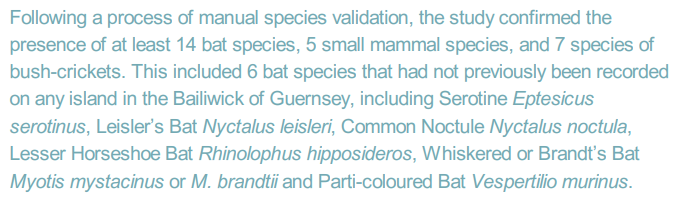
This has resulted in more than four million bat identifications being made, and 14 different bat species have been confirmed to live here in the Bailiwick, including six bat species never previously recorded in the Bailiwick.
The citizen science-based approach, meant over 400 volunteers, many of whom
were new to biological recording used acoustics and machine-learning techniques over four survey seasons, from 2021 to 2024, at 2,364 different locations across
the Bailiwick of Guernsey.
By reserving a bat detector, volunteers were then asked to place the detector in their chosen square (s) for at least four consecutive nights, once between 1 April and 15 July and once between 16 July and 31 October.
In addition to bats, the recordings helped to describe and identify bat social calls and feeding buzzes, providing additional behavioural insights on bats.
The study also found that underground tunnels from the German occupation in WWII were particularly important roosting and hibernation sites for several of the scarcer species of bats in the islands, and were also found to provide sites where swarming occurred in Autumn.
Over its lifespan the Bailiwick Bat Survey has helped Improve Guernsey’s understanding of the status, distribution and timing of occurrence of our bat, bush-cricket and small mammal species.
It’s helped get involve and inspire a large section of the wider community to connect and engage with an aspect of nature that is poorly known and understood.
Plus it’s helped develop a community awareness of what bats do for us, what they require, why it is important to conserve them, and how landowners and householders can enhance their properties for bats.
