

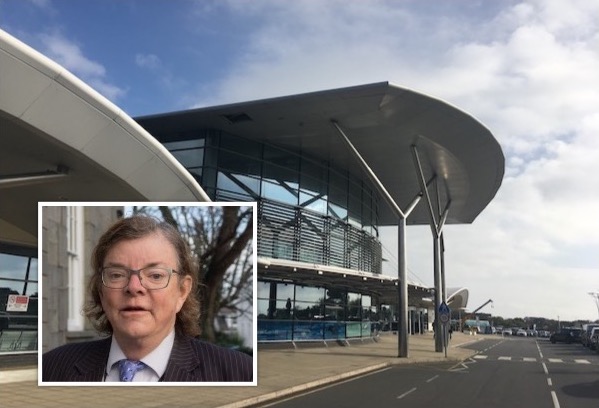
Deputy John Gollop asked some rule 14 questions in the States this week over Aurigny’s decision to drop its Dinard route.
That move from Aurigny has seen the last year-round air link Guernsey has to mainland Europe end. Deputy Charles Parkinson, the President of Economic Development, said the decision was ‘obviously disappointing’.
“People will of course be inconvenienced by this loss, but alternative connections do exist by sea,” he said.
“Last year, 367 visitors came to the island by the route, which was 3% of French visitors, and 952 residents used the route, 5% of people travelling to France. Therefore the impact on tourism will only be modest.”

Pictured: The Dorniers are only used on the Alderney route now the Dinard route has been cut.
Deputy Gollop also questioned whether the decline of the route was down to Aurigny’s fare policy, but Deputy Parkinson said Economic Development was not responsible for financial decisions within Aurigny like this.
“Operators have to make a return on all operations, and it is not for Economic Development to tell them what they can charge,” he said.
Concluding, Deputy Parkinson said it was his committee’s ‘investment objective six’ to develop air links to Europe, and that was being actively investigated and analysed. Currently the States is awaiting the results of an air and sea links review, which is part of this work.
He also said Economic Development also ‘engage regularly’ with UK and European airlines.
“We are currently exploring opportunities to develop new air links to France, and we will continue to do so in the coming weeks and months.”
Aurigny said the following reasons led to its decision to cut the route:
- A lack of demand on the Dinard route in 2018, with under 1,500 bookings, representing a load factor of less than 50%.
- An 80% decline in passenger numbers over the last 10 years.
- A need to focus the Dornier resources on the Alderney operation and service levels required by the Public Service Obligation, should Aurigny be successful in being awarded it.
Pictured top: Deputy Charles Parkinson.
