


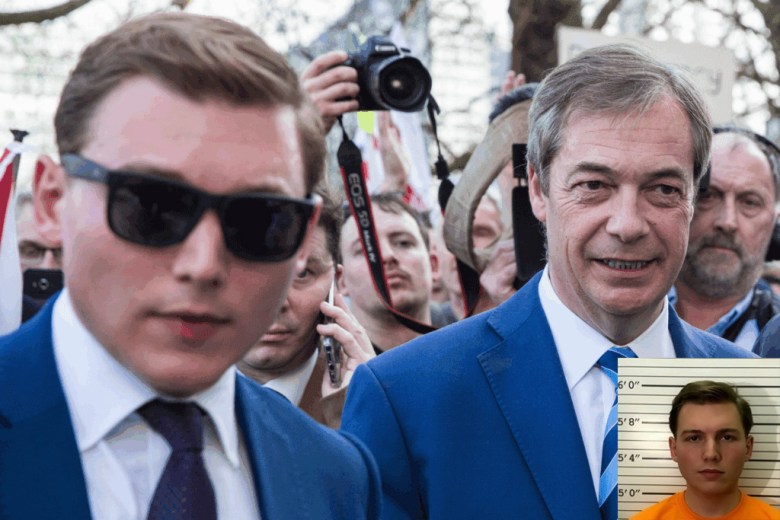
One of Nigel Farage’s closest political allies has become embroiled in a mystery £8.5 million Chelsea property deal involving a Guernsey-registered company.
Convicted fraudster George Swinfen Cottrell – known in Reform UK circles as “Posh George” and a long-time adviser to Mr Farage – became the owner of an £8.5 million Chelsea property transferred from billionaire Nick Candy, Reform’s treasurer.
But Land Registry records show the recorded purchase price was zero.
The unusual transaction has raised questions over how the deal was structured.
The adviser who called Farage “Daddy”
George Swinfen Cottrell (32) is a British financier, political fixer and one of Mr Farage’s longest-standing allies.
Born into an aristocratic family and educated at Malvern College, Cottrell first came to Mr Farage’s attention as a young Brexit campaign volunteer in 2016 after being introduced through his uncle, Lord Hesketh.
Known as “Posh George”, he went on to become a trusted behind-the-scenes operator for Mr Farage, helping with fundraising and political campaigns.
The closeness of their relationship has long attracted attention.
Mr Farage has previously described Cottrell as being “like a son” to him, while former Reform figures have said Cottrell referred to Mr Farage as “Daddy”.

Cottrell’s career has also been marked by controversy.
He was jailed in the United States in 2016 after pleading guilty to wire fraud in a case involving a money-laundering scheme, before later returning to Mr Farage’s circle as an adviser and fundraiser.
Not a gift
Mr Candy has insisted that the Chelsea property was not a gift to Cottrell.
Instead, he says Cottrell became the beneficial owner after acquiring shares in the Guernsey-registered company that previously held the property.
Mr Candy has also said Cottrell settled a loan owed by the company to the Candy group.
However, documents relating to the ownership structure appear to raise further questions, as the company is no longer listed as the property owner.
The result is that Cottrell now owns the Guernsey company connected to the transaction – while the value of the deal remains undisclosed.
Why Cottrell is back in the spotlight
Cottrell’s name has recently returned to public attention amid questions over Nigel Farage’s declarations as an MP.
Allegations have been made that Mr Farage failed to register support provided by Cottrell in the run-up to the 2024 general election.
Reports have claimed that Cottrell helped fund elements of Mr Farage’s political operation, including back-office support, staffing, security, transport and accommodation.
The Times has also reported that Mr Farage has stayed at a London property rented by Cottrell since entering Parliament.
Cottrell’s legal representatives said the arrangement reflected a personal friendship, with the property made available because of the pair’s close relationship.

Under parliamentary rules, MPs must register financial benefits or support where it could reasonably be viewed as influencing their actions or words, with the aim of ensuring transparency in public life.
The scrutiny comes in the wake of wider questions over the money and wealthy networks surrounding Mr Farage’s return to frontline politics.
Reports of a £5 million personal gift from crypto billionaire Christopher Harborne have prompted debate over how such funds are used.
Mr Farage originally claimed the money was for security, while later saying he could spend the money how he chose, even if that was on “a Ferrari”.
At the centre of the story is a politically connected adviser, an eight-figure London property, an offshore Guernsey structure – and a transaction whose true value remains hidden.
