


Next Saturday a special military ceremony and church service will be held to consecrate a new replica set of the Regimental colours of the Royal Guernsey Light Infantry.
The colours are a brand new set that has been made by the same firm that produces standards for the British Army. The ceremony to consecrate them will take place on Saturday 29 November at the Town Church, which is the Regimental Chapel of the RGLI.
The ceremony involves a blessing by the clergy, and a formal acceptance on behalf of the reigning monarch, which will be performed by His Excellency, the Lieutenant Governor.
In an ancient tradition, Lieutenant General Sir Richard Cripwell KBE, CBE will grasp the bottom of the colours, accepting them on behalf of the Sovereign. This signifies they are the Sovereign’s colours, consecrated by the clergy and accepted by the Crown.
Following the church service, there will be a ‘Trooping of the Colour’ in Church Square.
This involves parading the new colours before the assembled troops, so that every person can see them—a tradition dating back centuries to ensure soldiers knew where to rally on a battlefield.
Representatives from the Princess of Wales Royal Regiment, the army infantry regiment twinned with Guernsey, will take part. The public is invited to attend the service and the subsequent parade.
This event is described as extraordinary because it is unusual to conduct a consecration for a regiment that no longer exists, said Chris Oliver, a founder of the RGLI Charitable Trust.
“There is a massive amount of history, culture, and ancient tradition in the establishment of the replacement colours. It’s extraordinary, and unusual, to do this for a dead regiment, and you could say that Guernsey or Jersey are one of the two places that you could possibly do this.”
Mr Oliver confirmed that anyone with ancestors who served in the RGLI, and still has their medals in their family’s possession, can wear them during Remembrance, even if you’ve never served.
“If you are a member of the family and your relatives served in the RGLI, you may just have their medals, and if you do have then it is absolutely appropriate to wear those medals on the left hand side of your chest, even if you’ve never served yourself,” Mr Oliver said.
“That’s very much a military tradition, those people going out on Remembrance day services, is that they would bring their relatives medals, and they would wear them.
“So this really is a time to bring your relatives medals and bring those back to life.”

The new colours will allow the RGLI to have a much bigger presence during memorials, now being able to travel to the other islands in the Bailiwick, who made up the regiment.
Mr Oliver said: “The RGLI colors will become one of the standards that goes on parade, and we will have brought it back into Remembrance every single time we go out and do a memorial, a remembrance activity, that the RGLI presence is part of that.
“For us in the trust, we also have the ambition, we’re going to take them to Sark for a Remembrance service there. We’re going to take them to Alderney, because Sark and Alderney men also fought and fell.”
The RGLI – punching up even when pinned down
Next Saturday’s ceremony will remember and honour the men of the Royal Guernsey Light Infantry, particularly those who served and died in the First World War.
The Regiment was formed in 1917, during the latter half of the war, after many Guernsey men had already volunteered to fight in the French Army or other British units, like the Royal Irish Regiment.
The RGLI was a Pals Battalion (a unit of men from the same locality), established to ensure Guernsey was seen to be playing its part in the war, explained Major Marco Ciotti LVO, The Secretary and Aide-de-Camp to the Lieutenant Governor.
“It wasn’t a long-lived regiment. It was only in the latter part of the second half of the First World War that it existed. But It does have a very distinguished history.
“The Bailiwick actually had already made a big contribution to the First World War, sort of disproportionately, I think, for the size of the place it contributed.
“They went off to the Western Front, and fought to the end of the war. They fought some very distinguished actions and big battles that people will know. They fought at Ypres, Passchendaele. They fought at Cambrai, which of course, featured the battle at Masnières, which is now twinned with Guernsey.
“After the battle of Cambrai, they had taken a lot of losses, and the battalion was reinforced and topped up by members of the Staffordshire regiment. So by this stage, it was quite a mix.”
Major Ciotti also explained how the RGLI was involved in stopping the last ditch effort by German forces to break through to the Channel.
“The Germans effectively had one last roll of the dice where they tried to break through the Western Front and get to the Channel to split the front.The RGLI found itself as one of the reinforcement units that was deployed to stop this huge assault by the Germans.
“They found themselves fighting with their backs to a railway embankment, and fought very, very bravely and this assault was stopped, but they took such heavy losses that they were not really combat effective again.”
Despite their depleted numbers, the members of the RGLI had ensured their place and presence were etched into the history books, with a famous photo providing a poignant reminder of their grit, determination, and sacrifice.
“They went down to less than a company of officers and men, but they were actually assigned as General Haig’s guard,” said Major Ciotti. “There’s a famous picture which people might be familiar with from when King George visited.
“The RGLI are the guard of honor with General Haig and the King walking past them, which is an iconic photograph.”
Because of these historic battles, the Bailiwick suffered disproportionately high losses for its size during WW1. This had a long-lasting impact on the island’s demographics and families for generations said Major Ciotti.
“If you look at the demographics, they took a big hit compared to many parts of the UK, and they didn’t start coming back up to recognisable levels until the late 30s, which, of course, is when Guernsey was invaded. That the legacy of what happened, it lived on for years and years.”
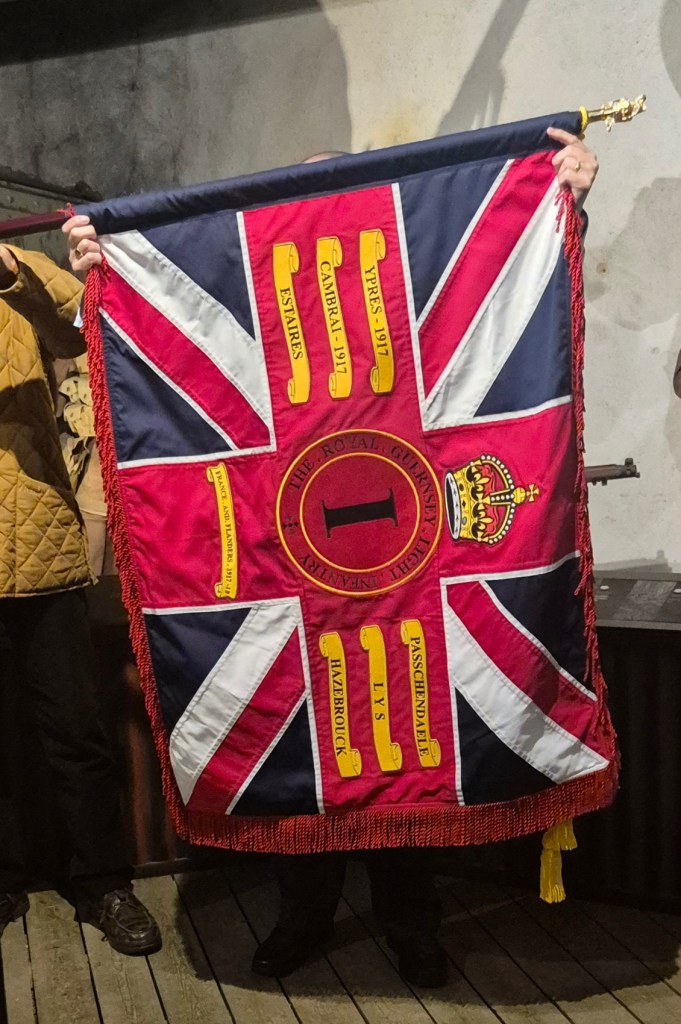
The new colours mean the RGLI Standard will now be part of every future remembrance parade and activity, alongside other Standards.
This ensures the regiment’s contribution and sacrifice are actively and visibly remembered in perpetuity, rather than being confined to museums and memorials.
The consecration service for the Royal Guernsey Light Infantry Regimental Colours will take place on Saturday, 29 November, at 11:00, at the Town Church.
Ken Acott is the Junior Constable of St Peter Port, whose parish is twinned with Masnières, a place close to the hearts of those committed to preserving the memory of the RGLI.
He said the parish hasn’t made enough out of its links with the French town, but with the new colours able to travel, that could all change.
“Oh, it’s absolutely, absolutely incredible. The guys, Chris and all his team, are doing amazing work bringing back the memory of the Royal Guernsey Light Infantry, who fought an incredible battle in Masnières.
“We haven’t made the most of that relationship over the past few years, and we’re determined to grow and strengthen that relationship between the two towns.”
Mr Acott hopes more people will recognise the impact the losses of the RGLI had on the island and their impact on the outcome of the First World War.
“What these guys did, the effect it had on the island, was just tragic, and really was a massive impact.”
