

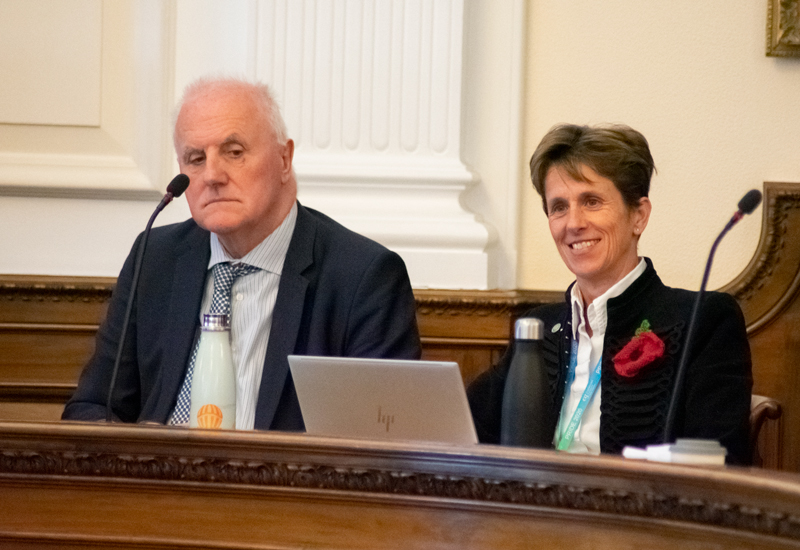
Deputy Soulsby said:
“In the summer, this Assembly – a new government – agreed our Government Work Plan, a single, focused and integrated plan.
It is designed to invest in islanders, our island, and our future, and represents a new way of thinking and a new way of working.
In shaping it, we asked ourselves: Where do we want the island to be in four years’ time? And how do we get there with limited resources and in the context of covid and Brexit?
That resulted in a Plan focusing resources on our immediate needs while positioning us for a thriving, sustainable future. It acts on what islanders need to flourish and prosper. It also invests in the island that sustains us – regenerating its economy; improving its connectivity; and protecting its environment.
That’s a lot for a Plan to achieve when financial and human resources are stretched. But we have done it through
• de-prioritising some activities established by past resolutions;
• working out a phased timeline and resourcing for actions put forward by committees; and
• critically, considering the interdependencies among strategies and actions to maximise efficiency and effectiveness.
That is thinking differently.
And we agreed to deliver:
• by making in principle decisions where to invest time, people and money;
• by clearly directing committees on their core work to develop and implement policies to achieve the outcomes we had agreed; and
• by empowering the Policy & Resources Committee to release funding we agreed in principle through delegated authority.
That is working differently.
Now, we promised the electorate that we would hold ourselves to account on progress within six months, but, as a government of action, we are starting seven weeks early and providing an update now because there is lots to say.
Let’s lift spirits and celebrate success in progressing our critical recovery actions.
This Assembly acted quickly to resource digital infrastructure. The first fibre connections to homes under this infrastructure investment programme are already complete. With a five-year implementation plan, it was essential this decision was made swiftly.
We have, through a cross-committee group negotiated the purchase of Kenilworth Vinery drawing on the delegated authority of the Policy & Resources Committee to progress quickly so plans can be submitted soon, building the first homes by summer 2023. Attention is now turning to other initiatives that are, in the main, policy levers and, all going well, implementation should be anticipated towards the start of quarter three next year, subject to any legislative requirements.
We have, through the Committee for the Environment & Infrastructure, started planning for the implementation of the General Housing Law we recently passed and today we will consider proposals from the Development & Planning Authority regarding redundant hotels and permitting alternative use of office space for housing.
This improvement and regeneration theme is reflected in the frameworks completed by the Development & Planning Authority, necessary before commencing the seafront master plan. A draft policy letter will be finalised this month so that the Assembly can debate how to take this forward in 2022.
Regeneration provides opportunity to do things differently.
We are all too aware that children have been disproportionally impacted by covid-19 and progress in education is now essential.
The difficult decisions in a very long-running story have been made on the reorganisation of education to deliver and improve non-selective secondary education and post-16 provision. Transformation can now be led by the Committee for Education, Sport & Culture with £6.25m being provided to fast track initial work that is needed.
Health recovery is another critical response to our wellbeing as we navigate living responsibly with covid-19 and is something this Assembly cares a lot about. The Committee for Health & Social Care recently announced additional wellbeing support over the festive season for individuals experiencing low to moderate stress, distress and isolation, recognising that it can be a difficult time of year, even without the relentless covid headlines. This will support the envisioned partnership approach with the third sector to provide out of hours drop-in crisis support on a pilot basis, which the Committee has already agreed in principle.
Our human capital – the knowledge, skills and health of our people – is critical to our future wellbeing. We need to invest wisely to remain an attractive and competitive place to live and work and with which to do business. It starts with statutory education provision but needs to be lifelong for the challenges ahead.
To help us do that, a Human Capital Development Plan will be published jointly by the Committees for Education, Sport & Culture and Economic Development in mid-2022 with work underway to establish data on skills gaps to enable the States to consider evidence-led proposals. A pilot to improve adult literacy and numeracy has also been commissioned.
Investment in human capital starts with how well we look after our island’s children. The Government Work Plan supports vulnerable children through revising the Children Law in alignment with the recently extended United Nations Convention on the Rights of the Child.
The newly-established cross-committee group is taking forward amendments to the Children Law and reducing delays in determining positive outcomes for children and young people.
Another key priority for this Assembly was tourism. The 2022 campaign is advancing well and the Committee for Economic Development is progressing its longer-term Tourism Strategy together with a cross-industry tourism recovery taskforce. It will ask for the Assembly’s support in delivering cross-committee initiatives to improve the island as a destination, essential investment in an economic enabler with impact broader than its Gross Domestic Product contribution.
Something else that will support the islands’ tourism offering is the seafront enhancement and earlier this year members provided direction on the regeneration of our ports. The work to support that is being led by the Policy & Resources Committee seafront enhancement area sub-committee and the States’ Trading Supervisory Board and, as already mentioned, members can decide in quarter one of next year their approach to managing this significant investment
The Committee for Economic Development has finalised a report on a runway extension and the airport is developing a land use and infrastructure master plan. These will be co-ordinated through the review group established within the air policy framework agreed just recently by the States.
Working with the Committee for Economic Development, the Policy & Resources Committee has confirmed funding for the finance sector promotion plan through to 2024. This economic engine now will rely on the wider interdependencies of our policy and investment decisions across education, skills, health, population management and housing to encourage productivity and growth.
Work is on track to determine what the island’s future population policy must deliver to meet social and economic needs. Given today’s pressing economic challenges, it will also establish what can be done under the existing law to help the situation in the short- to medium-term.
This Plan is indeed laying the foundations to deliver our vision of where we want to be by the end of this political term. The Plan also remedies the previous trend of underinvestment in island infrastructure.
We must now complete what we have started against a backdrop of having to deal with covid, whether we like it or not. Addressing the pandemic remains non-negotiable, as is navigating Brexit’s impact.
We have come a long way, working together to make real change happen.
Now is the time to take a ‘New Year’s Resolution’ approach. To refresh the Plan and to make it more meaningful to our community. To consider the global movements – including climate change – that are changing our relationship with the economy from a Gross Domestic Product focus to a more sustainable approach.
It’s one thing having a vision. It’s far harder making positive change real.
We’ve done so much in such a short space of time, but we can do more.
The Government Work Plan has already made a difference but we need to refine and develop it, focusing even more on what matters most to Islanders.
The Government Work Plan we have now is just the start. If we continue as we have done, we can really make a positive difference to our islands and our islanders in a way those before us have not been able to do.”
