
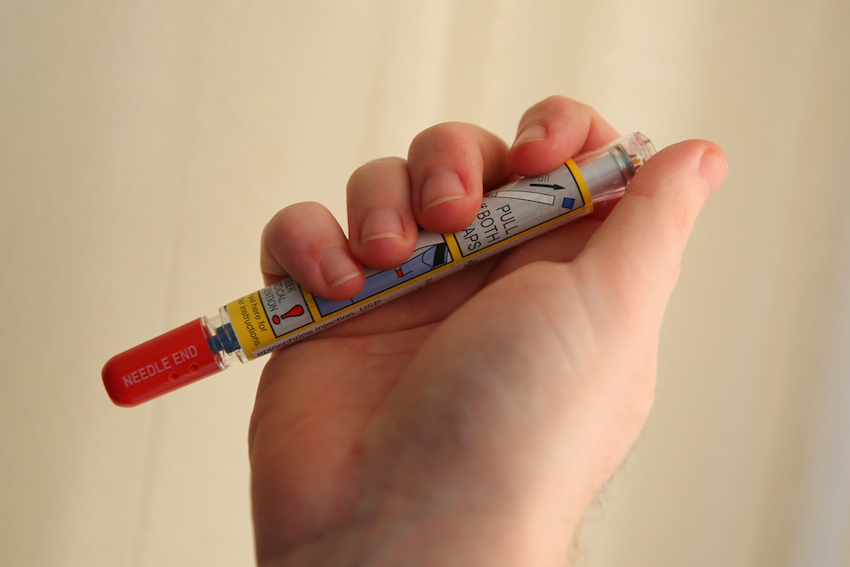

Jersey schools will now be allowed to buy, store and administer spare EpiPens under new legislation that brings the island in line with the UK.
The law change, which came into force on 20 October, permits trained school staff to use the devices in emergencies on pupils known to be at risk of anaphylaxis.
The update also allows schools to purchase adrenaline auto-injectors – more commonly known as EpiPens – directly.
The move has been welcomed by allergy campaigners, who have long called for Jersey to follow the UK’s example, where similar legislation was introduced in 2017.

Jersey Food Allergy Group founder Dominic Jones said parents of children with food allergies would be “delighted” by the law change.
“Up to 3% of children in Jersey schools are at risk of food-induced anaphylaxis, with UK data indicating most experience a reaction every two to three years,” he explained.
“The recent change to local legislation will allow schools to hold generic adrenaline pens in key areas around the school and when on outside trips, enabling teachers and caregivers to respond quickly to anaphylaxis, which can save a child’s life.”
He added that it is critical adrenaline is given quickly and that “children should not be rushed to the location of the pens, as exercise can make an anaphylactic reaction worse.”
“I hope that cost will not be a barrier”
Mr Jones referenced a recent study which highlighted that while UK schools have had the legal right to house spare EpiPens since 2017, many had not obtained spare devices due to the cost – sometimes up to £100 per injector.
“I hope that cost will not be a barrier to schools in Jersey and that schools will quickly be able to receive the pens, and importantly ensure all teachers and staff are provided with annual adrenaline pen training,” he said.
Currently, children at risk of anaphylaxis are typically prescribed four adrenaline pens – two for home and two for school.
Mr Jones said that if schools were provided with spare devices, overall prescription costs could be reduced.
“Children could simply have the recommended two pens prescribed and rely on school pens when at school,” he explained.
He said the change would be particularly important for younger children, as “pens are usually kept stored away in one location at school”, while older pupils are expected to carry their own.
However, he noted: “As pens can often be mislaid by children, it is important secondary schools have spare adrenaline pens as well.”
“Adrenaline pens are the defibrillators for allergy”
Mr Jones also urged the government to consider extending the law to allow other workplaces – such as theatres, hospitality venues, retail outlets and transport hubs – to hold spare adrenaline pens, as is done in the UK.
Mr Jones added that a new UK-approved device, Neffy, an adrenaline nasal spray, could offer a convenient alternative for some allergy sufferers and hoped it would soon become available in Jersey.
“Whilst not suitable for everyone, they provide a more convenient, smaller device to carry around and can help overcome the ‘needle hesitancy’ some people experience,” he explained.
Mr Jones encouraged wider awareness and training, adding: “Adrenaline pens are the defibrillators for allergy and should be available alongside every defibrillator and easily accessible in all educational establishments and other appropriate public places.”
UK schoolboy’s cheese allergy death
The UK changed the law in October 2017 to allow all schools to buy spare adrenaline auto-injectors for use on children with serious allergies in emergencies.
That change followed the death of 13-year-old dairy allergy sufferer Karanbir Cheema, who died after having a severe reaction at his school in London when another student flicked a piece of cheese at him, triggering his allergy.
His own EpiPen was out of date and did not work when it was administered.
Since then, campaigners have called for it to be made mandatory for schools to carry spares and have this extended to other places such as restaurants.
But until last month, parents of children in Jersey with allergies needed to supply an EpiPen which could only be used for the named child.
