

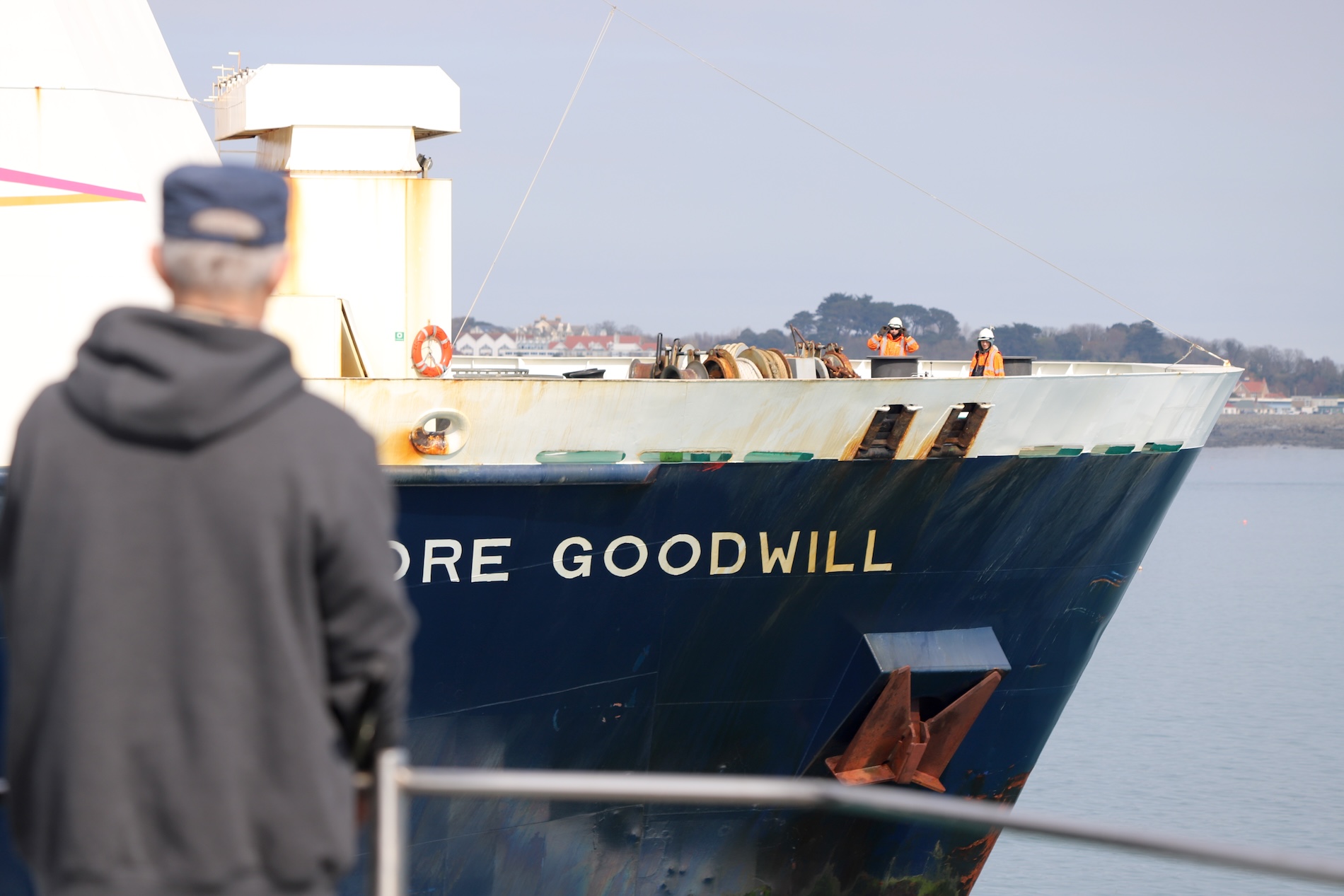
Manual controls, rather than auto-pilot, should have been used ahead of the fatal collision between a freight ship and a fishing trawler, a court has heard.
Second officer Lewis Carr, who was in charge on the bridge of the Commodore Goodwill at the time it collided with fishing trawler L’Ecume II, accepted a Royal Court judge’s query about whether or not autopilot was the best way of manoeuvring a vessel at close quarters.
Mr Carr (30) and his colleague Artur Sevash-Zade (35) each deny three charges of manslaughter in relation to the incident in December 2022, which resulted in the deaths of L’Ecume II’s three crew members – captain Michael Michieli, Larry Simyunn and Jervis Baligat.
During the closing stages of his evidence, Mr Carr was questioned by Commissioner Sir John Saunders, presiding.
“Should you have made sure to be on manual?” Sir John asked. Mr Carr replied: “yes”.
Asked whether a switch to manual could have made a difference to what happened, Mr Carr said: “It’s hard to say with any certainty.”
Advocate Matthew Maletroit, prosecuting, asked whether Mr Carr could have taken action sooner as it became apparent that the two vessels were headed towards each other.
Mr Carr agreed that action could have been taken sooner, “with the benefit of hindsight”, but added that he believed he had complied with international regulations designed to prevent collisions.
Mr Maletroit challenged the second officer on this matter, saying that the rule covering action to avoid a collision stipulated that such action should be “positive, taken in ample time and through the use of good seamanship”.
Mr Carr said that he believed a 20-degree alteration of Goodwill’s course to starboard had been a sufficiently “big” move and that the matter of timing was a “grey area”.
The two vessels would have passed each other at “close quarters” without colliding, Mr Carr asserted, if the crew of L’Ecume had not steered the trawler to port, a move which left it on a collision course.
Asked about his failure to activate a “man overboard” alarm after the collision, Mr Carr said Goodwill crew members were already mustering after hearing earlier blasts on the ship’s horn.
The court heard that Condor’s rules required its vessels to remain at least one nautical mile away from other ships in order to mitigate risk.
Mr Maletroit asked Mr Carr if he had failed to comply with this rule, however the Condor employee said this was not always possible, particularly in coastal waters.
It was also stated by Mr Maletroit that at the time of a routine call made by Mr Carr to Jersey’s Coastguard to confirm the Goodwill’s approach to St Helier, the ship’s radar had shown a flashing red warning about the potential for a collision with L’Ecume.
Evasive action could have been taken at that stage, the prosecuting lawyer said, but instead Mr Carr had “allowed Goodwill to steam ahead into a potentially risky situation”.
The jury trial – now at the mid-point of its third week – is scheduled to last four weeks.
READ MORE…
The L’Ecume II trial

WATCH: Condor seaman jailed for 20 months for L’Ecume II collision
The seaman who was in charge of a Condor freight ship when it hit a fishing trawler off the coast of Jersey in December 2022,…
WATCH: Condor seaman jailed for 20 months for L’Ecume II collision
The seaman who was in charge of a Condor freight ship when it hit a fishing trawler in December 2022, killing its three crew members,…
Condor crew member’s sentencing underway
The sentencing of the seaman who was in charge of a Condor freight ship when it hit a fishing trawler in December 2022, killing its…
PODCAST: Inside the investigation… The last voyage of L’Ecume II
On the morning of 8 December 2022, the Jersey fishing boat L’Ecume II set out to sea with three men on board. Just after 5.30am,…
Something went wrong. Please refresh the page and/or try again.
