
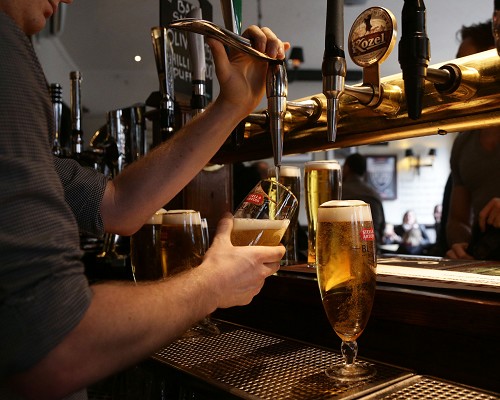

Alcohol duty should be completely abolished for on-trade sales to reduce the incentive to pre-drink and bring islanders back to pubs, the head of the hospitality industry body has said.
Jersey Hospitality Association co-chief executive Marcus Calvani was responding to government plans to introduce ‘tap relief’ – a lower rate of duty on beer, cider, wine and ready-to-drink cocktails sold from large containers in pubs, restaurants and hotels.
Published this week, the government’s draft Budget states that the tap relief would be at a standard rate of 10% of duty charged on products dispensed from containers of ten litres or more, and 15% on products below 4.9% alcohol by volume “to incentivise responsible consumption”.

“Tap relief is an administratively simple approach used in other jurisdictions to benefit both businesses and consumers,” it added.
Elsewhere, alcohol duty would be raised “in line with RPI growth” at 2.6% following freezes in 2021, 2023 and 2025.
“Barely noticeable for consumers”
Mr Calvani said that the move “seems like good news” but added that “once the numbers are run, the reality is somewhat different”.
“The impact at the bar is tiny, barely noticeable for consumers and little consolation for operators facing spiralling costs from every angle,” he said.
“If you take a standard 30-litre keg of 4.6% beer at a trade price of £180. Without relief, the duty bill in 2026 will be £22.72. With the 15% discount, that falls to £19.31 – a saving of just £3.41 on the whole keg, or 6.4p per pint.
“Even when passed through at typical pub margins, that means about 22p off a £6.50 pint at the very best. For a stronger 5.2% beer, the saving is slightly better, around 28p off.
“Either way, the consumer would see a pint drop from £6.50 to around £6.20–£6.30, but that’s only if there weren’t increases in shipping, utilities, wages and other costs.”
A “gesture, not a game-changer”
Mr Calvani explained that these “hidden costs” make the difference in margin for a venue to break even or make a profit.
“Unfortunately, they cannot simply be absorbed, or the venue would go bust,” he said.
“Even with this small tinkering in the cost chain, prices paid at the bar will go up and it’s the venues that get blamed for being too expensive.”
The Jersey Hospitality Association co-chief executive explained that tap relief is a “gesture, not a game-changer”.
If government truly wishes to change behaviour, support its visitor economy and stimulate growth, the answer is clear: separate alcohol duty for the on-trade and off-trade, and abolish duty altogether for on-trade sales
Jersey Hospitality Association co-chief executive Marcus Calvani
Mr Calvani said that the “gulf between the price of a pint in a pub and a can in a supermarket remains enormous”.
He added: “This is why people ‘preload’ at home, why binge drinking thrives in unregulated environments and why our venues – the safest, most supervised places to enjoy alcohol – continue to struggle.”
The co-chief executive said that the Jersey Hospitality Association has “little hope that this form of modest duty relief, though welcome, will make any meaningful dent in consumer behaviour”.
“It will not bring people back into the pubs, nor will it rebalance the on-trade and off-trade divide that drives damaging social outcomes,” he said.
“Drinking moves back into supervised, vibrant venues”
Mr Calvani called for the alcohol duty to be removed from the on-trade entirely.
He said: “If government truly wishes to change behaviour, support its visitor economy and stimulate growth, the answer is clear: separate alcohol duty for the on-trade and off-trade, and abolish duty altogether for on-trade sales.”
He pointed to modelling which shows that a 4.6% pint could fall by around £1.20 to just over £5, and a 5.2% pint could drop by nearly £2.40.
“Suddenly, the price gap between pub and shop shrinks from three times to less than two,” he said.
“For many islanders, the incentive to preload disappears. Drinking moves back into supervised, vibrant venues.”
“A lively visitor economy”
Mr Calvani also highlighted the “wider economic impacts” of removing alcohol duty from on-trade sales.
“A thriving hospitality industry generates more than just ringing bar tills,” he said.
“Every extra pint sold in a pub creates jobs, supports supply chains and injects energy into our social fabric.
“Government also wins: the reduction in duty take would be offset by a higher GST yield on greater sales, more income tax and social security from increased employment and the secondary spend that comes from a lively visitor economy.”
