


Belfast-based Artemis Technologies is leading a consortium of businesses designing a battery-operated ship which will fly above the water using an innovative foil system.
Condor Ferries is the operational partner and will help develop the technology for commercial use.
Recently, the UK government allocated £60m to help fund low-carbon maritime transport projects, 10% of which it gave to Artemis.
This will be shared among two projects: the high-speed ship and a 12m electric vessel designed to transfer crew to and from offshore wind turbines.
The allocation was the third round of the UK Government’s Clean Maritime Demonstration Competition, an initiative to help decarbonise the British merchant fleet.
19 projects received funding in the latest round.
Dr Iain Percy OBE, Chief Executive Officer at Artemis Technologies, said: “The global fight against climate change is one we are all united in, but if the UK Government is to play its part and achieve its ambitious target of reaching net zero emissions by 2050, it needs to unearth and quickly adopt disruptive technologies within the maritime sector.”
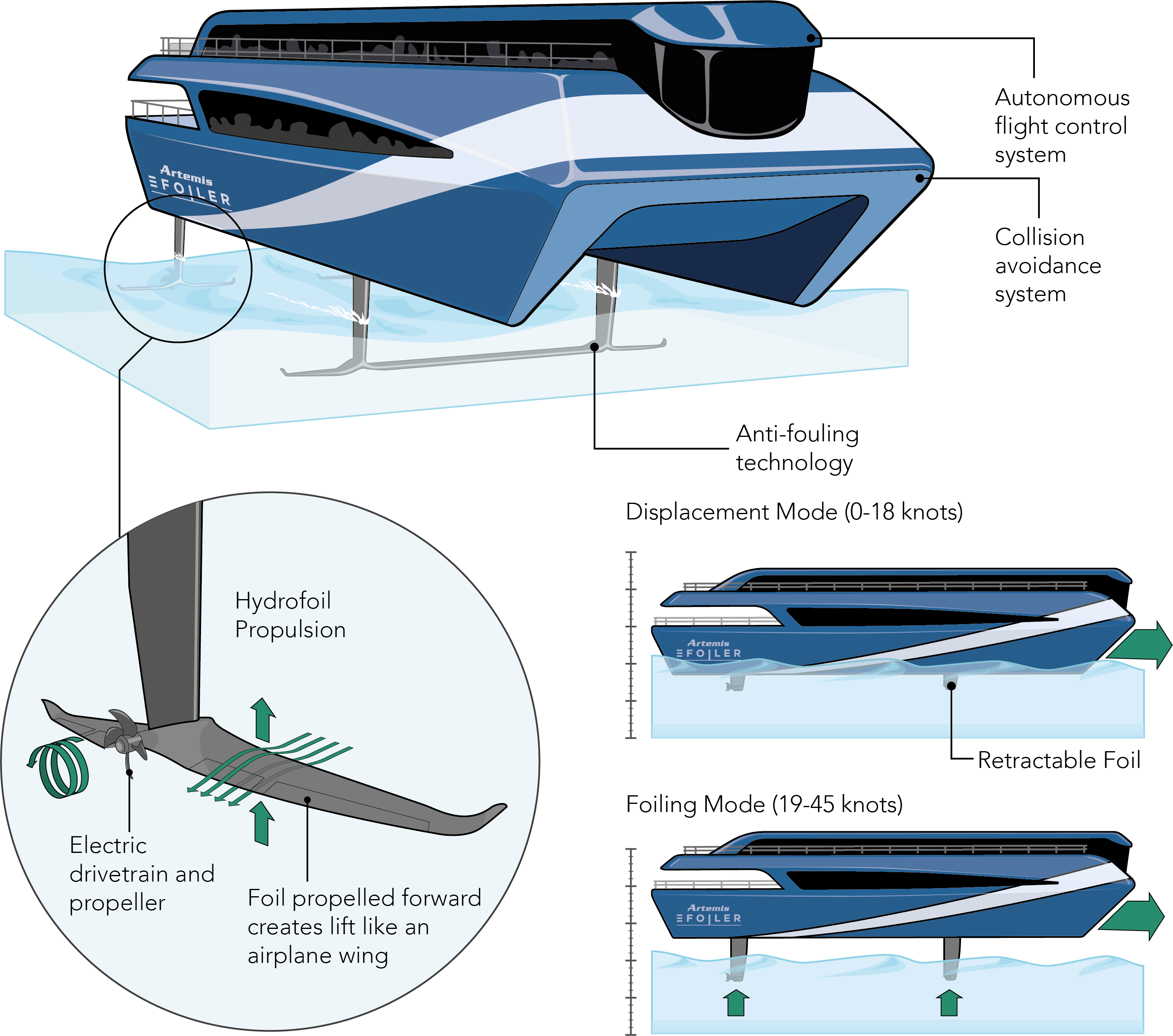
Pictured: How the revolutionary ‘eFoiler’ system will work.
Although foils are not part of its current fleet, Condor was a pioneer of hydrofoil technology; indeed, its first ship in 1964, Condor 1, was a hydrofoil.
Only in 1979 did the company introduce its first catamaran, Condor 6. Its last hydrofoil was Condor 7, launched in 1985 and retired in 1994.
Artemis is aiming to run a pilot service in 2024 which would see Condor operate a commuter passenger route between Belfast’s Titanic Quarter and Bangor Marina.
The anticipated journey time would be 30 minutes, providing a greener solution to commuters along one of the busiest traffic routes in Northern Ireland.
