

Backbench politicians want more time to scrutinise the savings plans – but for the first time this year, savings are being considered at the same time as spending, leading to concerns that the civil service could grind to a halt if the Government Plan is delayed beyond the new year.
It follows the Chief Minister Senator John Le Fondré suggesting that staff ‘won’t be paid’ if Scrutiny manage to push the savings plan back into 2020, rather than debating it at the end of this month as planned.
His comments came in a recent Scrutiny hearing with the Government Plan Review Panel and were supported by the Treasurer of the States Richard Bell who explained that the Public Finances (Jersey) Law doesn’t technically include a safeguard for the first Government Plan if it’s not approved by the date it’s supposed to take effect.

Pictured: The Chief Minister has suggested that pay slips won’t get signed if the Government Plan is delayed into 2020.
This issue was highlighted in Scrutiny’s Review of the Government Plan when elaborating on their finding that they needed “greater cooperation from Government” to allow for “a smoother scrutiny process.”
The report states: “The length of time required for proper scrutiny of the plan, combined with the proximity of the debate to the end of the session (it is due for debate on 26 November, the second-last sitting of 2019), does not allow enough time for the Assembly to properly consider the plan, associated proposition, and amendments without feeling undue pressure to approve it.
“This is compounded by the uncertainty around what may happen should the plan not be approved.”
This “uncertainty” hinges on the wording of the Public Finances (Jersey) Law – which the Scrutiny report proceeds to quote from.
Framed as a “supplementary power” within the law, this article allows for the running of Government to be paid for on a monthly basis by taking a twelfth of the annual budget “set out in the most recently approved government plan.”
With this being Jersey’s very first Government Plan – having moved over from the Medium Term Financial Plan (MTFP) format for 2020 – there is no “most recently approved government plan” to draw these monthly running costs from.
When pushed by Express, the Government released a statement this morning declining to comment on a “hypothetical” scenario, and saying in any case, the plans would be passed by States Members:
“The Government Plan was lodged in July, and States Members and Scrutiny will have had 18 weeks to raise issues and propose amendments before the debate takes place on 26 November. Given that the Government Plan is focused on the strategic priorities agreed unanimously by the States Assembly in December 2018, that it is carefully balanced to ensure that we don’t spend more than our revenues, we don’t anticipate that the Plan would not be passed.
“The Government won’t speculate on a hypothetical scenario.”
With just over two weeks to go until the key debate where the spending and saving ambitions for the next four years hang in the balance, the plans have already garnered several amendments from scrutineers and backbenchers alike.
Alongside their report, the Scrutiny Panels have put forward the following changes:
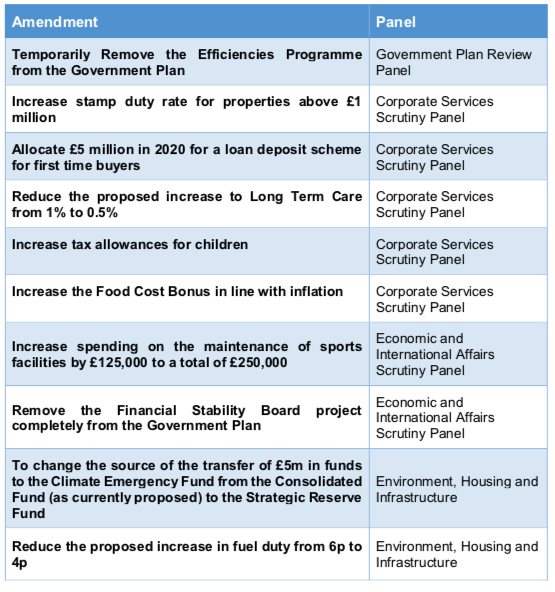
Pictured: The amendments put forward by the various Scrutiny Panels reviewing the Government Plan.
A number of other politicians have also submitted their suggested changes to the Government Plan.
These include bids from Deputy Rob Ward who proposes that the removal of GST from certain “climate-positive goods” should be incorporated into the plan and Deputy Geoff Southern who is seeking £0.9million to reduce fees for GP consultations for certain groups of islanders.
