


Islanders are finally feeling some relief from soaring prices, in part thanks to fluctuations in mortgage rates – but trips away, cigarettes and energy bills may still be burning a hole in some people’s wallets.
The island’s latest inflation stats show that, during the 12 months to this March, the Retail Prices Index (RPI) for Jersey increased by 2.3%, down from the inflation figure of 2.5% reported in December.
The decrease in housing costs once again made the most notable contribution to the overall drop, but price increases across most groups were also similar to or less than those seen over the 12 months to December.
Leisure services, which includes entertainment, sport and leisure fees, and off-island holidays, made the largest contribution to the annual rate of inflation.

Inflation rose to double digits for the first time in three decades in September 2022. Since then, it has fallen steadily, and the current rate is around 3.4% lower than it was this time last year.
The latest Retail Price Index (RPI) report, released this morning by Statistics Jersey, shows that costs are still rising – but at a much slower rate than during the peak periods of recent years.
The latest stats at a glance…
Going up
Tobacco ↑ 8.2%
Fuel and light ↑ 6.8%
Leisure services (includes TV licence, TV subscriptions, entertainments, sports and leisure fees, and foreign and UK holidays) ↑ 6.8%
Fares and other travel ↑ 3.7%
Household services ↑ 3.1%
Food ↑ 3.0%
Motoring ↑ 3.4%
Personal goods and services ↑ 1.5%
Catering ↑ 4.6%
Alcoholic drinks ↑ 1.2%
Clothing and footwear ↑ 0.9%
Going down
Household goods (includes furniture, soft furnishings, electrical appliances, kitchen and dining ware, cleaning products and pet care items)↓ 0.9%
Housing ↓ 0.6%
Leisure goods (includes toys, books, papers and magazines and gardening products) ↓ 1.4%
What contributed most to the change?
Leisure service costs continue to rise – up 6.8% over the year – and made the largest contribution to the overall RPI increase (+0.6 percentage points).
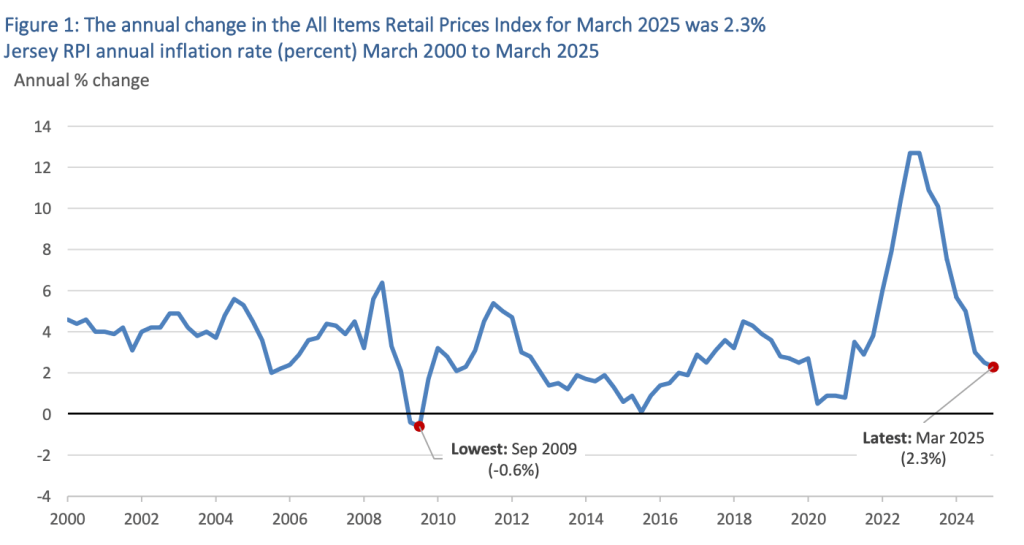
However, housing costs, which had previously been a key driver of high inflation, decreased by 0.6% over the year, compared to a 0.5% increase to December 2024. This change contributed -0.2 percentage points to the overall RPI change, largely due to easing mortgage interest rates.
Fuel and light costs also rose significantly (up 6.8%), contributing +0.3 points to the inflation rate.
Impôt duties, which rose in January, also made a small upward contribution (+0.1 points).
Impact on vulnerable islanders
The report also looks at how inflation is affecting vulnerable islanders, such as pensioners and those on low incomes.
Over the 12 months to March 2025:
- RPI Pensioners increased by 3.3%, up from 3.0% in December.
- RPI Low Income increased by 3.4%, unchanged from the previous quarter.
How do we compare to the UK?
According to the report, Jersey’s RPI was 1.1 percentage points lower than the UK’s comparable measure, CPIH.
- Jersey RPI: 2.3%
- UK CPIH: 3.4%

It marks a reversal from the previous years when Jersey often recorded higher inflation rates than the UK.
Read the full report here.
