

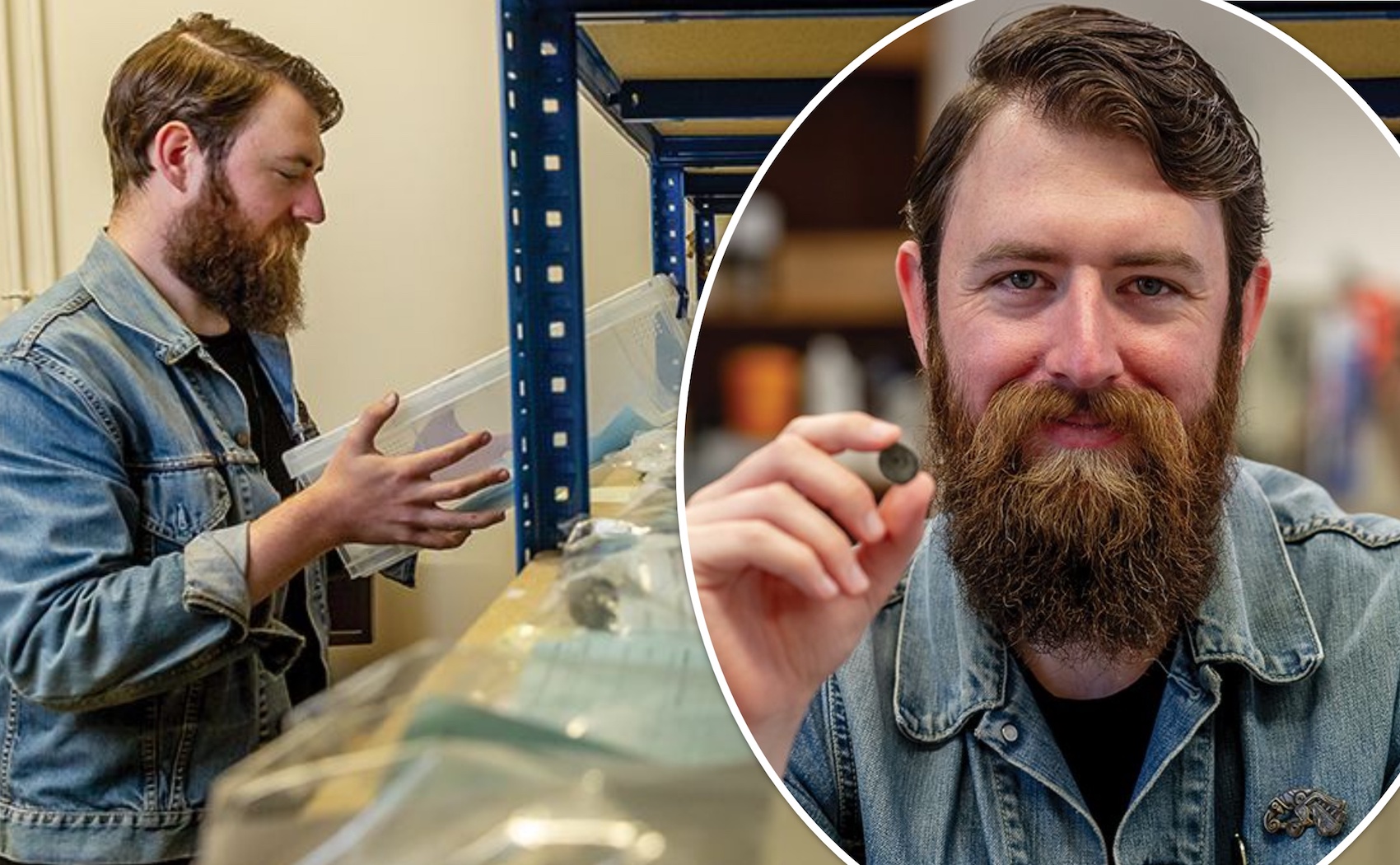
It may not be every day that a hoard of Celtic coins is discovered, but items are regularly being found, and they still need to be identified and registered by the experts at Jersey Heritage.
That process was strengthened earlier this year with appointment of dedicated Finds Liaison Officer, Perry Mesney.
Writing for Express, Chris Rayner took an object he’d found in a Trinity field for Perry to have a look at…
I have a confession to make. It was a number of years ago now, but instead of telling someone who would be able to say whether I had found something that had historical significance – someone like Perry Mesney – I kept quiet and took the object I’d found home. I’d spotted it sitting on top of a pile of recently moved earth.
It fits neatly into the palm of your hand but sadly, it’s not made of silver, gold or even iron.
“It’s surprisingly light,” he says as I hand over what I think is a stone cannonball. “It certainly looks like one to me, and if it wasn’t then there’s always the possibility that it’s ballast from a ship.”

Pictured: “It’s what I love about this job. I’m seeing a lot of the shiny stuff without having to be in a hole at seven o’clock in the morning in the rain.” (Gary Grimshaw)
Since Perry took on the job, he’s had a steady stream of people like me arrive at the Jersey Archive, sometimes bringing boxes full of material. That those items might have been kept in a cupboard, with no one apart from the finder aware of their existence, is not a problem at all.
“It’s just nice to see it in the end,” he explains. “There is so much we just don’t see. I take in finds of archaeological interest from members of the public, including metal detectorists who are really good at keeping us informed. Someone might be out walking and find something, and hopefully they bring it to me. I’ll photograph it, record it and return it to them with the report. They are welcome to donate it to us, but they don’t have to.”
Unless of course it is treasure. The law is being updated but it dates back hundreds of years. Essentially, if it is made of silver or gold, and was buried with the intention to return to it, then it needs reporting to the Receiver General. But most of what is being brought in doesn’t fall into that category. Instead, it will be entered into the Historical Environment Record.
Perry’s role in recording finds is a relatively new concept, and mirrors the Portable Antiquities Scheme in the UK, where there hadn’t been a set system to record finds. Now everything gets recorded, and unless it’s donated, everything gets returned.
“It’s a way for the public to see what’s being found. It’s important our heritage isn’t just kept behind a wall where no one can see anything. The Historical Environment Record that we are setting up and adding to, allows people to connect with the heritage of Jersey and it allows us to show our heritage to a wider audience in a more accessible way.”

Pictured: “I take in finds of archaeological interest from members of the public, including metal detectorists who are really good at keeping us informed. Someone might be out walking and find something, and hopefully they bring it to me.” (Gary Grimshaw)
Perry always had an interest in history, especially from the medieval period, but when he went to college aged 18, it was IT that he chose to study. His interest in history persisted and, after an access to higher education course, he went to Cardiff University to study archaeology and medieval history.
There are lots of jobs for archaeologists. They’ll often be called on to record the layers of history lying below a planned development, which is what Perry did in Wales, after graduating.
“I was mainly working as a digger. There was a big power station being built in North Wales and there were hundreds of archaeologists working on a massive Iron Age town. That was just digging, digging and digging with shovels and trowels. It was what you would imagine an archaeologist does. Outside of that, archaeology units do surveys, depth space assessments and preliminary research before a building is put up. But this role in Jersey is different. It is involved in archaeology, but it is mainly recording finds. So, my day-to-day is liaising with members of the public and metal detectorists, receiving finds which I’ll measure, record, research and identify for them.”
Among the objects brought in that have caught his eye was an early-to-middle Bronze Age axe head which was in an amazing condition, some Coriosolites coins similar to the ones found in the Câtillon Hoard, and half a Bronze Age sword.

Pictured: A Celtic coin hoard was recently bought by the Government for £4.25m.
“It had been hit by a plough pretty badly, but you could still tell it was a long thin blade. It’s fascinating because we’ve got every period here, including more Roman stuff than I was expecting to see. There is something to be said for islands. You shouldn’t necessarily think of an island as something away from the mainland, but as a hub for different cultures to connect and trade. If you see Jersey as an Anglo-Norman mixture, you see how they interact with each other quite a lot.”
Seeing and handling these objects on a daily basis is his passion and in his spare time he doesn’t entirely step away from the history of the island. Perry is a member of the 1781 Jersey Militia, and he is also the branch leader of the Young Archaeologists’ Club. Its aim is to get young people aged between eight and 16 involved in events and activities.
Perhaps one of things that gets instilled in any budding archaeologist is that there is no guarantee of finding anything remarkable yourself. I ask Perry about that, and he shakes his head.
“I haven’t really found that much. I’ve done a lot of digging and it’s actually quite crazy the little I have found. When you are doing archaeology and excavating, finding something is great, but it’s almost like a secondary part of the job. You are there to record the heritage. As much as I would love to find shiny things, a lot of the time it’s saying, ‘Ok, there’s a ditch here and this ditch is related to this ditch.’ You are looking at the context, measuring and drawing so it’s a lot less of the shiny stuff.”
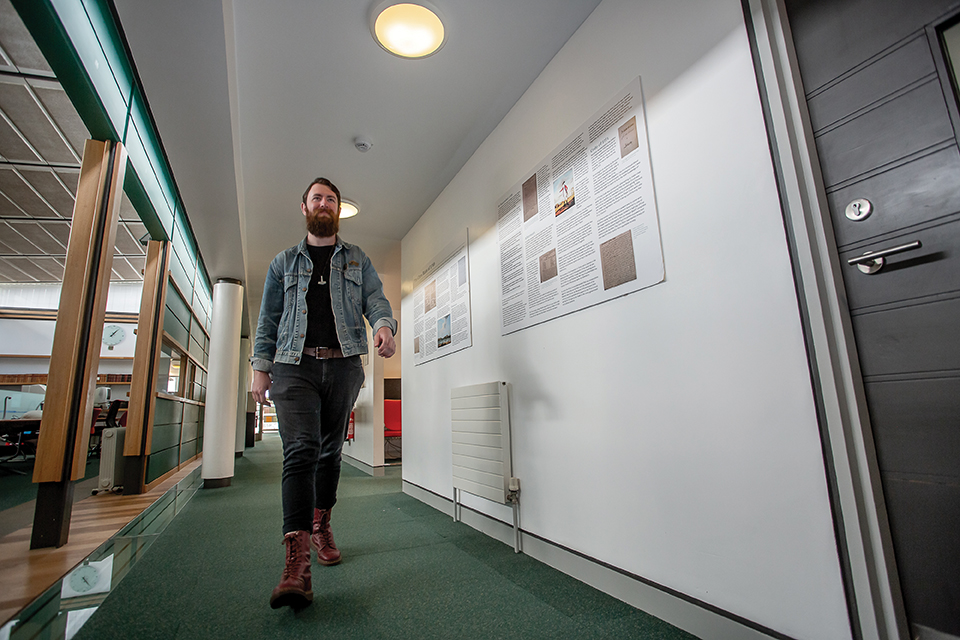
Pictured: Perry is a member of the 1781 Jersey Militia, and he is also the branch leader of the Young Archaeologists’ Club. Its aim is to get young people aged between eight and 16 involved in events and activities. (Gary Grimshaw)
But that’s all vital to how we understand our past and interpret what is out there. By setting up the historical Environment Record, Perry and his colleagues at Jersey Heritage are making it possible for all of us to really look at Jersey’s history, how it is related to Britain, but also how it is separate, and archaeologically more similar to Normandy and Brittany.
“At the Iron Age site in Wales, we’d excavate a wall, we’d look at the earth underneath the wall and to the side of the wall. We’d look at the different colours of the soil and draw the section, including the way the soils interact with each other and from that you can date when the deposits were put in. I really love that, but it’s not really finding stuff.”
Hopefully, my small piece of Jersey history which I had been lucky enough to find will help with that process of understanding at least a small piece in Jersey’s past. We filled in a Public Records Form, and my cannonball was bagged up ready for examination and recording. Who knows, it could hold some relevance due to where it was found, or it could simply be something that just happened to be there. Whatever it is, Perry is happy to find out more.
“It’s what I love about this job. I’m seeing a lot of the shiny stuff without having to be in a hole at seven o’clock in the morning in the rain.”
This article first appeared in Connect magazine, which you can read HERE.
READ MORE…
Dug up something special? Here’s who to call…
‘Hidden treasure’ protection law due next year
Gov overrules Jersey Heritage and top officials on £4.25m coin hoard purchase
