


Egypt Farm, just off La Rue d’Egypte, currently comprises some partly demolished farm buildings, a greenhouse, an orchard and groups of trees and shrubs.
One of the owners – John Rice – who has inherited the property through several generations has now submitted plans to breathe life back into the farmhouse after several failed applications.
Debates over whether it was “abandoned” after the war, a lack of funds, and concerns about the ecological impact have all plagued the house’s journey back to a habitable state – but this attempt could be the charm.
The story of Jersey in one house
Buildings have existed on the site since at least the late 18th century and it appears on the 1795 Richmond Map. At this time, its owner was M. Ramié. The field patterns seen on this map are also still visible today.
The principle farmhouse was built later, and then the second house was built in the second half of the 19th century, in the heyday of the Island’s farming industry.

Pictured: The farmhouse, before the German forces brought it to ruin.
During the early 1900s, the large barn on the west of the site was altered to provide a ballroom, reflecting a change in tastes.
In 1936, the farm was bought by Alfred Rice, the grandfather of the applicant John Rice, and the buildings were refurbished and updated by his son, Gordon, as a home for him and his new wife Gracie.
However, only five years later, the area around Egypt was put to use by the occupying German forces as a battle training area. On 14 July 1943, the occupants of the three farms at Egypt were given 24 hours to leave their homes. Owners were allowed to remove the joinery, but the buildings were then partially demolished so they could be used to train troops in street and house-to-house fighting.
The Rice family were evacuated to England, and Gordon Rice (John’s father), an officer in the Jersey Militia, was seconded to the 11th Hampshire Regiment.
In a Jersey Evening Post article from June 1945 entitled “Three Good Farms Disappear”, a “well-known Trinity farmer” said “the fields have gone to ruin, full of weeds and brambles and I doubt they will ever be cultivated again. I am afraid that we will never see farms here again, thanks to the Germans”.

Pictured: A newspaper cutting of the article.
When the Rice family returned after the war, Egypt Farm was uninhabitable and Gordon and Gracie moved to South Africa with their young family to start a new business with the hope of rebuilding it one day.
The £2,000 in compensation offered by the British Government covered only a seventh of the estimated cost to rebuild it. The buildings remained untouched, despite several attempts to reach out to Planning, but the land was restored and let out.
When Gracie Rice died in 1994, ownership of the property passed to her children, John and his siblings.
A planning application for the reconstruction of the buildings lodged in 2013 was refused as it did not meet requirements in the Island Plan – a document that reflects the needs and environment of Jersey at any particular moment in time.
Another application submitted several years afterward was also rejected on the grounds that the property was “abandoned” and the then Planning Minister was not satisfied that reconstruction would not “cause harm to biodiversity”.
The question of abandonment
The owners remain firmly of the position that the farm was never abandoned.
However, in its responses to the Rice family since 1984, the Planning Department has maintained that the principal reason for refusing applications for reconstruction is due to the farm having been abandoned.
A tension therefore exists.

Pictured: The ruined buildings at Egypt Farm are covered in ivy. (Dave Ferguson)
The family is arguing that apart from appropriation by occupying forces, the land has been in “continuous use” since at least the first half of the 19th century.
“The Rice family have continued to let the land since their buildings were destroyed in 1943,” the application added. “In addition the owners have never shown that they want to giv eup the land and strongly refute any suggestion that they wish to do so and since 1984 have actively sought to repair their damaged property”.
Due to several reasons stated, they claim that “abandonment should not be given as a reason for the Planning Department not to consider a reasonable application for development at Egypt Farm”.
A new lease of life?
Mr Rice is seeking to create one house at Egypt Farm together with an outbuilding to provide one garage and shed. The greenhouse would also be repaired and other ruined parts of the farm returned to their former glory.
The farm track would be re-surfaced as a gravel drive, granite walls repaired and boundaries re-enforced, along with seeding for a wildflower meadow and new fruit trees.
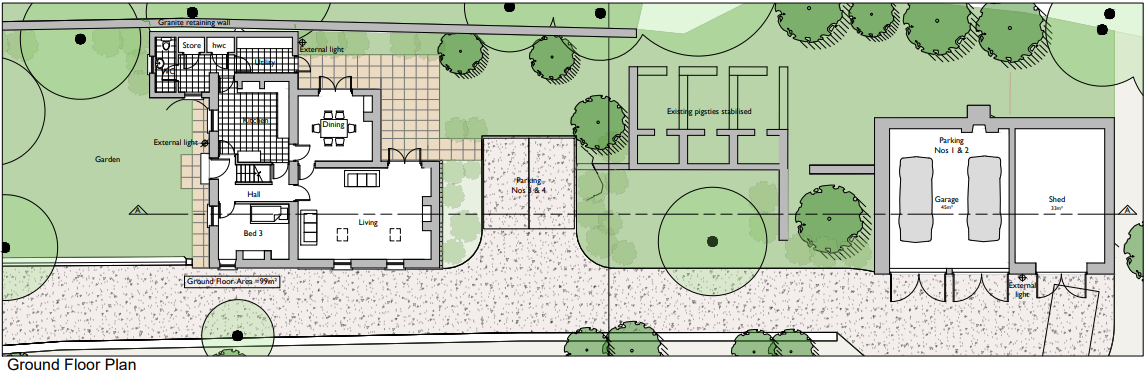
Pictured: The plans for Egypt Farm. (Antony Gibb)
The application notes that the form and appearance of the house would be same as it was on 14 July 1943, rebuilt in a traditional style with 19th-century finishes.
It adds: “The proposal to redevelop some of the existing buildings at Egypt will retain as much of the existing fabric as possible.”
“Moral responsibility”
In a more emotive conclusion than one is used to seeing in planning applications, Mr Rice makes a direct appeal to the officers.
He said: “As well as the above planning arguments, the moral responsibility of the Island to allow an owner to rebuild his property after destruction during the Occupation should be taken into account.
“In this case, the owner fought for his Island and his country and returned after the war to find his property ruined.
“He and his heirs have tried to rebuilt for 75 years, but have been prevented from doing so by lack of funds, by politics and, most recently, by the Planning Department.”
Pictured top: Egypt Farm in its current state. (Dave Ferguson)
