

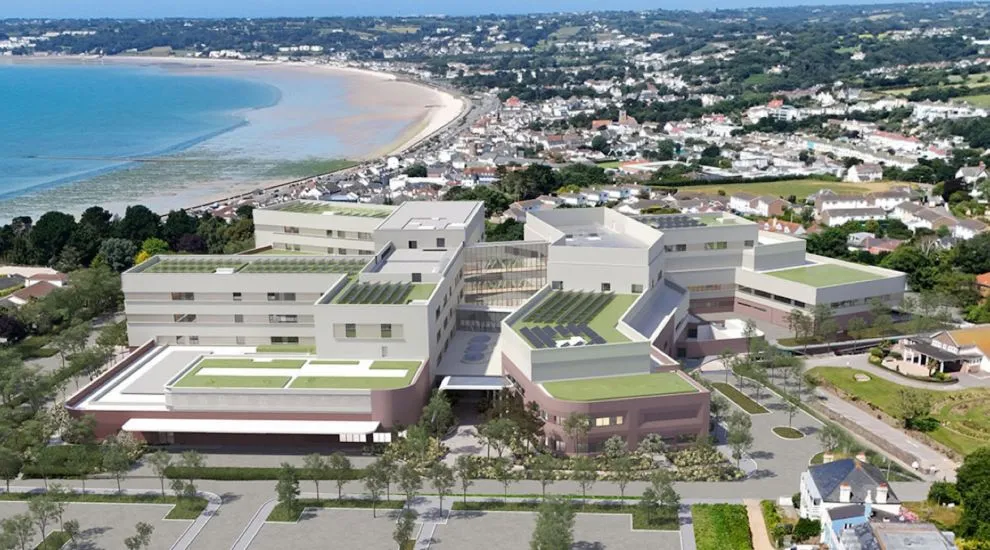
The Health Minister has hit back at a damning report about Jersey’s £710m hospital project – accusing scrutiny politicians of getting their facts wrong and scaring the public in the process… but did he accept anything they said?
Coming out swinging in response to the Hospital Review Panel’s critical 117-page report published in February, Deputy Tom Binet today dismissed much of the review as “inaccurate” and potentially “needlessly alarming” – rejecting more than half of its recommendations.
Of the 20 suggestions for improvement, he rejected 11, partially accepted seven and only fully accepted two.
The report said the Government’s healthcare plans – which include building the main hospital at Overdale, as well as a health village in St Saviour and an ambulatory care facility in town – lacked clarity, transparency, and any real detail on key areas such as staffing and procurement.
And their warning was stark: the island “may not be able to afford to build and operate the enlarged healthcare estate that is currently envisaged”.
They also said the financial oversight of the project was “very weak and limited”.
Panel Chair Deputy Jonathan Renouf said the outline business case for the scheme did not come anywhere “close to meeting the standard that islanders have a right to expect for the largest capital project in the island’s history”.
The panel also uncovered that the Government had withdrawn £10m in funding earmarked to ensure the General Hospital can operate safely whilst a new health facility is built – something they deemed a “risk to patients”.
Now, nearly two months on, Deputy Binet has responded in full – claiming that the report “contains inaccuracies and certain claims that may have caused unnecessary alarm for the public”.
“While I welcome constructive scrutiny and remain completely committed to the process, I remain saddened by some of the inaccuracy of this particular piece of work and am disappointed by some of the views expressed in the report,” he said.
Had the professional assessment been carried out in the context of a Jersey-specific scheme, instead of assessing it as if it were a project for the NHS, the report would have been of greater impact
Deputy tom binet, Minister for Health and Social Services
Deputy Binet also said that the assessment “would have been of greater impact” if it had been “carried out in the context of a Jersey-specific scheme, instead of assessing it as if it were a project for the NHS”.
He added that most of the accepted recommendations were “already partially complete” thanks to the “considerable progress” made since spring last year.
Express took a look at what the Panel asked for – and how the Minister responded…
Tell us what the risks of withdrawing £10m funding for the hospital refurb are – REJECTED
The funding – which was split into £5 million per year in 2026 and 2027 – was “allocated to ensuring the safety and operability of the General Hospital” in the Government Plan 2024-2027.
But whilst analysing the new hospital plans, the Hospital Review Scrutiny Panel learned that the funding was “rejected by the latest central Government finance team review”.
In their critical report published today, the panel said the decision “presents a risk to patients as well as to the healthcare system”. They said the Government should publish details about the additional risks arising from this decision.
What the Minister said: Deputy Binet refused. He said that the case for funding in 2026 and 2027 will be considered as part of the Government’s 2026 Budget.
How will different parts of the hospital project depend on one another? – ACCEPTED
The panel said that the hospital project team should provide information on how different parts of the programme depend on one another.
What the Minister said: Accepted. Deputy Binet said that this work is already “highly developed” and can be provided.
What’s Kensington Place going to be for? – REJECTED

The Government acquired numerous hotels in the Kensington Place area, which were demolished to allow for the expansion of the current General Hospital. However, no detailed plans for this area have been shared and the site has been vacant for some time now.
The Minister should publish more details about how the proposed new ambulatory care facility at Kensington Place will be used by the end of June.
What the Minister said: Rejected. Deputy Binet decided not to share this information. He said that it is “important to keep the exact makeup of the funding envelope at a high level” whilst the procurement process is underway.
Give us full details on how you’re going to staff the new hospital – PARTIALLY ACCEPTED
The panel’s report revealed that the hospital plans had no clear strategy for hiring and retaining staff – despite the island already spending nearly £22 million on agency health workers last year.
With bed capacity set to increase by 32% in the upgraded facility, questions were raised about whether the Government is building a state-of-the-art facility it simply won’t have the workforce to run.
The panel said the Minister should published a “detailed workforce model” explaining how the hospital and other new sites will be staffed, with a clear strategy in place by 30 June 2025.
What the Minister said: Partially accepted. Deputy Binet said this is underway, but it “will not be possible to complete this work in the timescale suggested”.
When will we actually get a proper health and care strategy? – PARTIALLY ACCEPTED
The Minister was asked by the panel to publish a timeframe for the development of a health and care strategy, with clarity about how this would sync up with the New Healthcare Facilities Programme, by 30 June 2025.
What the Minister said: Partially accepted. Deputy Binet said work is underway to develop a health and care strategy which will consider the existing healthcare provision and the requirements for the new acute facility. “A timeframe will be presented for this work by the deadline,” he added.
How many beds are we actually going to need? – REJECTED

The panel called on the Minister to produce an updated model to evidence how many beds are needed at each of the proposed New Healthcare Facilities Programme sites.
What the Minister said: Rejected. Deputy Binet said that there is “no evidence” to suggest that the current demand and capacity model is incorrect.
He added: “It is therefore difficult to understand the reasons that Hospital Review Panel is recommending further theoretical analysis at considerable cost to islanders.
“The time for an update or reworking of the demand and capacity modelling for the Acute Hospital has passed.
“The new Acute facility has planning permission, funding in place and has been the culmination of hundreds of hours of consultation with clinicians about existing and future service provision: the most important point now is to move forward with delivery.”
Can you explain the building plans in full – PARTIALLY ACCEPTED
With many elements remaining unclear, the review panel said that the New Healthcare Facilities Programme Team should produce a full functional content schedule.
What the Minister said: Partially accepted. Deputy Binet said that it is “important to keep the exact makeup of the funding envelope at a high level” whilst the procurement process is underway, but committed to “providing more clarity on the services that will be provided from each of the sites” later this year.
How will you track how the benefits of the programme are measured? – PARTIALLY ACCEPTED

The project team should review how the programme’s benefits are measured, with more detail and proper tracking by 30 June 2025, scrutineers said.
What the Minister said: Partially accepted. Deputy Binet said further work on benefits and benefits realisation will be outlined within the full business case – but this will not be available in the requested timescale.
Set out a list of the risks to the project and the possible costs those could carry – ACCEPTED
As Express previously revealed, political interference sat at the top of the “risk register” for the new Hospital programme this time last year, but is that still the case? And how much could these risks cost us if things go wrong?
To find out, the New Healthcare Facilities Programme Team were urged to produce a costed risk register for both capital and revenue risks to inform risk transfer and risk provision by 30 June 2025.
What the Minister said: Accepted. Deputy Binet confirmed there is already a cost risk register for all programme risks and revenue risks that can be provided to the panel.
Develop a plan for buying goods and services for all sites – PARTIALLY ACCEPTED
The panel said the Government needed to be clearer about how it would be going about sourcing suppliers and contractors to upgrade and build all the island’s health facilities.
As a result, it said that clear procurement strategies for Kensington Place and the St Saviour Health Village should be published by 30 June 2025.
What the Minister said: Partially accepted. Deputy Binet said the plans for the Kensington Place and St Saviour sites are at an “earlier stage” and it is therefore “not logical” to provide a full procurement strategy ahead of this work being completed.
Can you share full architectural designs for the new hospital? – REJECTED
A full architectural report showing how the design meets the needs of the site should be published by September 2025.
What the Minister said: Rejected. Deputy Binet said it would “not be appropriate” to share full designs whilst the procurement process is underway.
He added that the documents are still subject to change, and “provide information about critical Government of Jersey assets that could be used for terrorism and other acts”.
The Minister said that the team have provided presentations on the Overdale architectural report, and will do similarly for Kensington Place and St Saviour at the appropriate time.
Get independent experts to check the cost estimates you’re working with – REJECTED
The design information on which the capital costs for the non-Overdale projects have been based should be independently reviewed by September 2025, the panel recommended.
What the Minister said: Rejected. Deputy Binet said that the design information for the non-Overdale projects have been prepared by specialist technical advisers with the appropriate level of expertise. He added that there is “expertise within the team to cross-check costing works”.
Deputy Binet said: “It is not cost effective for the work of experts to be further checked by other experts.
“All costings are estimates and these will be proven by the procurement process that fundamentally will determine the price for which a contractor will agree to build the healthcare facilities.
“This will be affected by the designs but also other factors, such as the risk to delivery within different jurisdictions.”
Make cost estimates more realistic by including staffing –PARTIALLY ACCEPTED
The financial forecasts should be updated by September 2025 to reflect the true cost of staffing the new buildings, the panel said.
What the Minister said: Partially accepted. Deputy Binet said current forecasts are based on future demand and that staffing costs will be reviewed as part of a wider workforce strategy – but this will not be completed by September 2025.
Make the financial plan clearer – REJECTED
The panel wanted a full set of figures, including inflation and depreciation, by the end of June 2025.
What the Minister said: Rejected. Deputy Binet decided that’s not happening – he said that there will be further financial information in the full business case, but there is no plan to include the recommended elements as “they are not a requirement in Jersey”.
Show how the new facilities can be run affordably – REJECTED
The government should show how the new healthcare facilities can be run affordably by confirming the source of funding for the revenue and operational cost increases by 30 June 2025, the panel said.
What the Minister said: Rejected. Deputy Binet said that revenue funding requirements will be considered in within the next Government Budget.
He added: “There are a number of pressures on the costs of healthcare, including from the ageing population, and ensuring the costs of healthcare are sustainable into the future remains a strategic challenge for the island.”
Make the project plan clearer when it comes to risks and assumptions made – PARTIALLY ACCEPTED
The panel said the plan should spell out what depends on what, what could go wrong, and what assumptions are being made.
What the Minister said: Partially accepted. Some of that’s now happening, but not all. Deputy Binet said this information is already including in internal documents available to the panel. He added that it will be provided in more detail in the full business case.
Do we need someone independent to keep an eye on the process? – REJECTED
The panel wanted an outside body to keep an eye on the programme and give public reassurance that the issues they flagged were being addressed before the final business case is signed off.
What the Minister said: Rejected. Deputy Binet ruled that out, saying the project is already “affordable, deliverable and appropriate to the healthcare needs of the island”.
Give Treasury more power to challenge – REJECTED
The panel suggested the Treasury Minister should take a more independent, hands-on role in scrutinising future versions of the hospital business case.
What the Minister said: Rejected. Deputy Binet turned the idea down and said that Treasury oversight and assurance processes are “already robust and attuned to the nature of the project”.
Get more local builders involved – PARTIALLY ACCEPTED
The panel said the hospital team should do more to bring Jersey-based construction firms and suppliers into the project.
What the Minister said: Partially accepted. The Minister agreed – but says work is already underway.
“…There has been significant engagement with the local construction and supplier sector,” Deputy Binet said, adding that: “…The team will continue to engage with the sector as the scheme develops.”
Follow Express for updates…
