


Simplifying the way significant changes are communicated will “keep the States employees onside”, Charlie Parker was told in a new report by the Public Accounts Committee (PAC) – a panel of politicians responsible for scrutinising the way taxpayers’ money is spent.
The PAC’s finding centres on the concern that some of the language used to explain drastic changes to the way the Government of Jersey is structured could be confusing for the civil servants working towards it.
The panel is chaired by Senator Sarah Ferguson, accompanied by Constable John Le Bailly and Deputies Rowland Huelin and Inna Gardiner, as well as three civilian Committee members: Adrian Lane, Moz Scott and Tim Rogers.

Pictured: The panel is chaired by Senator Sarah Ferguson.
Their latest report, ‘Recurring Themes: Organisational Culture and Corporate Learning’, recommends that Mr Parker cuts back on confusing jargon, which the Committee associates with low staff morale within the civil service.
One of their key findings on Mr Parker’s overhaul of the Government structure indicates that PAC “is concerned that the volume, complexity and phraseology of documents generated to explain organisational change may lead to confusion and not encourage enthusiasm for change.”
One example of complex language given is Mr Parker’s new ‘Target Operating Model (TOM)’ – referring to the reorganisation of Government departments. Instead, the Committee proposes that “revised management structure” would perhaps be easier to understand.
Other common terms that have emerged since Mr Parker took the reins of government include ‘OneGov’ (Mr Parker’s proposed non-silo model of working), CSP (Common Strategic Policy – the Council of Ministers’ agreed set of goals), DGs (Director Generals – the new departmental leads), CYPES (the shortened version of the revised Education/Children’s Department), and GHE (Growth, Housing and Environment – a department that has absorbed the former Infrastructure and Environment Departments), among others.
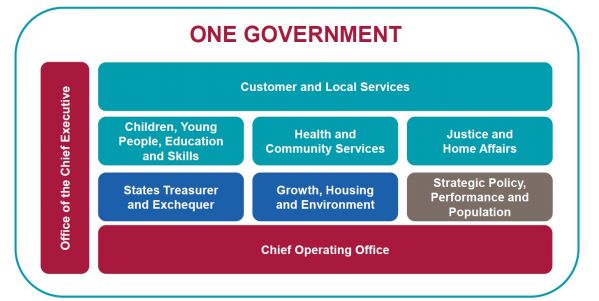
Pictured: The Committee has warned against jargon and confusing acronyms within the implementation of Mr Parker’s new ‘Target Operating Model’.
Following on from this, the Committee make two recommendations. Firstly, “the PAC recommends that measures are taken by the Executive to improve clarity of communication throughout the organisation, making the most of listening and feedback, to keep the States employees onside.”
Secondly, the PAC emphasises the need for “a clear and concise approach” to help “all States workers to understand the vision towards which they are working.”
As part of this, the Committee suggests that “fewer acronyms would also simplify the approach.”
They add that “where acronyms are used in written communications, they should be defined in an executive summary.”
These recommendations are made within a section of the report focused on “low morale” where they say they challenged Mr Parker “on how he envisaged creating an improved culture and delivering excellent services to the island when staff morale was currently low.”

Pictured: Clear and simple phrasing would help to keep civil servants “onside” the PAC advises.
The Committee writes that there is “little understanding of the changes and that morale is low” amongst public sector staff.
“A simplified vision could be to be a government that delivers services in the best possible way by learning from the people it is serving and being supportive in equipping its staff.”
Elsewhere in the report, the Committee makes several other recommendations associated with the following key findings:
- “too much weight is being given to the structures rather than behaviours of people”;
- although government needs “independent structures” to “strengthen governance and oversight,” the Committee felt that “over-complicated changes are counter-productive”;
- “conflicts of interest may occur where… functions that were previously in separate departments, are brought together”;
- the Committee were “disappointed” that the C&AG recommendations relating to “corporate learning” were “still not transmitted through all departments.”
