


The repercussions of a highly critical review of Jersey’s rheumatology department are still being felt over two years later – with the diagnosis and treatment of more than 250 islanders now being reassessed after questions were raised about the quality of their care.
Up to 270 people who had a scan to assess their bone density between January 2017 and January 2022 are being called for a rescan after an independent review identified “potential concerns” with the diagnosis and treatment recommendations of some patients.
Bone densitometry scans are sometimes referred to as Dual-Energy X-ray Absorptiometry, or DEXA, scans; they use low-dose X-rays to see how dense or strong a patient’s bones are, which is important in assessing the risk of fractures.
Health said that specialist independent consultants had reviewed just over 1,000 patient notes and found that in 20 cases, the treatment and care a patient had following their DEXA scan “fell below the level that would have been expected”.

For another 250 patients, the specialist consultants have advised that a rescan should be undertaken, in order to monitor any changes to bone density.
The 20 highest-priority patients have already received a letter, with 11 invited back in for a rescan.
The other 250 patients affected will be notified this month. It is anticipated, subject to patient availability, that all recall scans will be completed by the end of May.
Patients who have not been contacted and offered a recall appointment by the end of April can be reassured that this issue does not affect them.
Rheumatology repercussions
The DEXA scan review was conducted as a result of a Royal College of Physicians audit, published in early 2024, which found the standard of care at the Hospital’s Rheumatology Department “to be well below what the review team would consider acceptable for a contemporary rheumatological service”.
It revealed a “lack of governance, not just in rheumatology but across the healthcare organisation.”
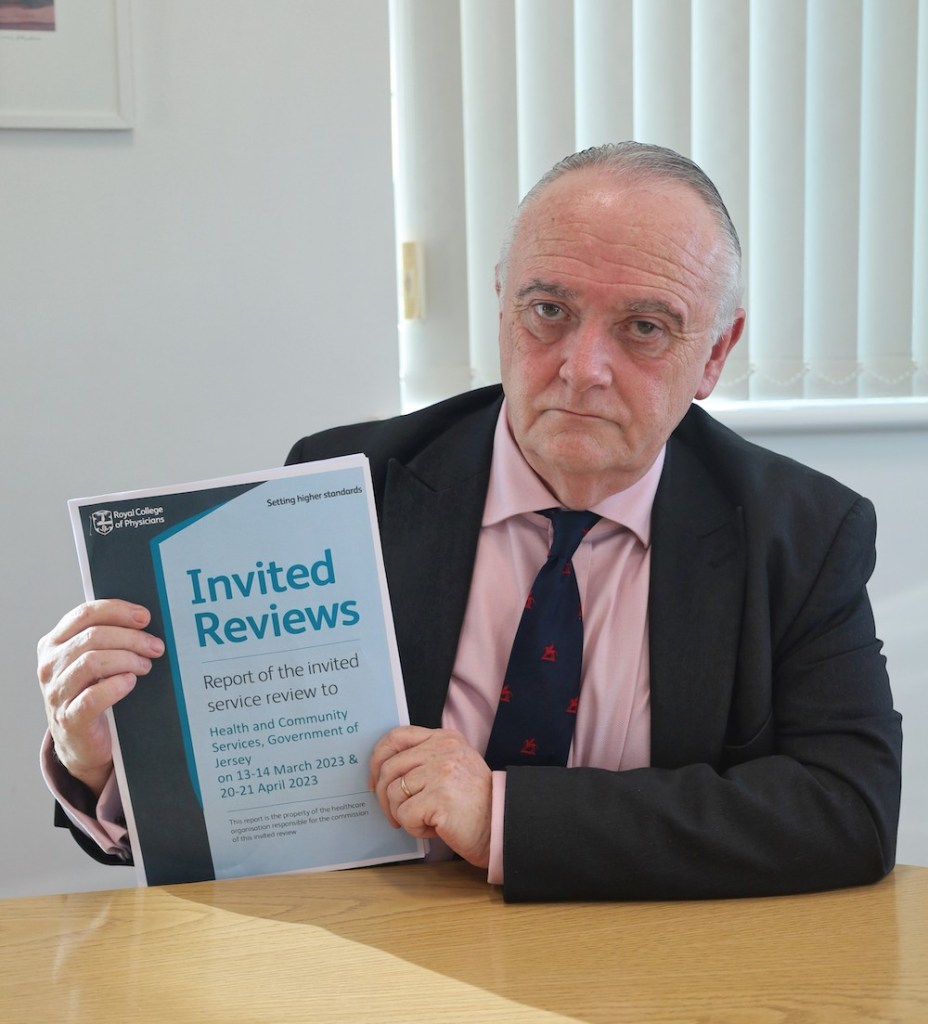
Medical director Simon West said the College had not called for the DEXA review; rather, it was the impetus of Health itself.
He explained: “Patients who were part of the rheumatology review specifically were asking if their DEXA scan – or any medication that they had been given as part of rheumatology – had played a part in them either having a fracture, which some of them had had, or could be linked to their osteoporosis.
“The answer was no, but some of the medication they had taken might have had a part to play.”
That prompted Health to enquire whether the reporting of DEXA scans of patients within the scope of rheumatology review needed to be investigated.
It then came to light that the issue extended beyond rheumatology patients to include referrals from GPs and other specialties such as orthopaedics.
A decision to review all the scans
“That led to a decision to review all the scans where we could have confidence in the quality of the data,” said Mr West.
“We have found that 20 cases require ‘duty of candour’ – where we think somebody might have come to harm.
“It is our responsibility to communicate that to the patient and that harm might be ‘mild’, ‘moderate’ or ‘severe’.
“All of these cases were only classed as ‘moderate’ harm’ because all involved fractures, and so we have written to all 20 of those patients, and they have received their letters already.”

He explained that a further 250 patients have been recalled after their records were reviewed by two specialist rheumatologists – but the extent of any harm to these patients is currently unclear.
“This is because either we do not have enough information about what has happened to them since their last scan; they should have been rescanned but have not; or they haven’t been given appropriate advice in their report for us to be assured that they do not require medication,” explained Mr West.
“We don’t know which category they fall under [‘mild’, ‘moderate’ or ‘severe’] until we have rescanned the patients. It could be that once we rescan all 270 [patients], none of them need any further action.”
Health has said that anyone who has had a DEXA scan since January 2022 can be reassured that there are no issues with the reporting of their results.
Mr West added: “We were quite assured that post-2022, the reporting of the DEXA scans was robust. However, we could not be assured pre-2022.
“We have only gone back until 2017 because we could only be assured of the data from then.
“To be clear, it is the reporting of the scans that we are looking into; not their conduction or facilitation.”
The actions of a single individual
Mr West confirmed that the uncertainty was down to the actions of a single individual who was responsible for interpreting the results of the DEXA scan.
He added that the person in question no longer worked for Health, the individual’s professional regulator was aware of this review, and it would be up to the regulator to take any action.

Asked how this potentially inadequate interpretation of scans was allowed to happen, Mr West replied: “What we have learned from conducting this review is that, pre-2022, there were not enough checks and balances, but post-2022, we are more assured of the service.
“We are certainly assured of the reporting and the quality of the service delivered both by the machine and the person doing the scanning – we have no issue with that.
“But even post-2022, we have identified areas where we think we can improve the service. One of the consequences of having two independent external rheumatologists look at 1,000 scans, as well as the service, is that they can make suggestions and recommendations.
“Part of this review is about us continuing to improve the service to make it more robust and more fit for the 21st century.
“That is one of the advantages of carrying out external and internal reviews, and why we will continue to conduct them.”
“I would like to sincerely apologise”
To help with the review, Health has recruited an additional radiographer who is a specialist in the conduction of DEXA scans and will be coming to the island on weekdays to deliver scans at the Enid Quenault Health and Wellness Centre.
Two rheumatologists who are experts in the reporting of DEXA scans are also being taken on temporarily.
Mr West said: “I would like to sincerely apologise to any patients who have been affected and recalled for a scan, as I understand receiving such news can be unsettling.
“As soon as it became apparent that there were potential issues with the accuracy of reporting of the results of DEXA scans, Health and Care Jersey took steps to commission an independent review. Following the findings of the review, we have worked as quickly as possible to contact affected patients and to recall them for another scan.”
He added: “I can assure islanders that they can have confidence in our current DEXA service, and I hope that the swift action Health and Care Jersey has undertaken shows that, as a department, we continue to address issues that have been identified from previous years, we are open and transparent when these issues emerge and that the quality and safety of our services is of the utmost importance to us.”
Any patient who has concerns is asked to contact the Patient Advice and Liaison Service on 01534 443515 or PALS@health.gov.je.
Anyone who would like to share their story can contact editor@bailiwickexpress.com.
