

If accepted, the Jersey Infrastructure Levy (JIL) would see developers – including the States’ own development company – contribute part of their profits at a rate of £85 per square metre.
Parishes would then receive a 10% portion of that levy from new development in their area, while the remaining 90% will continue to support the Future St Helier project to make town and St Helier’s surrounding parishes, “…a more vibrant place to live, work and visit.”
“I’m hoping the constables would have a little pot of their own that they’ll build up over two to three, maybe four to five years,” the Minister for the Environment, Deputy Steve Luce, who is bringing the proposals, explained.
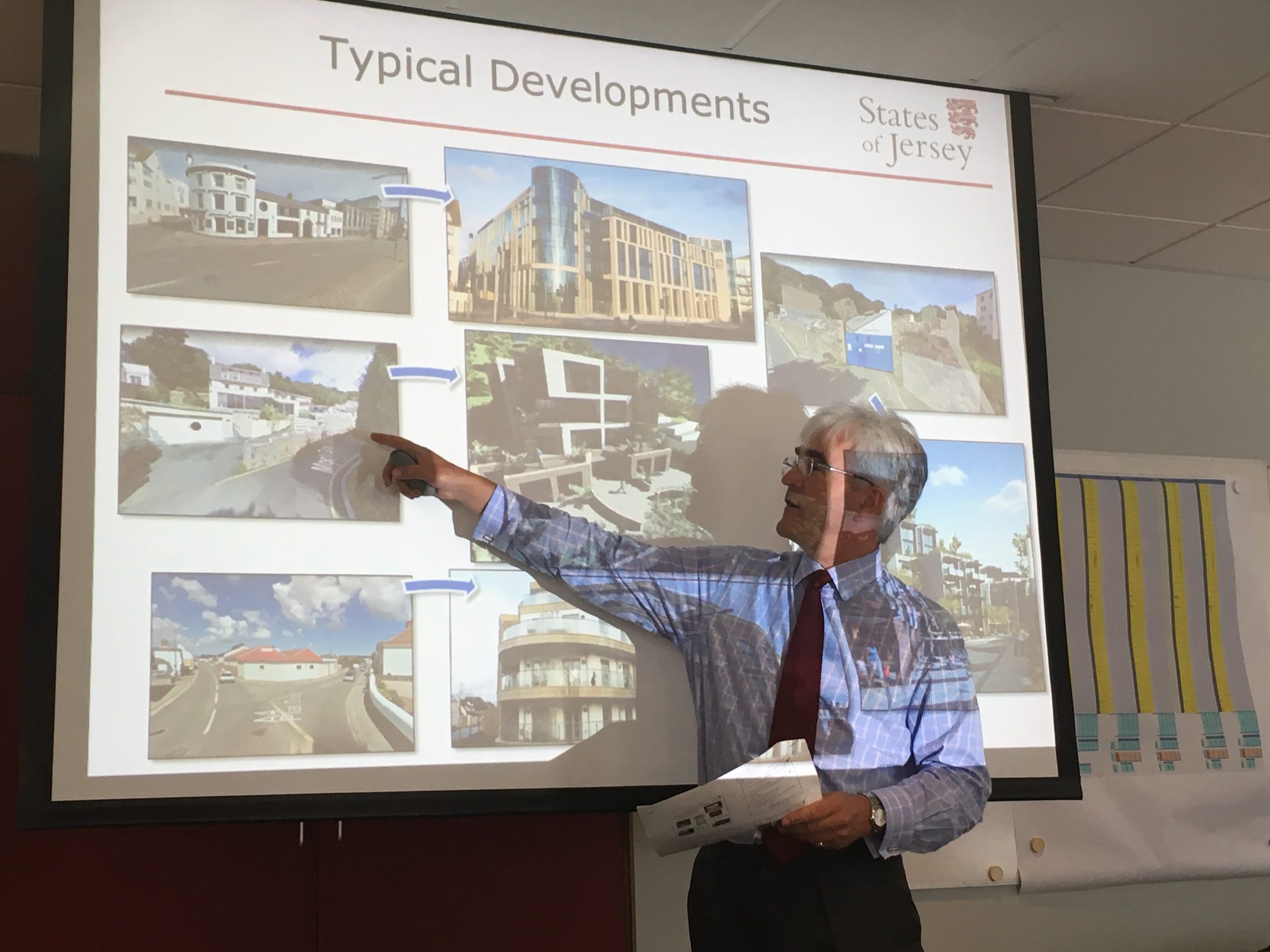
Pictured: Simon Drummond-Haye, who produced a viability analysis, explains the types of eligible developments.
It’s hoped the levy will generate between £1.5 and £2.5 million annually for investment in improved streets and recreational facilities, transport and pedestrian and cycle schemes, whilst also helping build the Island’s climate change resilience with better urban drainage, flood defence and increased tree planting.
The tax, however, would only apply to developments of more than 75 square metres, and not to affordable homes, constructions with a charitable purpose or public sector buildings.
The Minister, Deputy Steve Luce, argues that development has put a strain on the Island’s resources and that this new levy will be “fairer” than the current Planning Obligations Agreements (POA) system, which has seen very few residential, office and retail sites make a contribution towards the impact on public services.
“Land in Jersey is at a premium and permission to develop immediately makes it more valuable… We think it’s fair that the land owner or developer who makes a significant profit out of permission, should also make a small contribution to improve the quality of life for people in that community,” he commented.

Previous: St Helier then and now – the Department for the Environment argue that the levy will help fund the continued improvement of the parish.
Nonetheless, the 11-year-old ‘Percentage for Art’ scheme – a ‘voluntary’ part of POA, whereby developers could have their applications looked upon more favourably if they commission artwork for the surrounding area – could be set to stay as a separate scheme. Deputy Luce told Express: “I’d like to think that it’s something that we can move forward with. I would always encourage developers to engage with an artist. They actually appreciate when they can do something artistic, people appreciate it, and people talk about it.”
The announcement comes following an extensive viability analysis and initial consultations with the construction industry. They have so far raised concerns that it may push up house prices and stop land supply coming forward, but analyses found that this has not been the case in a similar UK scheme.
Consultations are set to continue with the public until 1 September 2017. If the States agree on the draft law, the levy could be introduced by early 2019.
“We’re very keen to give people time. We’re aware that a lot of people have already bought land, so we want to give them an opportunity to build up their plot, and what we’re saying is if you’re going to consider buying something now, just take this into account that you may have to pay a little bit later. The other reason for 2019 is so we’ve got to factor in that we’re not going to ask people to pay the levy the moment they put the application in. That would constrict their cash flow…. It would be a phased payment,” the Minister added.
