


Jurors were shown a reconstruction of the radar signals that were broadcast onboard the Commodore Goodwill in the hour before it collided with fishing trawler L’Ecume II – a collision that killed all three of the fishing boat’s crew.
The trial of Artur Sevash-Zade (35) and Lewis Carr (30) at the Royal Court entered its second day today.
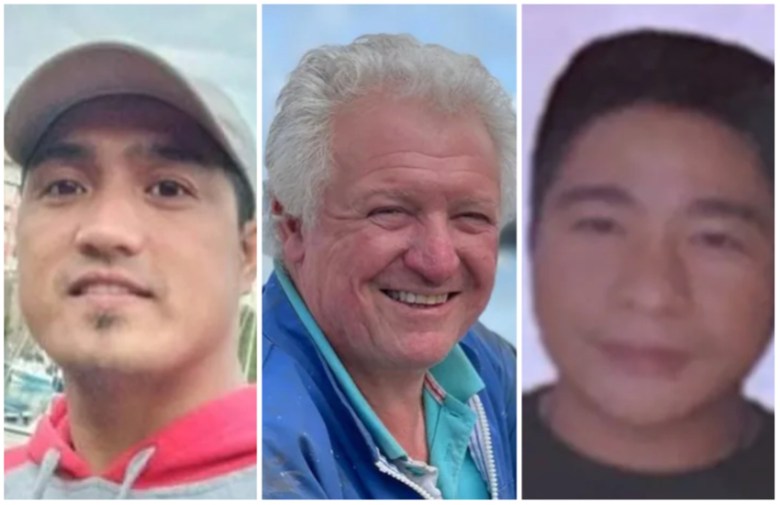
Both have pleaded not guilty to three counts of manslaughter for the deaths of skipper Michael Michieli, and crew members Larry Ladion Simyunn and Jervis Ramirez Baligat on the morning of 8 December 2022. They have also denied an alternative charge of endangering others at sea.
Crown Advocate Matthew Maletroit, prosecuting, said the wooden fishing trawler had broken under the impact of the collision and all three crew members drowned.
The last anyone heard from its crew, he said, was a message from Mr Baligat to a friend.
The advocate said: “This message at 5.21 was the last message from the crew and the last time that the crew were heard from.”
Nobody knows what the crew was doing on board in the moments before the collision, but he said it was likely that they were preparing to start fishing at Long Banks, where they were headed. Mr Michieli’s body was found in the auxiliary machinery room, where the generator used for fishing equipment was located.
This morning, the advocate introduced a reconstruction of the Goodwill’s radar systems and its course as it left Guernsey. They showed how early in the morning, the ship had avoided other smaller boats – but come closer to them than the one nautical mile imposed by their rulebook.
Mr Carr took over as the most senior officer on deck shortly after the Goodwill left Guernsey, he said, making him responsible for decisions about the ship’s safety and collision avoidance. The captain went to take a mandatory rest break.
In audio recordings taken on the bridge, he argued, Mr Sevash-Zade can be heard agreeing with Mr Carr that he would go to breakfast, leaving Mr Carr as the only person on deck.
He came back half an hour before the collision – but this was against the ship’s rules, which reflect industry standards.
“The defendants, both of them, were knowingly breaching the rules of the whip, the rules of the ship called the Standing Orders.”
These included a requirement, at night, for both the officer of the watch and the lookout to be on the bridge.
Mr Sevash-Zade’s breakfast, the advocate said, was “the first example of really poor practice by the defendants on the bridge”.
Their behaviour was “reckless”, he added.
The reconstruction showed how L’Ecume II appeared on the Goodwill’s radars while Mr Sevash-Zade was in the mess, but he came back with enough time to avoid a collision.
But as the two vessels came nearer one another, the advocate said the defendants’ reactions were “incredibly reckless” – in particular, not following the one-nautical-mile rule.
“If Mr Carr had just adhered to that one rule, the collision, the fatalities, and all of the other consequences that have followed from it, including this trial, would never have happened. That’s how important that rule was.”
At 5.22am, the radars showed the Goodwill made a starboard turn at 7 degrees – leading to the two vessels to overlap.
The advocate said this move “compromised the safety of both vessels and everyone on board”.
The jury trial is scheduled to last a month. Commissioner Sir John Saunders is presiding.
Advocates Mike Preston and Simon Thomas are representing Mr Sevash-Zade and Mr Carr, respectively.
Catch up on the case…
Day 1: “Nobody would have predicted that L’Ecume II was taking her final voyage”
