


Owned by the Société Jersiaise and managed by Jersey Heritage, the site was discovered in 1881 and is a key site in European prehistory, preserving one of the best records of Neanderthal behaviour from over a quarter of a million years ago.
His Royal Highness worked at the site when he joined excavations there in 1968 under the guidance of his Cambridge Professor, Charles McBurney, who recovered almost 100,000 large stone artefacts and thousands of mammal remains including large heaps of mammoth and woolly rhinoceros bones over a 20-year period.
The Prince’s presence instantly raised the site’s profile internationally and has been a touchstone for its importance ever since.
The Royal patronage comes at the same time that archaeologists return to the site at Ouaisné this week to restart excavation work for the first time since the pandemic began. They returned for a three-week season of excavation, having been unable to excavate there since 2019 due to the pandemic.

Pictured: His Royal Highness working at La Cotte in 1968. (Société Jersiaise Photo Archive)
Jon Carter, Jersey Heritage’s Chief Executive, said the charity was “incredibly grateful to The Prince of Wales for accepting our invitation to become Patron of Jersey Heritage’s La Cotte de St. Brelade Archaeological Project and are sure the news will be a tremendous boost to gathering interest in, and support for, the next crucial stage of this important project.”
He added: “Rising sea levels continue to be a threat to this ancient heritage site and we know these issues are close to the Prince’s heart, having read archaeology at Cambridge University – which included taking part in excavation work at La Cotte itself – and having been a long time campaigner to raise awareness of global warming and climate change.”
Mr Carter went on to describe it as “an honour” to have The Prince of Wales as Patron, and that La Cotte still “has the potential to surprise us with incredible new stories.”

Pictured: “La Cotte has the potential to surprise us with incredible new stories.”
The team working on La Cotte is led by Dr Matt Pope of the UCL Institute of Archaeology, who’s team initiated a new era of research at La Cotte in 2010.
In addition to fieldwork, this research included scientific studies of archaeological material from historic excavations, including fossil remains of Neanderthal people, now cared for by Jersey Heritage.
As they recommence their work, Dr Pope’s team are working alongside Geomarine, who carried out the cliff stabilisation and sea wall work on behalf of Jersey Heritage and whose staff are on hand to ensure the archaeologists can safely access the site.
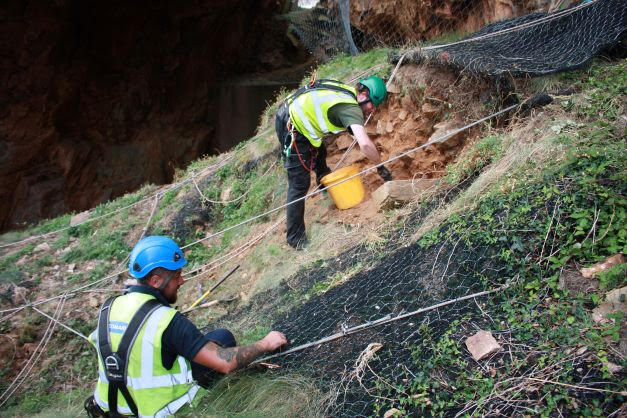
Pictured: Archeologists pictured on-site before the pandemic.
Reflecting on the project’s new Royal patron, Dr Pope commented: “The Prince’s time with McBurney at La Cotte de St. Brelade, working under challenging conditions, saw the future British monarch physically revealing the traces of Ice Age archaeology from the site.
“Reconnecting with that historic moment, over half a century later, and as the site is once more under excavation, is significant.
“It reminds us that understanding our shared past is an inter-generational endeavour.”
