


The teenager, who cannot be named for legal reasons, was handed his youth detention sentence in the Royal Court this morning.
Giving his sentence, Royal Court Commissioner Sir Michael Birt urged the teen, who has a “poor record”, to avoid further offending and wasting his life.
The Court heard that the incident took place on 8 November 2018 just after midnight. The two victims, both aged 17, had been taking photos in town for a project when they came across the young man, whom they both knew from school, at the junction of Trinity Road and Dongola Road.
The teen pulled out a large knife, which one of the victims described as approximately 15cm to 20cm in length and 10cm wide, and ordered the pair to empty their pockets. The teens first thought he was joking but soon realised he wasn’t. One of them said he became “very scared and frightened”.
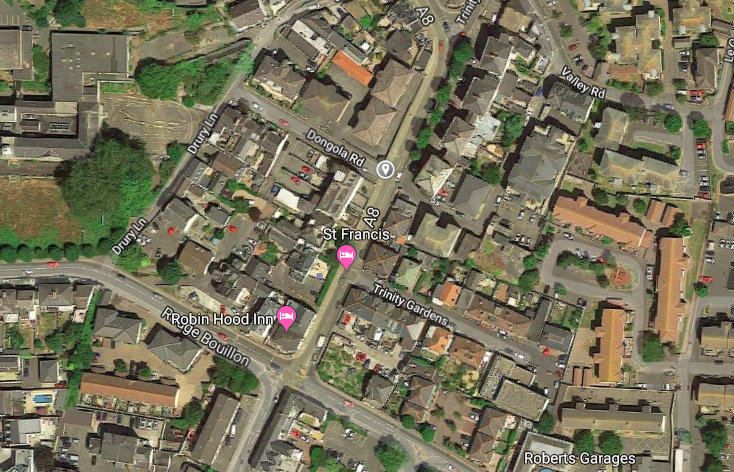
Pictured: The incident took place at the junction of Trinity Road and Dongola Road on 8 November. (Google Maps)
The victims gave up a £10 note and an iPhone and the teen then threatened to cut them up if they spoke to anyone about the incident.
One of the victims said he felt the threat was “very real,” while the other one felt “very intimidated and suffered from delayed shock and was shaking.” They said the incident had had a lasting impact on them, leaving them stressed and anxious about what will happen when the boy is released.
The robber was arrested a day after the incident and told officers he had bought the phone from a friend at Snow Hill. He denied robbing his schoolmates and said he had spent his evening drinking and playing video games with friends. He eventually admitted the offence before the Youth Court on 13 November.
Crown Advocate Conrad Yates told Court that the boy had “a poor record for someone his age,” with four convictions for 21 offences at only 17.
He said that the teen had made “worrying comments” to the author of a report into his background and previous offending, stating that he felt no remorse over the incident and that he probably would have used the knife if his demands hadn’t been met.

Pictured: Advocate Adam Harisson was defending the teen.
The Crown Advocate said a “non-custodial sentence” couldn’t be justified as the teen had failed to comply with probation and community service orders in the past. He recommended a two-year custodial sentence in youth detention.
He also asked the court to make a five-year restraining order to prevent the teen from contacting his victims, including over social media.
Advocate Adam Harrison, defending, told Court that his client did not wish him to convince the court to impose a non-custodial sentence or that the proposed sentence was too high.
“He reasons that if he were to be released too soon, he wouldn’t have the opportunity to undertake the work that is necessary and would reoffend and return to prison,” Advocate Harrison said. “…He does not want to spend his life in and out of the criminal justice system.”
He told Court that the teen intended to use his time in detention as “productively as possible”, and wanted to take up a carpentry course to improve his job prospects once released. Advocate Harrison added that the teen would cooperate with all the recommendations made to reduce his risk of reoffending.

Pictured: The boy said he would use his time in detention “as productively as possible”.
Handing down the Court sentence, Royal Court Commissioner Sir Michael Birt, who was sitting with Jurats Collette Crill and Rozanne Thomas, told the teen that his life “appeared to be on a reasonably even keel” until a point in 2017.
“Since then, you have been before the Court for a number of offences, including public order offences, dishonesty offences and a grave and criminal assault,” he continued.
He reminded him that the Court had previously made it clear they would not tolerate violent robberies and would aim to deter further attempts with “severe punishment”.
He agreed with the two-year sentence suggested by the Crown Advocate and warned the teen that, had he been older, the sentence would have been higher.
He urged him to take advantage of all the measures offered to him, adding: “We do hope that the agencies will deliver on those because if you do take advantages of those measures then there is hope for the future. If not, we fear you are going to spend time in and out of prison for longer and longer periods and that would be a terrible waste of your life.”
The Commissioner also made the restraining order to prevent contact “that would put the victim in fear of violence”.
