


Open Letter on the Tax Review debate
Dear Editor,
It’s now a just over week since we published our recommendations in the Tax Review Policy Letter and presented them to the community. Firstly we want to thank all those who watched the presentation or took time to read the policy letter and look at the information on Our Island, Our Future | States Of Guernsey since then.
The recommendations we’re making are a package, one that aims to ensure those on lower and middle incomes are not worse off, but also raise enough revenue to ensure we can provide the essential services that people rely on for the coming decades. Right now, if we do nothing, we’re genuinely concerned that won’t be possible.
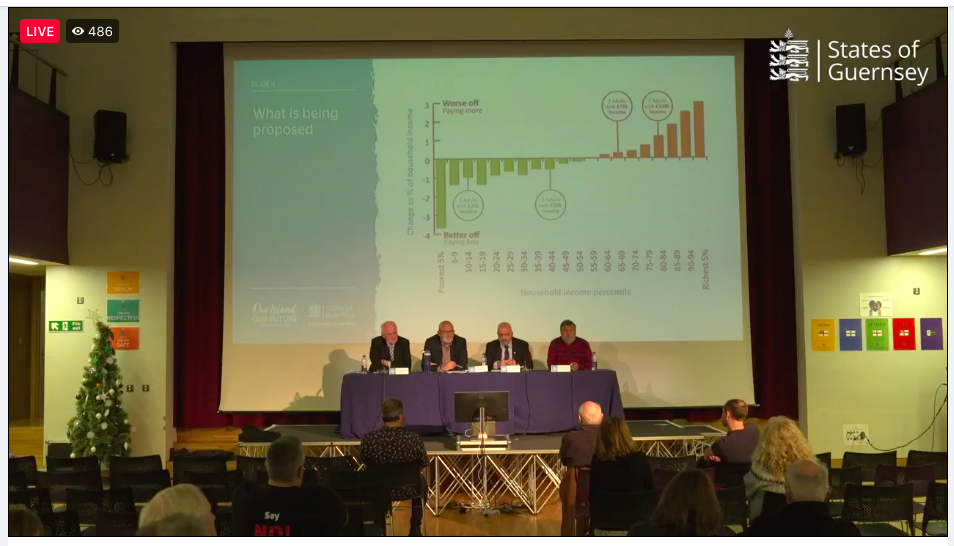
Pictured: The proposals were presented at a public meeting last month.
Some have accused us of making threats and scare-mongering and we’ll readily apologise if that is how it has come across. We don’t want anyone to feel bullied into what is a difficult and unwelcome decision for this community. But we do want them to consider all the implications of not acting, with their eyes fully open to what it would mean if health and pension costs continue to soar far beyond the available funding for public services. We all recognise our proposals will not make us at all popular but if nothing else, we hope people will believe that we aren’t making these recommendations for any reason other than we truly believe Guernsey faces an incredibly serious problem and this is the least-worst option for solving it.
We’ve listened and read a lot of the feedback there has been in the past week, either directly sent to us or shared online. In this letter, we’d like to respond to some of the recurring comments and hopefully address some misconceptions and give some reassurances. So here goes:
‘You’re punishing the poor to help your rich friends!’
We’ve heard many people make this comment, especially focusing on the GST-element of our package of tax reforms. We cannot stress enough, that a 5% GST is just one part of a package which has been designed especially to ensure those on lower or middle incomes are not worse off, in fact most would be better off. But in order to make that whole package work, it does need to have a GST in it, because that gives us both a means to raise significant amounts plus the flexibility to redistribute some of the money so it genuinely helps lower and middle-earners. The GST allows us to:
- Reduce income tax to 15% for earnings up to £30,000.
- Raise income tax allowances by £600
- Introduce a Social Security allowance for everyone, (because right now, very many people are paying contributions on all of their earnings even if they are low-earners!)
A GST also means businesses will contribute more, and tourists, business visitors and anybody spending money in Guernsey will make a contribution which they don’t currently.
We’re worried these details are already being lost in the public debate, but they’re so important to this package as they make all the difference between what some people fear – a tax hike that hits the poorest hardest – and what we are proposing – a way to raise more funding from those on higher incomes and from businesses while protecting those who earn less.
‘Get rid of all the overpaid civil servants, problem solved!’
Wherever there are roles that are costing a lot and not contributing to essential services, we of course need to cut those. This term we’ve put tighter rules on replacing any officer who’s making around £50k or more, so we can check every single one is genuinely essential. We’ve also reduced the size of the leadership team at the very top of the public service. We’re committed to being as efficient as possible. But we cannot raise anywhere near the sums needed, which are in the tens of millions, by just slashing staff. There really aren’t offices full of ‘overpaid desk jockeys’ who you wouldn’t notice if we sacked them, and we’re worried that’s becoming the sort of scapegoat that distracts from debating real solutions.

Pictured: Recruitment in health is one of the biggest drivers for reorganising the tax systems, says P&R.
The big driver for the size of the public sector workforce is in health-related jobs. Overall the public sector has increased by 440 employees between 2011 and 2021. The number of nursing and medical staff went up by 450 in that time – in other words, the number of staff working in other areas went slightly down. And that is just one sign of the very problem we’re trying to solve: more of us needing health care as we reach our later years.
Please remember, the public servants working in areas outside of health, where numbers have gone down, are trying to deliver essential services in education, law and order, roads, benefits, pensions and many other services, with the same or fewer resources. They’re under huge pressure trying to support their community already, and while we should have an honest debate about all public sector costs, we shouldn’t fall into baseless stereotypes – branding all civil servants as ‘lazy spongers’ is not only untrue, it does a disservice to some incredibly hard-working and dedicated professionals who regularly go above and beyond. Most of us will have a friend or family member working in the civil service, or the wider public service and will know the stereotype is far from the reality. So let’s not perpetuate it because it doesn’t help to inform this incredibly important debate.
‘We’re already in a cost of living crisis, this is not the right time’
It’s not. We agree. We’re asking for this decision to be made now, not so it can be introduced tomorrow, but so we can start putting the new systems in place for 2025. That’s two years away, and all the best forecasts show inflation coming down well before then. But of course, we don’t know what global events may happen in the future that could affect that, so we’ll be watching that closely.
But we also need to recognise there is no ‘right time’ for this. Doing it 10 or 15 years ago, would have been better but previous States chose not to reform their tax systems, in line with the public mood at the time. But it hasn’t made the problem go away, it has only become more urgent. There will always be reasons to put it off, but the longer we do, thefaster we’ll reach a point where we cannot fund services, and the impact on the generation that then has to pick up the pieces will be even worse. That generation will be our children and grandchildren, and it is for their sakes we need to introduce these measures.
Again, the package we are proposing would see the majority of low and middle-earners better off compared to now, and the wealthiest paying the biggest increases. If that helps protect our children from bigger cost hikes or the loss of essential services, it is surely worth it.
‘There’s no deficit, it’s all a con’
This is perhaps the most worrying of all the comments we’ve seen, and it isn’t just from conspiracy theory fans, we’ve noted that respected business leaders and members of the Assembly are perpetuating this myth. Even if you don’t agree with the solution, please don’t bury your head in the sand, there is too much at stake.
Yes, forecasts by their nature have to look into the future and so can never be 100% certain, but to simply shrug it off and say ‘it may never happen’ would be reckless in the extreme. All the analysis tells us the deficit is real and will grow. Some people are looking at a better- than-expected single year of tax take in 2021 or 2020 and saying ‘hey, what’s the problem?Everything is fine!’ But the make-up of our population is not a difficult thing to track, if more of us are getting older and moving into retirement, and less are coming into the workforce, it’s not a very complicated calculation to do. We’re going to have more people needing pensions and health care, and less people earning salaries and contributing to income tax. The number of people claiming pensions alone rose by more than a quarter since 2010 and will likely rise by a further 18% by 2040. Some of the effects are already being felt – more pressure on health and care services, labour shortages in all sectors – and this is the beginning. Already, we are effectively living off our savings. In 2023, the cost of providing pensions and other benefits will be around £25m more than comes in through contributions. Our savings are therefore dwindling, and while we invest those savings to raise more revenue for the community, those returns are shrinking because the savings pot itself is shrinking.
Above: The tax presentation can be watched back here.
We know there are many other comments, criticisms and questions out there on the Tax Review, and we’re sorry not to have covered them all here. We’ll keep engaging with you, we will be organising events for January ahead of the debate where we can keep the conversation going. We have answered more of your questions on Tax Review | States Of Guernsey so please do look at the information on there, to understand the full detail of our recommendations and what they would mean for you. And please write to us or call us and give us your views. Our goal is to secure the best outcome for Guernsey’s future and in particular for the next generation of Islanders. If we don’t act now we will be putting them in an impossible situation where they have no hope of funding the sorts of services we think of as essential. But it’s not yet too late to do something about that.
Best regards,
Deputy Peter FerbracheDeputy Mark HelyarDeputy Jonathan Le TocqDeputy Dave MahoneyDeputy Bob Murray