

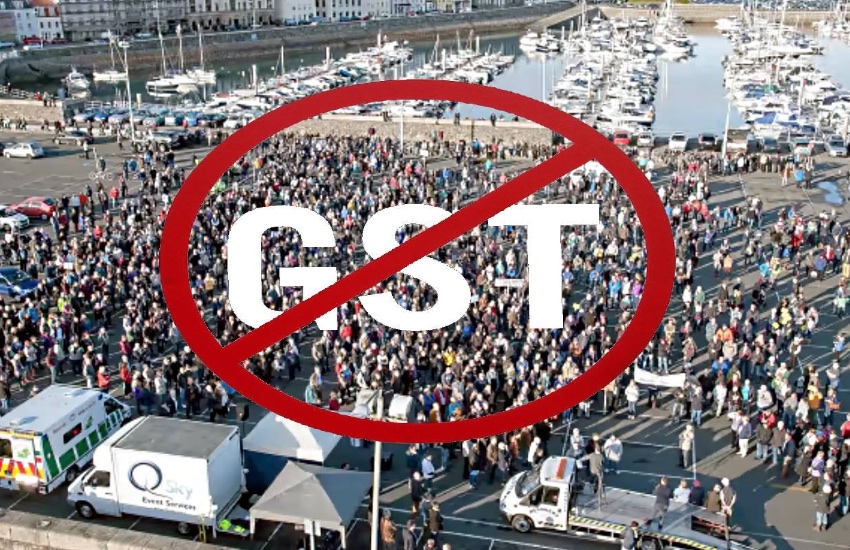
There are two issues with the States’ Tax Reform Policy letter (the Paper) that need much deeper consideration. For readers who are not financially literate, P&R’s tax proposal is long, full of figures, hard to follow, but fundamentally misleading on two important points.
Firstly, the assertion that Consumption Taxes will bring in £55m. It won’t; the headline figure excludes all the underlying additional administrative and inflation costs (GST creates that inflation) for the States. The real figure for GST looks to be nearer £12.3m, and there are also £40.9m of one-off costs to recover.
Secondly, the core premise underlying the argument for GST is the claim that there is a £50m funding gap – the proverbial Black Hole (explained in Appendix 10). However this gap is not real; it is a contrived argument that appears designed to confuse. For many this an arcane accounting matter, but it is important to understand because it destroys the argument for GST. The real funding gap is negligible.
For more detail, please read on, and sorry for the length of this.
GST
The Paper starts with the headline assertion that the proposed consumption tax will raise £55m annually. It does not do that, so is wholly misleading.
To begin with, of the £55m, £12m is an International Services Entity (ISE) fee, so the GST element will raise only £43m (there is nothing stopping us levying this ISE fee without bringing in GST).
But this is not the figure that will translate to net income for the States because it does not deduct:
- The initial cost of implementing GST, estimated at up to £10.6m (page 49 of the paper)
- The ongoing cost of administering the scheme, estimated at up to £3.6m annually (page 53 of the Paper)
- The cost of ongoing support for business (£1.1m per page 4 of the Paper)
Furthermore, because GST creates inflation at 1.9% (para 10.8 of the Paper), the Paper should also recognise the effect of this on the following ongoing States costs, but does not:
- Benefits are proposed to increase by 3.2% (para 10.3 of the Paper). 2025 benefits costs were £309m (2025 financial statements page 53). So these are set to rise by c. £10m.
- States pay costs for 2025 were £415m (2025 financial statements page 66) so these are set to rise by 1.9% or c. £8m.
- General goods and services bought by the States in 2025 amounted to c £405m (2025 financial statements page 7) so these are set to rise by 1.9% or c. £8m
- As regards the effect of inflation on the States Superannuation Fund, I could see no mention in the Paper but it was estimated (by the former Vice President of P&R, and confirmed by P&R in a Media Release dated 11th October 2023) to increase the States Superannuation Fund liability by £50m based on a 5% GST. The Media Release characterised the £50m effect as “funding strain” as though that didn’t count or somehow wasn’t real. We’re not idiots. One could assume this cost would be £30m with 3% GST.
So, to sum up how much GST at 3% will cost us all:
One-off costs of c. £40.9m
- Implementation costs – £10.9m
- Increase in States Superannuation Fund liability – £30m
Ongoing Costs of c.£30.7m annually
- Support for business – £1.1m
- Administration costs of GST – £3.6m
- Benefits increases – £10m
- States Pay cost increases – £8m
- States goods and services cost increases – £8m
And to summarise the net effect of all this:
- Annual GST income £43m
- Annual GST costs £30.7m
- Net GST income £12.3m
And with initial costs of £40.9m to pay back, GST will not add anything to States Net Income for well over 3 years.
So let’s not be fooled that the proposed “Consumption Tax” will generate £55m overall. It just won’t. GST will deliver a mere £12.3m or thereabouts to the bottom line. And if you still believe there is a £50m “funding gap” (Appendix 10 of the Paper), GST at 3% won’t touch the sides.
Funding Gap
The paper tries very hard to convince us that, although the audited financial statements show a surplus of £113m, we cannot include unrealised investment gains (of £119m), so in fact we made nothing last year, and this leads on to the £50m funding gap. Deputies need to understand whether this claim is correct because it is core to the question of whether we so short of money that we need GST to balance the books. So I will explain below.
The unrealised investment gains arise on our three investment funds, namely the Core Investment Reserve, the Social Security Funds, and the General Revenue Reserve.
It is true that for the Social Security Funds (£69.1m of the total investment gains), we cannot count these because they are already considered by the Government Actuary in establishing whether the funds will be sufficient to pay out future old age pensions, and long-term care benefits. The last States increased Social Insurance contributions in 2022, based on the Actuary’s calculations which included potential investment gains, so that the funds would continue to provide sufficient money until 2080. So we can’t touch these, the paper is absolutely right.
However, the paper is not right that we also can’t take the other returns (£14.1m for the Core Investment Reserve and £33.9m for the General Revenue Reserve) into account when we consider the “funding gap”.
These two reserves are simple operating reserves; they are not ring-fenced for specific future benefits or liabilities. We have significant investments underlying these reserves, they have risen in value, but we have deliberately chosen to leave them invested, so we have deliberately chosen not to realise the gains. If we didn’t think they would continue to increase in value we should have sold them, but we didn’t do that; we clearly think the investment gains will recur. So, it is perfectly correct to include, and not dismiss, them. IMF rules stipulate that we can take them into account, but the paper has a very woolly argument for excluding them.
In fact, the real funding gap is not £50m and should be reduced by investment gains on the General Revenue Reserve (£33.9m) and the Core Investment Reserve (£14.4m). £50m less £33.9m less £14.4m is £1.7m.
So, the real funding gap is inconsequential, there is no “Black Hole” as it stands, and it follows that we don’t need to bring in GST at all.
Yours etc
Peter Rose
