

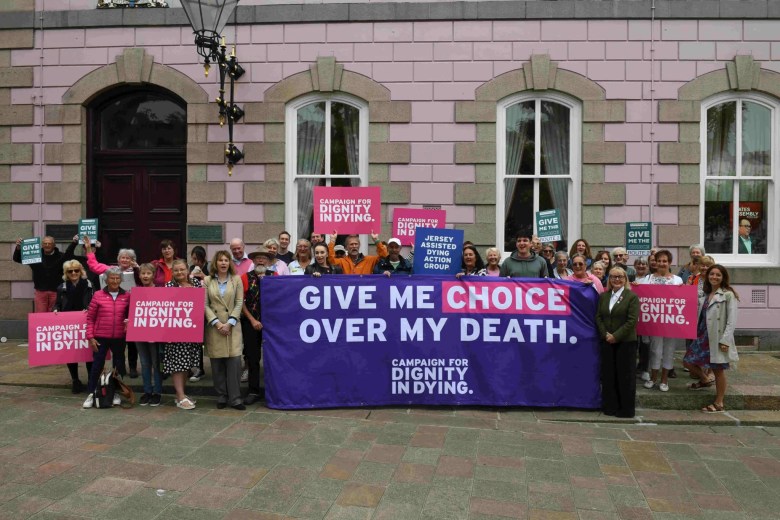
Jersey became just the second place in the British Isles to approve assisted dying this morning, following a lengthy debate in the States.
Members have been discussing the proposals since Tuesday afternoon, and voted 32-16 in the final stage.
It is expected that the new law will take around 18 months to fully come into force, as it still requires Royal assent.
The new law provides a framework for terminally ill adults living in Jersey to end their lives under carefully defined conditions and strict safeguards.
The legislation, put forward by the island’s Council of Ministers, sets out who could be eligible, how the process would work and what checks would apply.
The proposals came after the island’s politicians in 2024 voted in favour of setting up a service for adults with terminal illnesses and neurodegenerative diseases, which built on a 2021 decision in which the Assembly supported assisted dying “in principle”.
The move was roundly welcomed by various campaign groups such as Dignity in Dying, Humanists UK, and My Death, My Decision, while islander Lorna Pirozzolo, who has terminal breast cancer and experiences extreme pain as a result of her condition, explained: “Today brings enormous relief – not just for me, but for future generations of Islanders who deserve compassion, choice and dignity at the end of life.”
How does Jersey’s law compare to what’s being considered in the UK?
Other jurisdictions are also grappling with the matter of assisted dying – the Isle of Man is also on track to introduce it, but has been awaiting Royal Assent for nearly a year.
Meanwhile, in Westminster, the Terminally Ill Adults (End of Life) Bill is a private members’ bill which proposes to legalise assisted suicide for terminally ill adults in England and Wales.
Humanists UK, which were supportive of today’s decision in Jersey, explained described several elements of each as “almost identical”, such as the fact that applicant must:
- Be an adult.
- Be terminally ill.
- Have a clear mental capacity and a settled wish to die.
- Be assessed by two independent doctors.
- Be ordinarily resident for at least 12 months in the relevant jurisdiction.
- Be able to withdraw or cancel at any point along the way.
Both also introduce new criminal offences for abuse of the system as well as conscientious objection or a ‘right to refuse’ protections for healthcare professionals.
However, the “core differences” are as follows, the organisation said:
- “Both Bills are for people with six months left to live or fewer, but the Jersey Bill allows people with a neurodegenerative condition like motor neurone disease to apply if they have twelve months left to live.
- The Jersey Bill includes a subjective suffering element: the person believes they cannot bear the suffering the condition is causing (or is expected to cause).
- In addition to the two doctors, the Westminster Bill requires the applicant to be approved by a panel of a social worker, a lawyer, and a psychiatrist; the Jersey Bill does not require this.
- The Jersey Bill has one 14-day reflection period that can be overridden if the person will die imminently. The Westminster Bill has two reflection periods, the first is seven days, the second is 14 days; only the second can be overridden.”
Follow Express for updates…
