

Financial goals can go hand in hand with long-term improvements to society, security and the environment.
That was the message from some of Guernsey’s financial leaders at an event in London last week.
Building resilience to climate, geopolitical and economic shocks was the theme of Guernsey Finance’s ‘Sustainable Finance in Action: Private Capital’ event, where speakers agreed that a shift from short-term thinking to long-term goals was needed.
Experts from the sustainability, defence, funds and fiduciary sectors explored the changing role of investment in addressing security and climate concerns.
The biggest threat to security
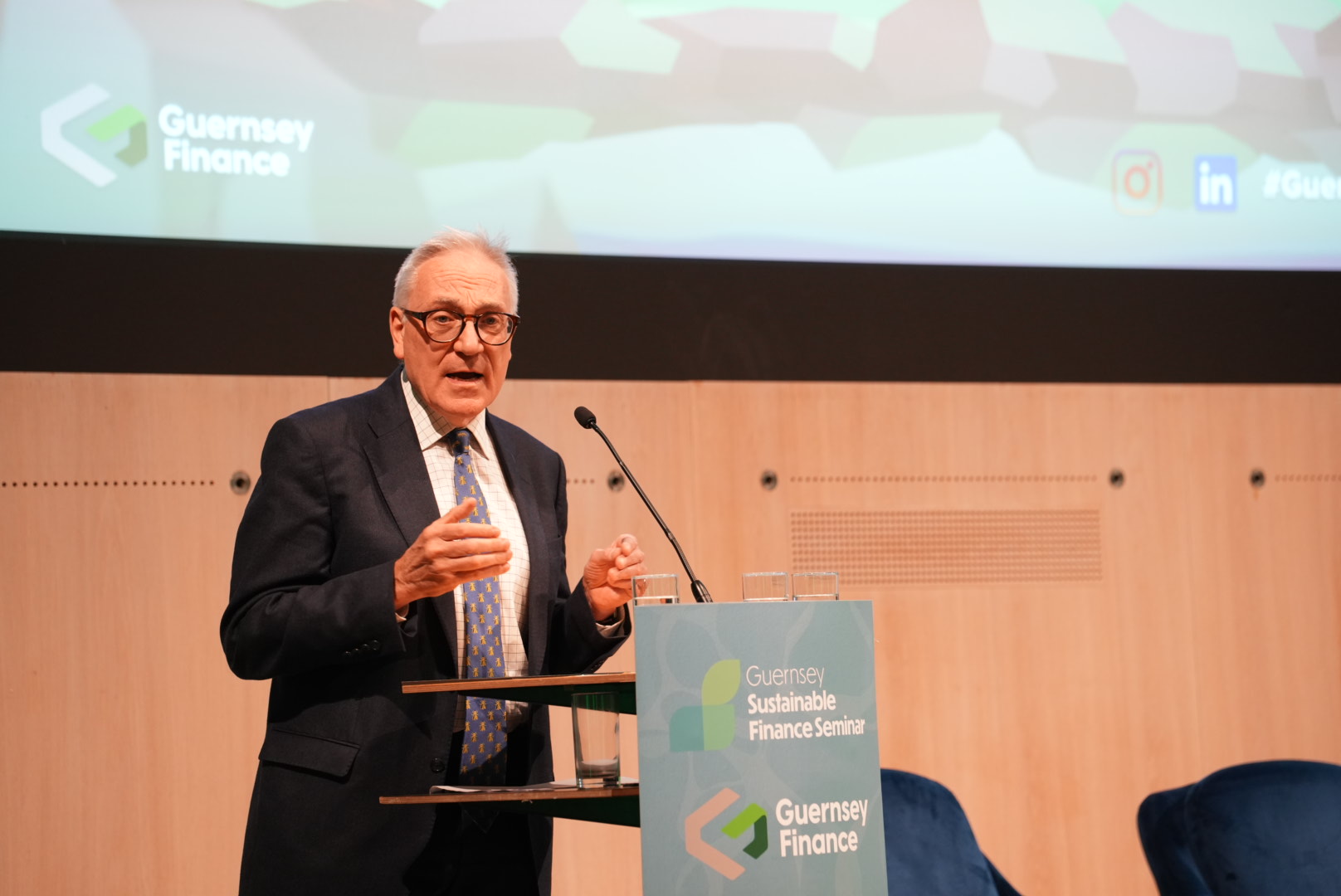
Lieutenant General Richard Nugee used his keynote speech to explore the link between sustainability and defence.
He said: “Climate change is a threat to our collective security and the security of our nations. Climate change is a geopolitical issue every bit as much as it is an environmental one.
“Please make no mistake: climate change is the biggest threat to security that modern humans have ever faced.”
Mr Nugee added that climate change and ecological degradation were strategic risks, urging investors to move away from short-term gains and instead strengthen the systems that underpin economic and societal stability.
In particular, he highlighted the growing vulnerabilities facing food systems, supply chains and critical infrastructure, saying resilience was needed to withstand future shocks.
He said companies needed to move from a “just-in-time” philosophy to a “just-in-case” approach to prepare for uncertainty.
He added that building resilience could create economic and investment opportunities, rather than simply adding costs.
He also highlighted a “triple use” strategy to identify where environmental, security and economic objectives align and how they can benefit one another.
“What’s good for resilience is also good for sustainability, is also good for our defence, because what it produces is a stronger national security, which is really good for finance and really good for business,” he said.
“What is the wealth for?”
A panel discussion followed on how private capital, family wealth and investment structures could support long-term resilience and deliver meaningful financial and societal outcomes.
Panellists from sustainable investing, private wealth and fiduciary services explored growing demand from investors and families for investments that align financial returns with wider environmental and social objectives.
Neil Chadwick, director of global operations at Oxycarbon, echoed Lieutenant General Nugee’s view that investment and sustainability were not only linked to financial performance but could also enhance it.
He explained that Oxycarbon’s projects improve local livelihoods through training, employment, infrastructure and community investment, while also generating carbon credits.
He said: “Every time we do that, we increase the value of the credit, which means you get the return on the money. It’s not bad to want a return on your money. It’s great to be able to do good at the same time.”
The panel’s moderator, Justin Sykes, reflected on his experience as the first director of Guernsey’s Fund Foundry programme and suggested there was growing demand for investment that generated “a more holistic return”.
Chris Moorcroft, partner at Harbottle & Lewis, discussed how wealthy families had increasingly come to see their investments as an opportunity to help others.
He said there was now “a massive growth in the idea of family wealth needing to have a purpose, a meaning”.
He suggested advisers and families should begin conversations with one fundamental question: “What is the wealth for?”
Guernsey’s role in the changing conversation on wealth
Kerrie Le Tissier, an independent governance and fiduciary consultant, outlined how Guernsey’s legal and regulatory framework was well placed to support changing priorities.
She said flexible structures tailored to family and investment objectives meant Guernsey could “keep pace with changing requirements”.
She added: “We are a small independent jurisdiction. We’re able to be very agile in terms of our legislation, regulation and thinking.”
Closing the event, Sally Rochester from the States of Guernsey’s Committee for the Environment & Infrastructure commented on Guernsey’s role in responding to the challenges posed by geopolitical uncertainty and climate risk.
She said: “We must respond to those threats and not ignore the realities of the world we live in.”
I was “absolutely right” that Guernsey plays its part channelling capital to where it was “most immediately needed, including infrastructure investment, the regeneration of nature and projects that limit climate change”, she added.
“Investors ultimately need practical mechanisms through which essential private capital can flow.
“Ambition needs structures, ideas need governance, and capital needs a trusted framework through which it can be deployed effectively and responsibly.
“And this is probably the clearest articulation of Guernsey’s value proposition.”
