


This is the fifth year in a row that the total has increased, according to the latest figures released by Statistics Jersey.
Financial services represented the largest component of total GVA in 2018, accounting for almost two-fifths (39%) of total Gross Value Added (GVA).
The next largest sectors in terms of GVA – excluding the rental income of private households – were other business activities – mostly private sector service industries – and public administration, which accounted for 11% and 9%, respectively.

Pictured: The distribution of GVA per sector.
Hospitality saw its GVA increase by £11m, while manufacturing saw the biggest increase of all sectors – 7%. In contrast, construction, agriculture, wholesale and retail, and the utilities – electricity, gas and water – saw their GVA decline in real-terms in 2018.
Gross Domestic Product (GDP) reached £4.6bn, thanks to a 1.8% increase in real terms.
The average economic standard of living of Jersey residents, measured by GDP per head of population, increased by 0.6% in real terms. GDP per head of population was £43,470, over a quarter more than in the UK but a fifth lower than that of Guernsey.
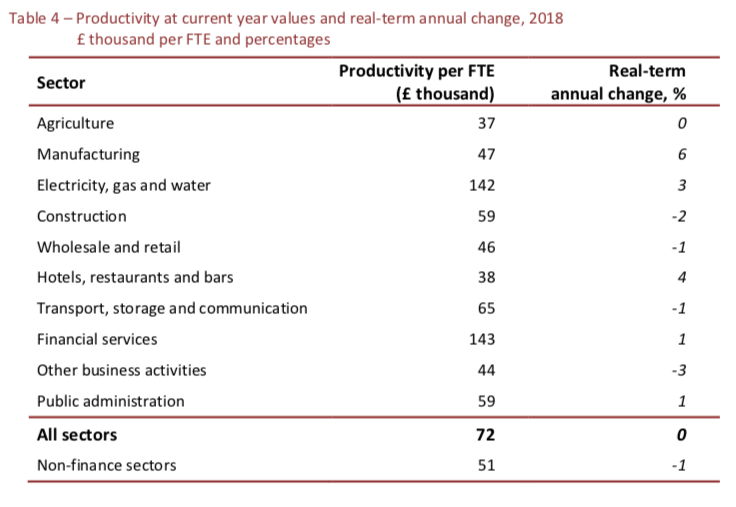
Pictured: Productivity in the non-finance sectors fell by 1% in 2018.
There was no change in terms productivity, measured by GVA per full-time equivalent (FTE) worker.
The productivity increase in the finance sector, 1%, was equal to the decrease seen in the non-finance sectors.
However, the rise comes amid wider challenges for local productivity, which has nosedived 6% in real terms since 2007 and has been relatively unchanged over the longer term (2% higher in 2018 than 20 years earlier, in 1998).
