


For nearly 15 years, Major Marco Ciotti has had a front row seat to island life.
As the Aide de Camp to three Lieutenant-Governors he has had the privilege of meeting people from all walks of life in more situations than you can imagine.
On the cusp of his retirement, he told me that his past military experience meant he was prepared for some of the work he has undertaken since his return to Guernsey.
In part two, we’ve reached the 1990s.
Marco was next deployed to Canada before Hong Kong, which is where he was serving when he was promoted to Captain.
He was working as part of the Gurkha Transport Regiment towards the end of British rule over Hong Kong.
His unit acted as border guards, sometimes catching illegal immigrants trying to get back to China having been working in Hong Kong. He said that work was “quite heartbreaking” knowing that those people would be handed back to China, having risked so much to try and earn money for their families.
With just a few years to go before China took back control of Hong Kong, the now-Captain Ciotti’s unit were regularly put on an exercise where they had to clear out their barracks and vacate the area – he later learned this was done to ensure they weren’t there when the Chinese Liberation Army had personnel looking at the sites.
Following some time back in the UK for further training around military transportation including railway logistics, Captain Ciotti was posted to Germany again – which is where he was when the Bosnian War broke out.
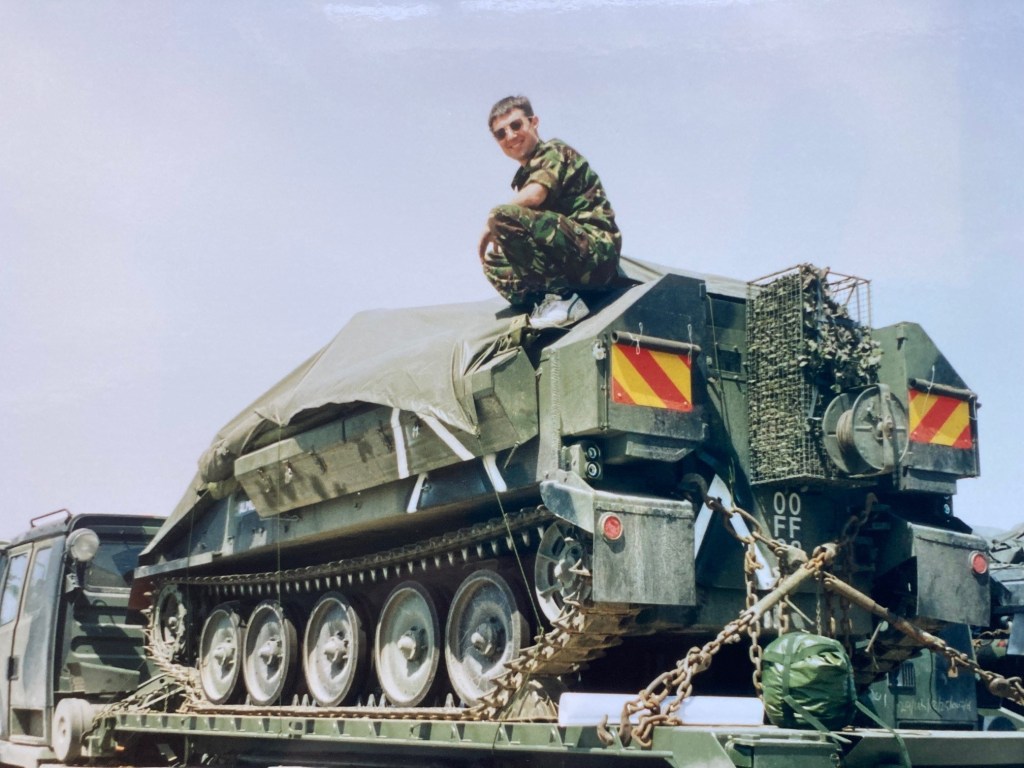
Working around the clock as part of a team of three, Captain Ciotti helped plan the movement of military equipment into Bosnia. He said they experienced some “real adventures” during this time, including losing track of a train that was taking British military equipment into the war -torn country.
“We lost it for about three days in Croatia in a blizzard,” he remembered. “This was pre-mobile phone, so nobody knew where it was.
“We used to have a briefing twice a day where we had to give the General and staff at headquarters an update, and the other two were older than me, so I was always pushed to do this, so that was a difficult couple of days. I always made sure that at the end of the briefing we had a funny story from the previous 12-hours we could finish with.
“Anyway, we found this train in the end, and we managed to get it pulled out of a snow drift by a Croatian Tank Crew using two Russian built tanks, pulling the locomotive out. Everything on the train was fine and we sent them a load of beer!”
Towards the end of his time in Germany, Captain Ciotti also had to arrange for the distribution of equipment that his unit no longer needed, which included a German World War II locomotive. It was one of the final pieces of German equipment that the British Army had captured and was still using.
Knowing that it couldn’t be taken back to Britain, he arranged for it to be given to a group of German railway enthusiasts with an open day arranged to mark the handover.
Following more time in England, for more training, the now-Major Ciotti was then posted to Greece.
Having lost one train and then given away another train, Major Ciotti soon found himself in the position where he needed to buy a train – and he ended up with three.
He was tasked with carrying out a reconnaissance of a planned route through Macedonia and into Kosovo.
He found that the size of the heavily laden trucks the British Army needed to move would fit through bridges in Greece, but the bridges in Macedonia appeared to be too low.
“After we’d been under a couple of these things, I was convinced that they might be too low, so we stopped. I didn’t even have a tape measure on me because I’ve been told that the road was okay. So, we stopped, and I was trying to work out how we could measure these things.

“I said to the two Americans, ‘take your bootlaces and your belts off’. I did as well and we tied them all together and I got one of them to go up on top of the bridge and hang it over the edge and I tied a knot in it. Then we put it along the side of the road and we paced it, because soldiers have to know how many paces you do to 100 meters. So, the three of us paced it, and I averaged the result, and it was the same as, or slightly lower than, our vehicles which were now carrying containers.
“We carried on up the road all the way into Macedonia and I counted these bridges because this was going to be a problem. I had to sort it out because the rest of the regiment was flying out.”
Having been trained on railway logistics, Major Ciotti came up with an idea.
“I was looking at the map, which I think was an American Air Force map so they didn’t have very much detail. The road went north, south, and to the west of that there was a river that went north, south, and in between the two there was a railway line, so I got the Americans to drop me at the railway station.
“I got in the queue and eventually got to the front, and there was a girl there and she only spoke Greek and I was trying English, German, Italian, French… eventually, there was a manager, who saw me, and he signalled for me to go over to him and he spoke German so I explained I was with NATO and we needed to buy a train.
“They worked away for about three hours and at the end of it they came up with a price. He showed it to me on a piece of paper and it was pre-Euro and it was just a huge number of zeroes. I didn’t have any money, I didn’t have a budget, so I said ‘Yeah, that looks all right’.
“When everyone else arrived, I explained and the CEO looked at it and he said, ‘that’s fine’ and so he went off to arrange the money and then someone appeared in the morning with a briefcase full of money. I went off with this briefcase full of cash, and we came out with three trains, and those three trains moved all of it.”
Major Ciotti said this was the first time the British Army had used railways on an operation since the 1940s.
“It was really exciting,” he remembered.
Part three to follow…
This article first appeared in CONNECT:
