

A week ago today Art for Guernsey’s latest exhibit, ‘The Lidded Lands’ opened to the public for the first time.
It features a trio of talented artists, all bringing their own interpretations on how our distant ancestors saw the islands.
It’s so much more though, with a story of co-operation and collaboration emerging between James Colmer and Vesna Parchet, and Magnus Buchanan, which in itself is an echo eons in the making.
When you first enter the Mansell Street Gallery, you’re greeted by two mammoth pieces, not in topic, but in grandeur.
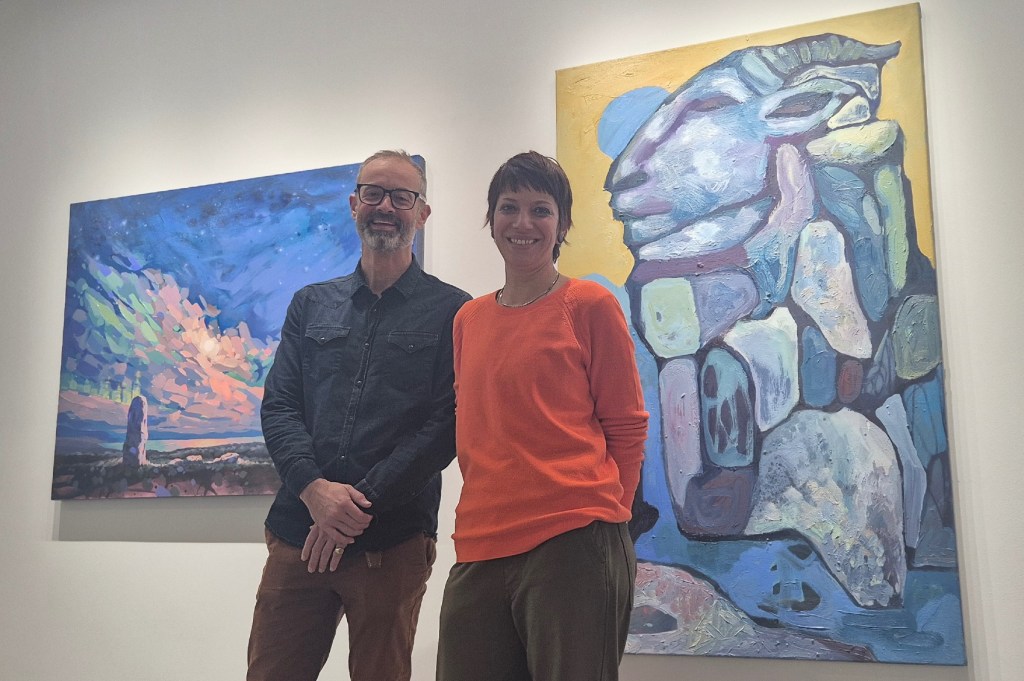
James Colmer’s ‘Stand the Stone’ sits central with Vesna Parchet’s ‘Goat’. Both embody the time period the artists are exploring, back to the megalithic period, when humans had yet to tame the land, but still called the islands home.
Their visual work pairs with poems created by the Head of English at Elizabeth College, Magnus Buchanan.
There are sets of headphones available for readings, and physical copies next to the artworks they share themes with.
The works really emphasise the collaboration between the artists, with Mr Colmer explaining that was present from the outset.
“We did a lot of collaboration to start with, to think about how we were going to create this show.
“We were trying to get into the mindset of the people who are living kind of 1000s and 1000s of years ago on the islands, picking up stories from the library, but also talking ourselves how they would be deeply connected with nature, thinking about the tides, where they’re going to get their food from, their spirituality, what it meant when big storms came in, or there’s a blood moon, or even, like an equinox.
“One of the topics that we were talking about is in literature from a long time ago, they didn’t use the word blue. It wasn’t a thing. It was something which came up in the news and we kind of hooked onto it and we loved that concept, because we see blue everywhere. So I wanted to kind of create a predominantly blue painting with a huge sky scape, kind of around that kind of blue concept.
“Magnus did a poem about the word blue, but without actually mentioning the word blue. Vesna used those kinds of blues in her work as well!”

Whilst Mr Colmer’s work focussed on the landscapes, London-based artist Vesna Parchet’s work focuses more on the human angle, with works mirroring early art, but defined and to the point.
There’s an emphasis on story telling within her pieces, and as a viewer you’re left to deconstruct the deeper meanings yourself, something which feels very much like an archeologist trying to examine ancient cave paintings.
Ms Parchet said the process of creating this body of work really took her back to our ancient ancestors footsteps and thought processes.
“Previously I’ve done a lot of work around mythologies, looking more at Greek art, so this time, before I started making works, I kind of became a bit familiar with folklore stories from the Channel Islands, and just visiting different dolmens.
“I tried to kind of channel myself into a place where our ancestors could have been, you know, sort of like how they would have reacted to the nature, to the surroundings, the imagination, the way of how they would imagine, all the things they couldn’t explain.”
Working in a collaborative approach to the curation and creation of art works weren’t the only new elements for the artists, with Ms Parchet trying her hand at seascapes, something she doesn’t normally undertake in her usual stylings.
Guernsey’s rugged coastline, and the thought of it being even more wild and untamed clearly resonated with the artist.
“For me it was quite eye opening. Often I would just take walks along the coast and just take it in, like rock formations and stones coming out of the water, and you see shapes. So it was an incredible first time that I think I really approached my art in this way.”

The gallery isn’t just focussed on the visual aspect of arts when exploring a megalithic Guernsey.
The written word has pride of place too, thanks to a series of poems created by the Head of English at Elizabeth College, Magnus Buchanan.
Mr Buchanan said by walking in their shoes, he’s found a new respect for Guernsey’s ancient humans.
“My admiration for these early people has grown, particularly in finding out how far they travelled by sea in early canoes. The distances they navigated are staggering. They also possessed great skill, not just as stone masons, as seen in the burial passages, but also as artisans.
“So much of what they made and wore has disappeared with the ravages of time, but we get tantalizing glimpses through the research of their instinct for ornamentation and beauty. I feel as if we are hankering to regain that primal connection with the natural world today and these sites are still there to remind us of where we came from.”

For anyone with an interest in the megalithic time period, much focus is placed on the way humans worked together, and collaborated in hunting, gathering, creating cave paintings, and of course the giant stone works that are most commonly associated with the time period.
It should be little surprise that the modern humans looking to walk in their shoes also collaborated heavily, and curated an exhibit utilising the social skills and team-work-ethos that was cemented as part of who we are as a species, by those very ancestors.
That team work, that social way of bringing the exhibit to life, is something that Mr Buchanan thought back to.
“This has been a joy for me. James is one of my oldest friends on the island and I felt an immediate admiration and kinship with Vesna’s work.
“They are very talented artists but also exceptionally open and likeable people. At different points, I was able to find new imagery to include in my poems by watching them paint, as well as then watch my words spring to life in new canvases they were creating. It was wonderful, like having a genie living in your mind’s eye.”
The exhibition is running until the 13 December at the Mansell Street Gallery.
This afternoon at 16:00, Art for Guernsey is hosting ‘Conversations With: James Calmer and Marcus Buchanan’, hosted by the non-profit’s Curation Director, Jock Pettitt.
