


Should Guernsey find a legal place to paint, somewhere akin to our own Bailiwick version of Leake Street in London?
A place where painting isn’t just legalised, but encouraged, and utilised as a tourist destination, and culture site.
That’s the question being asked as part of our ‘A Place to Paint’ series which kicked off on Saturday with our podcast.
Yesterday Express platformed visiting artists Teddy Baden and Charlie McFarley, who agreed that there were plenty of spaces that would help Guernsey embrace street art.
Today, the team at Art for Guernsey, the organisation behind this summer’s Diversion exhibition, get to have their say on the future possibility of a legal place to paint.

Mansell Street and Mill Street have been in need of some TLC for some time, and thanks to a smorgasbord of local and visiting talents, it got the chance to shout loudly for the positives found within street art through ‘Diversion’.
However, the desire to impact the Old Quarter dates back further than the opening of Art for Guernsey’s gallery in the area, and goes back to their original reason for taking up the space in St Peter Port.
“Diversion was an idea that we had for quite a while, and it comes from the very same ethos that drove us to the Old Quarter,” said David Ummels, the Founder of Art for Guernsey. “We were kind of a nomadic organisation for the first five years, and then about four years ago, we secured the gallery.
“We came here because we felt that it was the wrong place to be, and we came here with a view to add footfall, to add life and inspiration, so that we could help to rejuvenate or regenerate the Old Quarter, which is absolutely beautiful.
“It’s a very well documented fact that art and culture helps to bring footfall, and we see that every day. It’s a busy space, a busy area, and so Diversion is directly generated from that. From ‘what else can we do to bring life back to the Old Quarter?’.”
The effort to beautify the area outside the Mansell Street Gallery may have looked like a week’s worth of work from the surface, but behind the scenes, that week of work was the culmination of years’ worth of effort.
“Some of the buildings were an eyesore,” said Mr Ummels. “It took us about two years of lobbying the various landlords and to get everyone on board and come up with a much better visual aspect and feeling for the street.
“I think that over the last 20 years or so, the economic forces failed to turn around the Old Quarter, the political forces too. I think as a wider community, everybody wants the Old Quarter to do better, but somehow it hasn’t quite clicked.
“I think we have a debt of gratitude to the artists who actually played a key catalyst role in obviously not solving the problem, but at least showing a way. I believe in metaphors, I believe in symbolism, and the fact that it looks so much better, at least allows everyone to have a bit of a vision, and it attracts investment.”
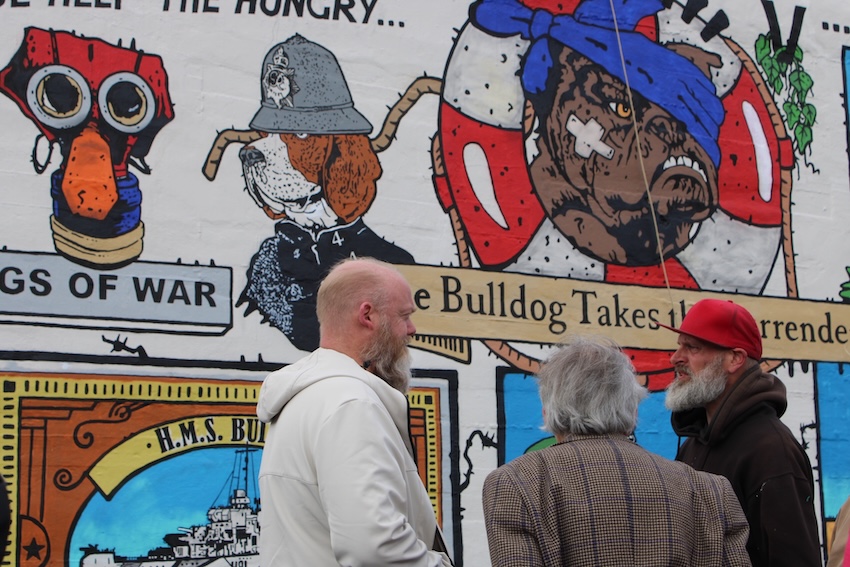
The non-profit organisation says all of the effort is already paying off, with a noticeable difference in the area since it moved to Mansell Street.
“Yes, we have, and especially this season with the French visitors,” said Mr Ummels. “They absolutely love it, and I think they have the references back home to relate to it, because in France, they have a lot of projects that involved street art and that helped to rejuvenate a town or part of a city.
“I actually speak French, so when they walked in the street, I could listen to what they had to say, and they were like, ‘oh, it looks like this area in Paris’, ‘it looks like this or that’ and so clearly they get it.”
Mr Ummels believes it is very important for tourists to have artistic works to relate to as they explore the streets of St Peter Port and he wants to offer more of it.
“It’s very important that we show them some visual entertainment on their way to Trinity Square, because from there they go to Hauteville house, and then usually they go to the bathing pools, so they have a proper tour.
“We have seen an increase in the appreciation of the visitors, but also, and quite frankly, before Diversion, over the last two years, we have seen a steady flow of investments, people picking up empty units, doing them up. Some of them come to introduce themselves. They said that they’ve been inspired by the fact that we have this long term vision for the area.”
Following on from the recent successes, Mr Ummels is hopeful that there will be more street art and public art exhibitions – like Diversion – in Guernsey.
“Well, I very much hope so. In the past, we have applied street art in an anti-bullying campaign with some of the schools, and we invited school children to respond to the Turner legacy project using street art because it’s more fun for them. We collaborated with the skate park to kind of beautify it as well!
“We like to apply street art because it’s very engaging, and I can tell you, pretty much everyone likes street art, from the kids who are your expected audience, all the way to grandma who is so happy to see something challenging or new, as long as it is done in a respectful way.
“It’s a fantastic medium. I believe that street art is now part of fine art. It has been assimilated as such. So we have plenty of ideas, and it would be nice, I think, especially as I understand the Old Quarter and Trinity Square is so strategic for the Island Development Plan.”
The medium of street art has been used not only to help provide several fresh coats of paint to the Old Quarter, with Art for Guernsey using the history of street art and public displays of art to help educate the next generation.
“We offer week long sessions to children to sign up throughout that week, they get an induction into all sorts of art, techniques, materials, ideas, concepts,” said Caitlin Grupping, the former General Manager of Art for Guernsey.
“Art for Guernsey has one of its four pillars as education, and through the holiday club, we provided a platform for children to come in, have that education, have that ability to express themselves.

“It started with cave art, then moved on to Egyptian, Medieval, Baroque, Modern, and Contemporary. Throughout that, we looked at a number of techniques, and why people created art. What was the importance of it? Was it political movements? Was it to signify food and safety? With cave art right up to modern art where people are doing it just for the fun of it, and that often, as is the case with the rest of Diversion, that beautification is in itself, a purpose for art.”
With street art being one of the fastest growing genres globally, and now being assimilated into fine art circles, could Guernsey see the next great artists emerge from our humble shores? It’s not something out of the question according to Ms Grupping.
“Absolutely, I don’t think that we need to look to the big cities for the great creatives. I firmly believe that anyone can be creative, but what’s what’s particularly inspiring for me is to see the way the schools have taken what we’ve done and run with it.
“We had a visit from Vauvert, who are doing a street art project specifically inspired off the back of our own work. So they organised a gallery visit and I led an education piece about the history of street art, starting from tagging. We also had Tim Gaudion, one of our exhibiting artists and muralists, come in and speak to the children about the possibility of art as a career, as a creative.
“So we’re looking forward to seeing what art comes out of that project from the school.”

Pictured: It’s not just St Peter Port that’s seen the Street Art Scene adding a jolt of colour, with a wonderful mural by Tiffany Anna, and Woodie, brightening up Guernsey’s Airport… 
Pictured: And Action for Children have a brand new mural thanks to artist Bjorn Martin, who was also responsible for one of the large murals outside Market street Co-Op.
With the island’s youth getting an education in street art, a wider variety of public art examples being pursued locally, and eyes on Guernsey from around the globe, could the Bailiwick truly experience the best the art genre has to offer?
Mr Ummels has cemented belief that through art and culture the St Peter Port Old Quarter, which has seen its fair share of social media posts pointing out its dilapidated status, could see an even greater rejuvenation.
“I really believe that it wouldn’t take too much to turn the Old Quarter into a kind of a self fulfilling environment, in terms of turning it around, not only with street art, but by collaboration between the landlords, and us being kind of an anchor tenant of the area.
“From my perspective they should seize those opportunities to engage with us and other organisations, and capitalize on the goodwill, but also on the know-how of the people living in the street and in the area.”
Mr Ummels said Art for Guernsey would whole heartedly support the idea of finding a legal ‘place to paint’ in Guernsey.
“Oh, yes, we would support any sort of initiatives along those lines. May I just suggest that at no cost whatsoever, the public authority should commit a tunnel? Because that will be a pretty good idea.
“I think that there are existing examples and benchmarks in London, for example, part of the tube is committed to that, in France as well, they have a couple of tunnels.
“It’s one of those things where artists just want to be part of that. I think it can bring a lot of visitors, a lot of artists, first of all, but secondly, I think it would be, instead of having a tunnel where nobody goes, which is pretty much the existing situation, because we have many tunnels, then it will be an extra destination, and a cool one for visitors.”
